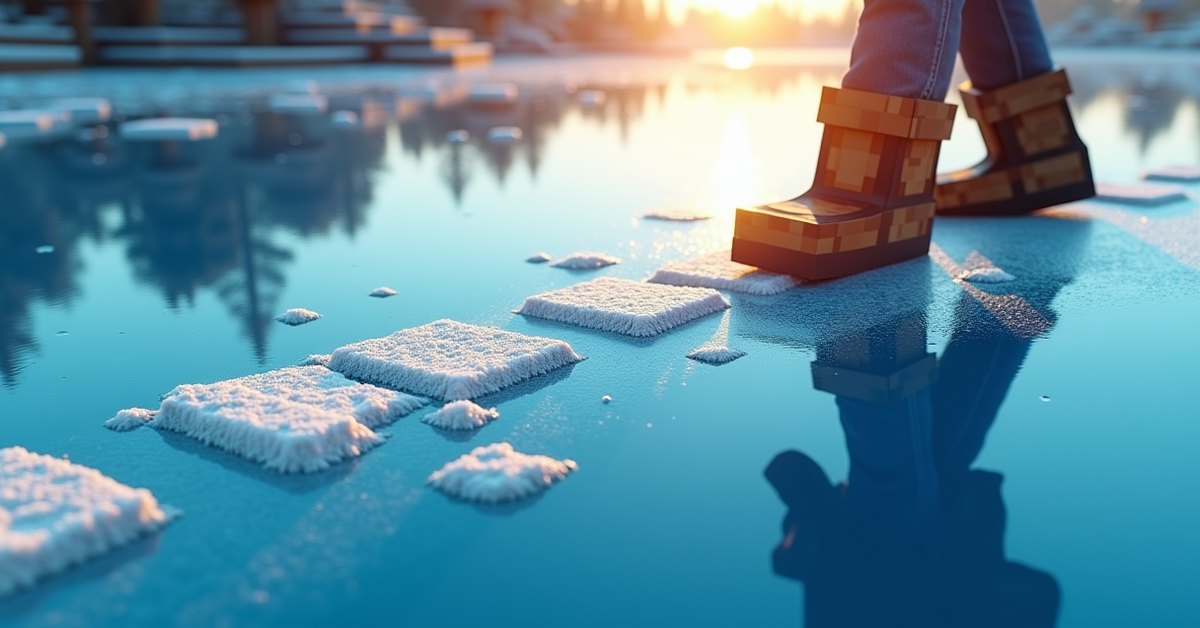
What is frosted ice?
Frosted ice is a temporary, semi-transparent block that forms when a player wearing boots enchanted with Frost Walker steps on a water source block. It looks like a cracked version of regular ice and behaves a lot like it. Players slip on it, light passes through it, and any tool (or none) breaks it instantly.
The block exists for a short window before it melts back into water, so it’s a movement tool rather than a building material. If you’ve ever wondered how someone walked across an ocean in vanilla Minecraft, frosted ice is the answer.
This article covers exactly how the block forms, how it ages through four visible stages, and what speeds it up or slows it down across Java and Bedrock.
Where frosted ice comes from
There is only one way to create frosted ice in survival Minecraft: walk on water while wearing boots with the Frost Walker enchantment. The enchantment converts water source blocks under and around the player into frosted ice, in a small radius that grows with the level of the enchantment.
Frost Walker has two levels (Frost Walker I and II). At level I, the conversion radius is 2 blocks from the player’s feet. At level II, it extends to 3 blocks. Bedrock matches Java on this. Frost Walker is a treasure enchantment, which means it cannot show up at an enchanting table. You can find it on enchanted books from villager trades, on boots looted from chests, or from fishing.
Frosted ice cannot be obtained through Silk Touch, cannot be crafted, and is not in the creative inventory. If you want to place it directly in creative mode, you have to use a command like /setblock ~ ~ ~ frosted_ice. Even then, the placed block starts aging the moment it appears in the world.
The four age stages
Every frosted ice block has an internal “age” property that runs from 0 to 3. Stage 0 is fresh, just-formed ice. As time passes and random ticks land on the block, the age climbs to 1, then 2, then 3. Once a stage-3 block ticks one more time, it converts back to a water source block.
The texture changes visibly with each stage. Stage 0 looks closest to clean ice, and the cracks get more obvious as the block climbs to stage 3. If you see a frosted ice block covered in dark cracks, it has seconds left before it melts.
The aging is not a fixed timer. Each block has a chance to age on every random block tick, and that chance is modified by the light level above it and by how many of its horizontal neighbors are also frosted ice.
What makes frosted ice melt faster or slower
Two factors decide how fast a frosted ice block ages: the light level hitting the block above it, and how many of its four horizontal neighbors are also frosted ice.
Light level
If the block above a frosted ice block has a light level greater than 11, the ice ages more often on random ticks. Direct sunlight pushes it through its stages in seconds. Below light level 12, the block can still age, but does so much more slowly.
This is why a frosted ice bridge melts almost immediately in daylight but lasts noticeably longer at night or anywhere out of direct sunlight. It also explains why placing a non-transparent block on top of a frosted ice block stops it from aging due to light. The block above cuts off the skylight, and the random tick chance drops.
Neighbor density
Frosted ice ages more slowly when it is surrounded by other frosted ice. When a block has fewer than two frosted ice neighbors on its four horizontal sides, it ages on every successful check. With two or more frosted ice neighbors, only a fraction of those checks tick the age up.
The practical effect is that edge blocks on a frosted ice bridge crumble first. The middle of a thick patch holds longer than the rim. If you want a frosted ice platform to last, build it wide and keep walking the perimeter to refresh the outer blocks.
Walking on frosted ice
Frosted ice is slippery, like regular and packed ice. Sprint-jumping on it gives you the same boosted travel you get on a packed ice highway, which is part of why some players use Frost Walker for fast water crossings.
Mobs avoid frosted ice paths in most cases because pathfinding treats the surrounding water as a hazard. Hostile mobs that do wander onto a frosted ice bridge can fall through when the block melts under them, so the bridge doubles as a soft trap for anything chasing the player.
The block does not deal damage. It does not apply slowness or freezing on contact. Powder snow handles cold damage in modern Minecraft; frosted ice is purely a placeable surface.
Breaking frosted ice
Any tool breaks frosted ice almost instantly, and so do bare hands. In survival, the block drops nothing. Silk Touch does not change that. Mining a frosted ice block also does not turn it back into water; it removes the block and leaves an air space where the water source used to be.
That detail matters for builds. If you place frosted ice over a pool and mine it out, you get a hole, not a refilled pool. Either let the ice melt naturally or restore the water yourself with a bucket.
Frosted ice compared to other ice blocks
Minecraft has four ice blocks in total. Regular ice melts in high light, can be obtained with Silk Touch, and turns into a water source block when broken without Silk Touch. Packed ice does not melt and is slipperier than regular ice. Blue ice does not melt either, is the slipperiest block in the game, and is the basis of high-speed ice roads. Frosted ice is the only one of the four that is created by an enchantment and the only one that ages through visible stages before reverting to water.
If you want a permanent walking surface over water, freeze the water with regular ice, then upgrade to packed or blue ice for speed. Frosted ice is for the moment when you need the path right now and don’t care that it won’t be there in a minute.
Tips and common mistakes
- Use Frost Walker II rather than Frost Walker I if you can. The extra radius lets you sidestep a falling block at the edge of your path without getting wet.
- Frost Walker and Depth Strider are mutually exclusive on the same pair of boots in Java. Pick the one that fits the trip you’re planning.
- The enchantment damages the boots when it places ice. The damage is small per step, but a long crossing wears the boots down quickly without Mending. Bring a backup pair if you don’t have Mending yet.
- You can’t place a frosted ice block by hand, but you can break one and immediately walk back onto the resulting water. The water comes back as a normal source block, so the next step re-freezes it.
- Frost Walker does not work in lava. The enchantment only triggers on water source blocks, not on flowing water and not on any other liquid.
- Boats float on water but not on frosted ice. If you plan to row across, freeze a starting square, place the boat in the open water just past the edge, and step on.
Java vs. Bedrock differences
The block behaves almost identically across editions. The Frost Walker radius is the same. The four age stages are the same. The melting logic responds to light and neighbor count in both editions.
The one place to watch is the visual texture. Bedrock renders frosted ice with slightly different shading at each stage, which can make the cracks harder to read at a glance. If you rely on the cracks to know when a block is about to melt, give yourself an extra step of margin on Bedrock.
The internal block ID is minecraft:frosted_ice on both editions. If you build with command blocks, the same command works on either side.
Frequently asked questions
Can you get frosted ice with Silk Touch?
No. Frosted ice is one of the handful of blocks that drop nothing regardless of the tool used. Silk Touch does not change the drop. The block has to be placed by Frost Walker or by command.
Does frosted ice work in the Nether?
No. Water cannot exist as a placed block in the Nether, and Frost Walker only acts on water. Stepping into lava in the Nether will not produce any ice, frosted or otherwise.
Can you grow plants on frosted ice?
No. Frosted ice does not accept plant blocks. It also stops light from reaching crops below it the same way regular ice does, so it can cut off underwater farms while it sits in place.
Why is my frosted ice melting so fast?
Either the block is in direct sunlight or it has too few frosted ice neighbors. Wide, shaded paths last longer than narrow, sunlit ones. Building under an overhang or working at night extends the lifespan a lot.
Can mobs walk on frosted ice?
Yes, but pathfinding usually steers them around it because the AI treats the surrounding water as a hazard. Mobs that do step on it may fall through when the block ages out and reverts to water.
Does frosted ice count as ice for advancements?
For most game checks, yes. It blocks light the same way, it counts as an ice block for advancements that look at ice variants, and it interacts with the same particle effects. The clearest difference is the random tick aging, which no other ice block has.
One more thing
Frosted ice is one of the few blocks in Minecraft that exists purely as a side effect of player movement. You don’t pick it up, you don’t craft it, and you can’t really stockpile it. If you want to see the full lifecycle in 30 seconds, stand on a sunlit lake with Frost Walker II and watch the path behind you crumble while the path ahead forms. It’s a small thing, but it’s the kind of detail that makes Minecraft’s world feel like it’s running with or without you.