Updated for Java Edition 26.3 (October 2026).
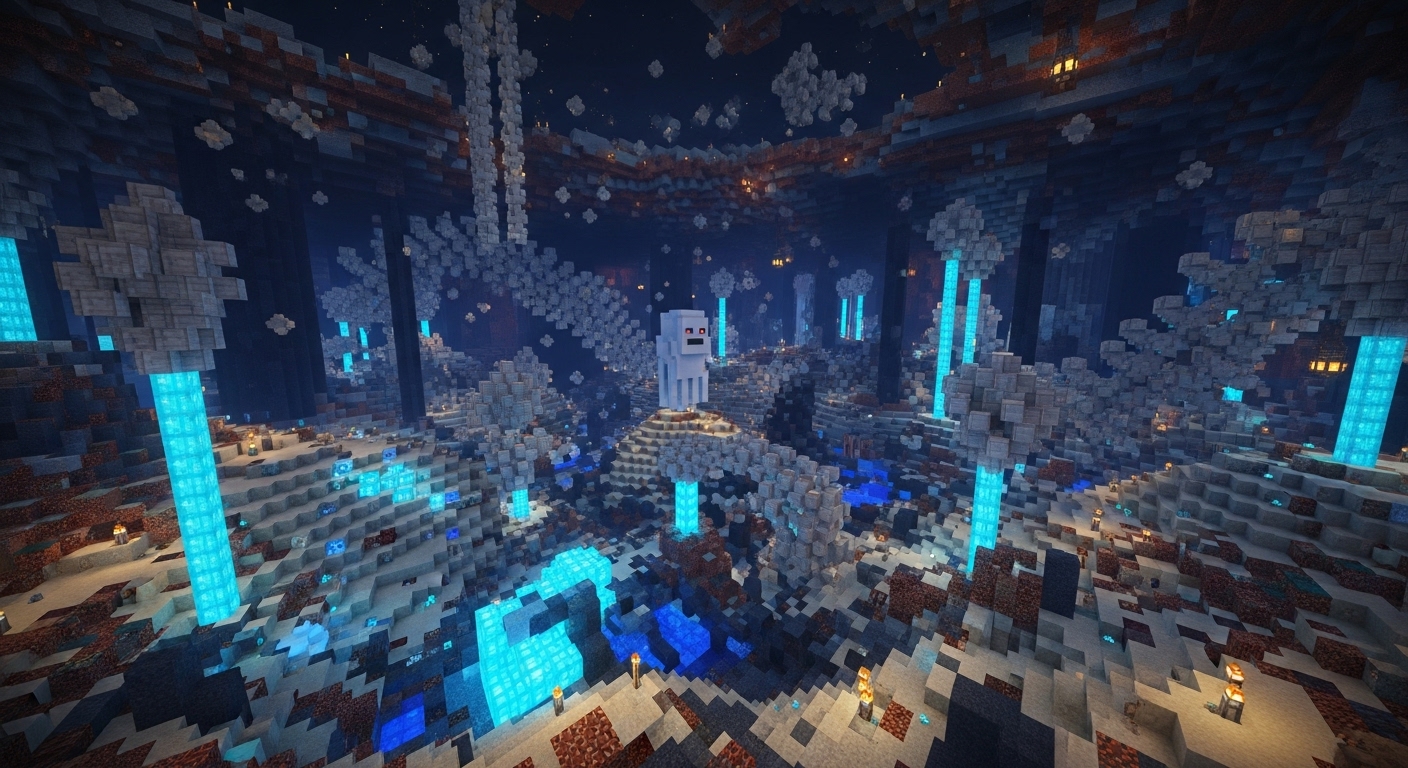
A soul sand valley is a wide, open Nether biome floored with soul sand and soul soil, lit by blue soul fire and dotted with giant bone fossils. Skeletons and ghasts are the main threats. It covers about a sixth of the Nether in our sample, and it is the only place Nether fossils and their dried ghasts generate.
| Dimension | Nether |
|---|---|
| Where it generates | Anywhere in the Nether, mostly bordering nether wastes; in our sample it never touched a warped forest |
| How common | 17% of the Nether in our sample (nether wastes 36%, crimson forest 22%, basalt deltas 16%, warped forest 8%) |
| Distance from 0,0 | Median 138 blocks from the Nether’s 0,0, and within 1,000 blocks in every seed (our sample) |
| Mobs | Skeletons, ghasts, a few endermen, and striders on lava |
| Notable blocks | Soul sand, soul soil, soul fire, bone blocks, basalt pillars, ancient debris |
| Structures | Nether fossils (only here), bastion remnants, Nether fortresses, ruined portals |
| Biome ID | minecraft:soul_sand_valley |
| Added in | Java Edition 1.16 (Nether Update, 2020) |
How to find a soul sand valley
Usually you just walk. In our sample of 300 Java 26.3 seeds the median distance from the Nether’s 0,0 to the nearest soul sand valley was 138 blocks, a quarter of seeds had one within 41 blocks, and every seed had one within 1,000. Its edges touched nether wastes 57% of the time, crimson forest 24% and basalt deltas 18%. In our sample it never bordered a warped forest, so if you are in blue fungi, head out through the nether wastes.
The biome is easy to spot from far off: the fog turns teal and blue soul fire flickers on the ground.
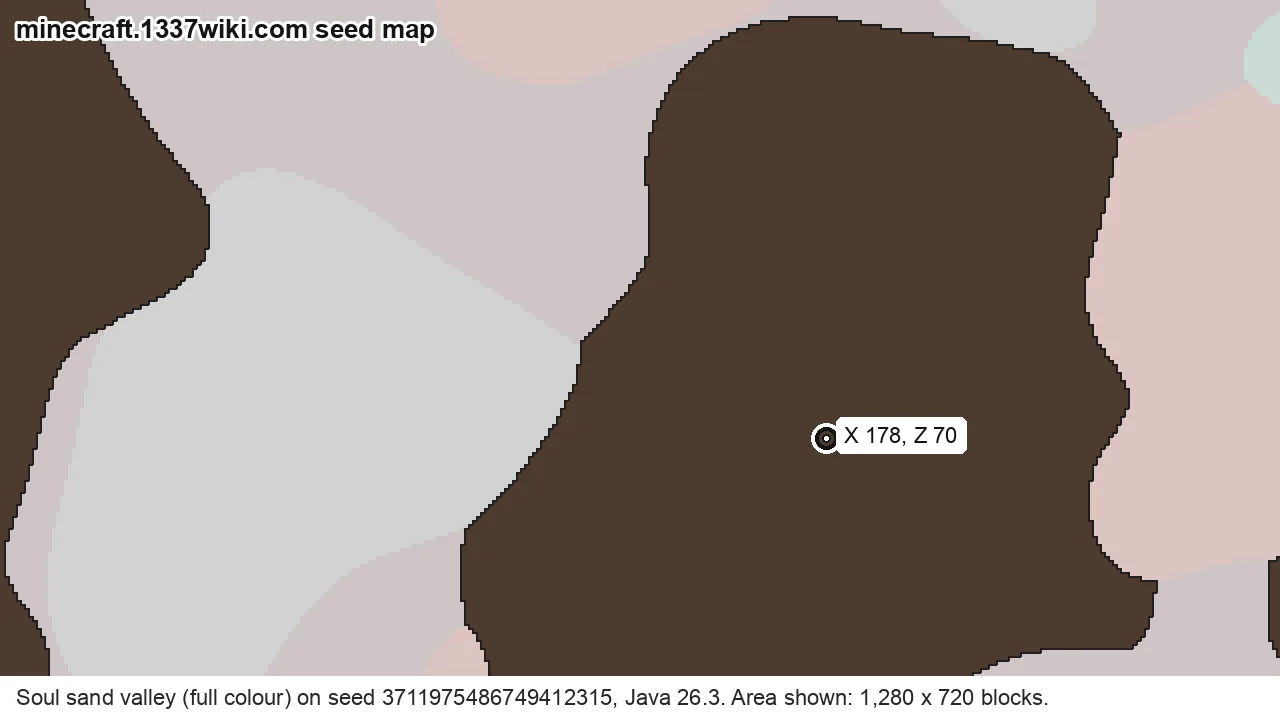
These Java 26.3 seeds have a soul sand valley near the Nether’s center. Coordinates are Nether coordinates, checked at block level.
| Seed | Soul sand valley at (Nether) | From 0,0 | Map |
|---|---|---|---|
3711975486749412315 |
X 178, Z 70 | 191 blocks | Open on the map |
-7359304947424811821 |
X 18, Z 158 | 159 blocks | Open on the map |
-7958239334195927214 |
X 2, Z -18 | 18 blocks | Open on the map |
With cheats on, /locate biome minecraft:soul_sand_valley gives the nearest one, or paste your seed into the biome finder. One block in the Nether is eight in the Overworld, so a portal built near Overworld spawn usually opens close to the Nether’s 0,0. These are Java seeds; the same number on Bedrock gives a different world.
What spawns in a soul sand valley
Skeletons, ghasts, endermen and, on the lava, striders. Ghasts and skeletons make up almost all of it; endermen are rare. The open layout means ghasts can see you from a long way off, and skeletons spawn in groups, so bring a bow and a shield. Soul sand slows you down, which makes dodging fireballs harder; stick to soul soil or lay a path of solid blocks.
Piglins, hoglins, zombified piglins and magma cubes don’t spawn here naturally. Piglins do live in bastion remnants, and bastions can generate in soul sand valleys, so wear a piece of gold armor if you go near one.
Nether fossils and dried ghasts
Nether fossils are giant skeleton shapes made of bone blocks, half buried in the soul sand. They generate only in soul sand valleys. Each bone block crafts into nine bone meal, so one fossil is a big stack of fertilizer.
Since Java 1.21.6 a dried ghast can generate at a Nether fossil. Place it in water and after about 20 minutes it hatches a ghastling, which grows into a rideable happy ghast. If the fossils near you have none, you can craft a dried ghast from one soul sand and eight ghast tears, and this biome supplies both.
Does netherite spawn in soul sand valleys?
Yes. Ancient debris, which smelts into netherite scrap, generates under soul sand valleys like every other Nether biome. Only the height matters: dig around Y 15. At that depth the biome on the surface makes little difference, but the open valley floor makes it easier to see ghasts and skeletons coming when you climb back up.
Soul sand vs soul soil
The valley floor mixes the two blocks, and they behave differently.
| Feature | Soul sand | Soul soil |
|---|---|---|
| Slows you down | Yes | No |
| Grows nether wart | Yes | No |
| Makes upward bubble columns | Yes | No |
| Burns with soul fire | Yes | Yes |
| Sped up by Soul Speed | Yes | Yes |
Soul fire is the blue fire that burns on both blocks. It deals more damage than normal fire. Either block also turns a torch or campfire recipe into its soul version, the start of soul campfires and soul lanterns. Soul Speed boots make you run fast on both blocks, but they wear out quickly while you do.
The tall gray pillars are basalt. Glowstone, gravel, blackstone, magma blocks, nether gold ore and nether quartz ore are mixed into the walls, and water evaporates the moment you place it, as everywhere in the Nether.
Soul sand valley vs basalt deltas
Both biomes are gray and both have basalt, but the basalt deltas are rough, full of lava pools and spawn magma cubes, while the soul sand valley is open and flat with skeletons and ghasts. Bastions generate in soul sand valleys but never in basalt deltas. For the other Nether biomes, see the nether wastes, crimson forest and warped forest.
What changed in 2025-26
Nothing changed in soul sand valleys in Wilderness Bound (Java 26.3, September 2026).
In Mounts of Mayhem (Java 1.21.11, December 2025), the Nether’s fog stopped depending on your render distance; it is now always applied from 10 to 96 blocks.
In Chase the Skies (Java 1.21.6, June 2025), dried ghast blocks started generating in Nether fossils, which only appear in this biome. A dried ghast in water hatches a ghastling that grows into a happy ghast.
In Spring to Life (Java 1.21.5, March 2025), the soul sand valley counts as a warm biome for the new farm animal variants, so a pig, cow or chicken spawned here (with a spawn egg, for example) comes out as the warm variant. They don’t spawn here naturally.
Source: the official 1.21.11, 1.21.6 and 1.21.5 release notes.
How we measured
The numbers on this page come from our own seed map engine, running Java Edition 26.3 world generation. We generated 300 random seeds and sampled every 16th block across a 10,240 by 10,240 block square of the Nether centered on 0,0, at about Y 60. “How common” is the biome’s share of those samples; “distance from 0,0” is how far the nearest soul sand valley sample was. The seeds above were picked from the same run, and each coordinate was re-checked at block level.