Updated for Java Edition 26.3 (October 2026).
Lush caves are a green cave biome under the Overworld, with moss on the floor, glow berry vines hanging from the ceiling and clay pools full of axolotls. They are common: in our sample of 300 Java 26.3 seeds, every seed had lush caves within 2,000 blocks of spawn. Look for an azalea tree on the surface and dig down.
| Dimension | Overworld, underground |
|---|---|
| Where it generates | Below the surface, most often around Y 0 and thinning out toward the bottom of the world (our sample) |
| How common | 10% of a horizontal slice at Y 0 in our sample (about 1 block in 10) |
| Distance from spawn | Median 297 blocks, measured horizontally; within 1,000 blocks in 98% of seeds, within 2,000 in all 300 (our sample) |
| Mobs | Axolotls (no other biome spawns them), glow squid, tropical fish in the pools, bats, plus the usual hostile mobs in dark spots |
| Notable blocks | Moss blocks and moss carpet, cave vines with glow berries, spore blossoms, azalea bushes, big and small dripleaf, clay |
| Structures | Mineshafts, trial chambers, ruined portals |
| Biome ID | minecraft:lush_caves |
| Added in | Java Edition 1.18 (Caves & Cliffs: Part II, 2021) for normal worlds; the blocks arrived in 1.17 |
What Y level are lush caves?
They are a fairly shallow cave biome. In our sample of 300 Java 26.3 seeds, lush caves covered 10.4% of a horizontal slice at Y 0, 7.6% at Y -24 and only 1.3% at Y -52. So the best depth to search is around Y 0 to Y -24. Dig much deeper and you are more likely to hit the deep dark, which covered 9.1% of the Y -52 slice in the same sample. We did not sample above Y 0, so this doesn’t tell you how high they can reach.
How to find lush caves
The surface gives them away. An azalea tree (a small tree with round leaves, sometimes with pink flowers) generates on top of lush caves, with a column of rooted dirt running down from it and hanging roots where it breaks through the cave ceiling. Dig straight down next to the trunk and you land in the cave. This works on both Java and Bedrock.
You rarely need to go far. In our sample the median horizontal distance from spawn to the nearest lush caves was 297 blocks, and 293 of the 300 seeds had some within 1,000 blocks.
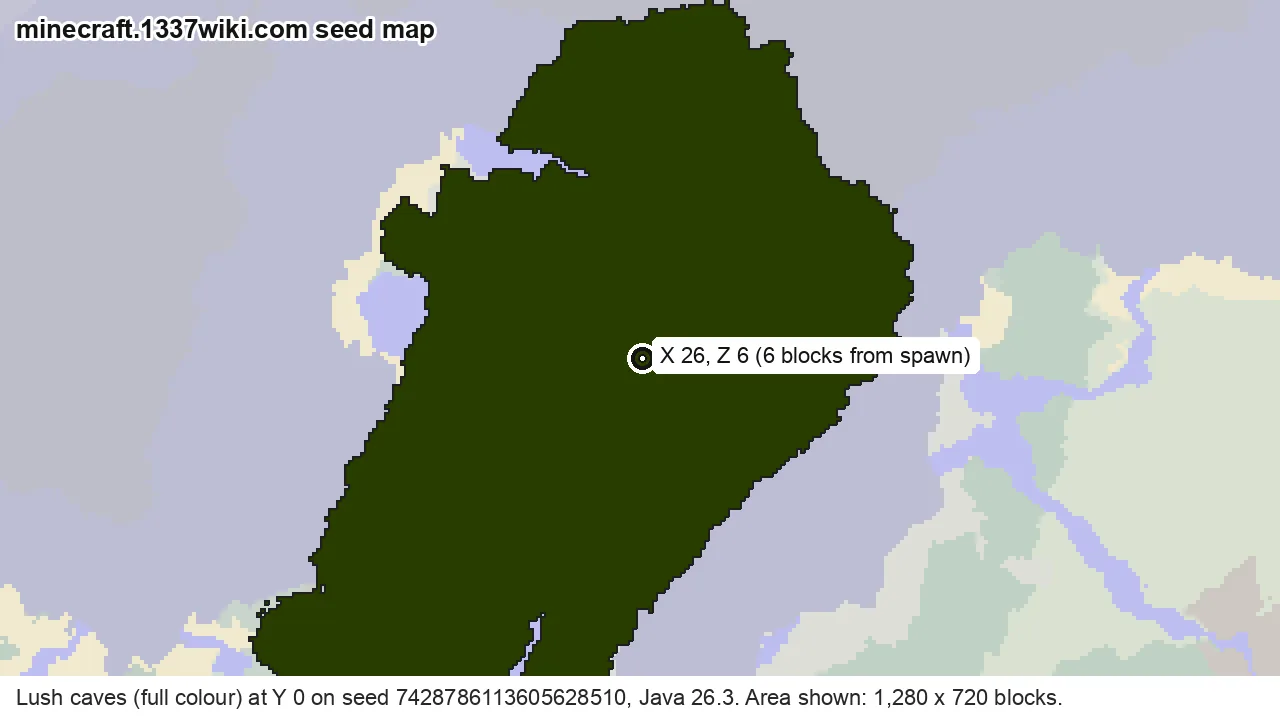
These three Java 26.3 seeds have lush caves close to spawn. Each coordinate is inside the biome at Y 0, checked at block level, and the map links open at that depth.
| Seed | Lush caves at (X, Y, Z) | From spawn | Map |
|---|---|---|---|
7428786113605628510 |
X 26, Y 0, Z 6 | 6 blocks | Open on the map |
7477144643603395230 |
X 274, Y 0, Z 30 | 241 blocks | Open on the map |
8527603118193051948 |
X 186, Y 0, Z 262 | 202 blocks | Open on the map |
With cheats on, /locate biome minecraft:lush_caves returns the nearest lush caves with a Y coordinate. Without cheats, paste your seed into the biome finder. These are Java seeds; the same number on Bedrock gives a different world.
What are the vines in lush caves called?
The vines hanging from the ceiling are cave vines, and the orange berries on them are glow berries. A cave vine with berries gives off light, which is why lush caves are often bright enough to explore without torches.
You can’t pick up the vine itself as an item. Use the vine (right-click) to pick the berries, or break it to get the glow berries it was carrying. To grow your own cave vines, place glow berries on the underside of a block; they grow down over time, and bone meal makes berries appear on them. Lush caves also have ordinary vines on the walls, which you can collect with shears.
Axolotls and other mobs
Lush caves are the only biome where axolotls spawn naturally, in the water pools. You can scoop one up with a water bucket and carry it, and breed two with buckets of tropical fish, which also spawn in these pools. In water, axolotls attack drowned, guardians and most other water mobs, which makes them useful company in an ocean monument raid. Glow squid share the pools, and bats fly in the dark parts.
Moss and glow berries don’t make a cave safe. Zombies, skeletons, creepers, spiders, endermen and witches spawn in any part that is dark enough, so light the spots the berries don’t reach.
Blocks worth collecting
Moss blocks spread when you use bone meal on them, turning nearby stone, dirt and similar blocks into moss, which makes them a cheap renewable source of greenery and compost. A hoe mines moss fastest. Big dripleaf works as a platform that tilts and drops you if you stand on it for a moment, and a redstone signal holds it level. Spore blossoms drip particles but don’t produce light. Clay pools under the moss give you clay for bricks and terracotta.
Lush caves vs dripstone caves
The two cave biomes sit at similar depths, and in our sample they were about equally common:
| Feature | Lush caves | Dripstone caves |
|---|---|---|
| Look | Moss, vines, flowers, water pools | Dripstone blocks and pointed dripstone |
| Animals | Axolotls, glow squid, tropical fish, bats | Glow squid, bats |
| Share at Y 0 / Y -24 / Y -52 (our sample) | 10.4% / 7.6% / 1.3% | 12.4% / 6.2% / 1.5% |
| Median distance from spawn (our sample) | 297 blocks | 204 blocks |
What changed in 2025-26
Nothing official changed in how Java lush caves generate or what spawns in them during 2025-26. On Bedrock, version 1.21.90 added new music tracks by Amos Roddy to lush caves (Bedrock 1.21.90 changelog).
How we measured
The numbers on this page come from our own seed map engine, running Java Edition 26.3 world generation. We generated 300 random seeds and, because lush caves are a cave biome, sampled every 16th block across a 10,240 by 10,240 block square centered on each world’s spawn in three horizontal slices underground, at Y 0, Y -24 and Y -52. “How common” is the share of the densest slice (10% is the Y 0 slice, not the surface). “Distance from spawn” is the horizontal distance to the nearest lush caves sample in those slices; it ignores how far down you have to dig. The seeds above were picked from the same run, and each coordinate was re-checked at block level.