Updated for Java Edition 26.3 (October 2026).
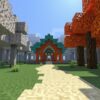
Wooded badlands is the badlands variant with a forest on top: orange and red terracotta canyons below, and high plateaus capped with grass, coarse dirt and small oak trees. It generates in hot, dry regions beside desert and regular badlands. Come for the only wood in the badlands, extra gold ore and striped wolves.
| Dimension | Overworld |
|---|---|
| Where it generates | Hot, dry regions, usually bordering rivers, desert and regular badlands |
| How common | 0.5% of the surface in our sample (about 1 block in 200) |
| Distance from spawn | Median 2,844 blocks; within 1,000 blocks in 13% of seeds, within 2,000 in 31% (our sample) |
| Mobs | Armadillos, wolves (the striped variant), sheep, pigs, cows and chickens, plus the usual hostile mobs at night |
| Notable blocks | Banded terracotta, red sand, coarse dirt, oak trees, dead bushes, cactus, gold ore |
| Structures | Badlands mineshafts, ruined portals, abandoned camps (26.3) |
| Climate | Temperature 2.0; it never rains |
| Biome ID | minecraft:wooded_badlands |
| Added in | Java Edition 1.7.2 as Mesa Plateau F; renamed Wooded Badlands Plateau in 1.13 and Wooded Badlands in 1.18 |
How to find wooded badlands
Start with a desert. In our sample, the edge of a wooded badlands touched a river 43% of the time, desert 27% and regular badlands 19%, and it bordered a jungle or a stony shore only about 3% of the time each. So the walking route is: find a desert, follow it until the sand turns into striped terracotta, then climb to the highest ground you can see. If the top of a mesa is green with scattered oaks, you are standing in wooded badlands.
Expect a long trip. The median distance from spawn in our sample was 2,844 blocks, and only 13% of seeds had wooded badlands within 1,000 blocks. Still, 281 of the 300 seeds had at least one inside the area we sampled, so it is far more often than it is missing.
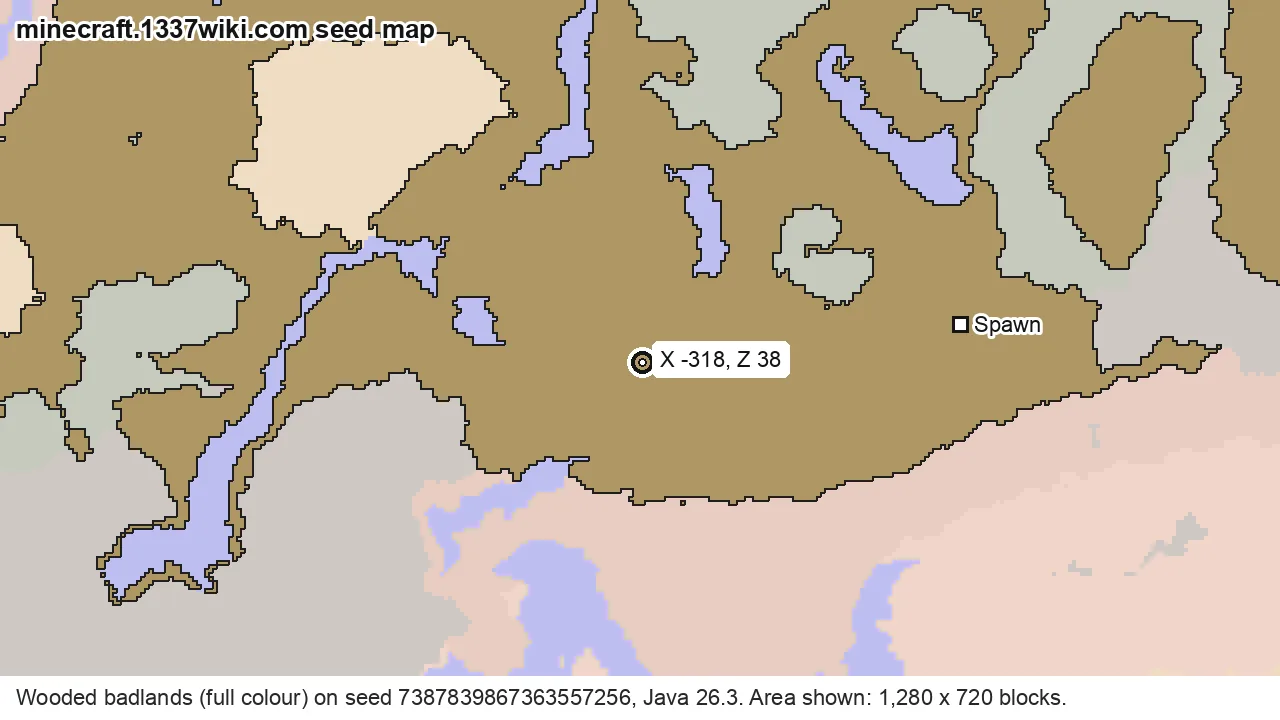
These three Java 26.3 seeds put wooded badlands within a few hundred blocks of spawn. Each coordinate is inside the biome, checked at block level.
| Seed | Wooded badlands at | From spawn | Map |
|---|---|---|---|
7387839867363557256 |
X -318, Z 38 | 320 blocks | Open on the map |
-4938873132436947297 |
X -94, Z -10 | 95 blocks | Open on the map |
-6825279759677013491 |
X 386, Z 442 | 86 blocks | Open on the map |
In a world you already have, type /locate biome minecraft:wooded_badlands (cheats on) for the nearest one, or paste your seed into the biome finder. These are Java seeds; the same number on Bedrock gives a different world.
Is wooded badlands rare?
By area, yes. In our sample of 300 Java 26.3 seeds it covered 0.5% of the surface, about one block in 200, and its median distance from spawn sat between regular badlands and eroded badlands. Here is how the badlands family compares:
| Feature | Wooded badlands | Badlands | Eroded badlands |
|---|---|---|---|
| How common (our sample) | 0.5% of the surface | 0.8% | 0.3% |
| Median distance from spawn (our sample) | 2,844 blocks | 2,641 blocks | 2,908 blocks |
| Trees | Oaks on the plateau tops | None | None |
| Wolves | Striped wolves spawn | No | No |
| Terrain | High, flat-topped plateaus with grass and coarse dirt | Terracotta hills and mesas | Tall terracotta spires |
| Extra gold ore | Same in all three: an extra layer of gold ore from Y 32 up to Y 256 | ||
The three usually sit together, so finding any badlands puts you close to the wooded kind.
Wooded badlands plateau and the old names
If you remember Wooded Badlands Plateau or Modified Wooded Badlands Plateau, this is the same place. Java 1.18 merged the plateau versions into one biome called wooded badlands, and the new terrain generator now builds the plateaus itself. The ID changed too, so /locate needs minecraft:wooded_badlands; the old plateau IDs no longer exist.
What the biome is good for
Wood in a treeless region
Regular badlands has no trees at all, so the oaks on top of a wooded badlands plateau are the nearest wood for a long way. The trees are small, but there are enough of them to get a base started. Since Java 1.21.5 some of them also lie on the ground as fallen trees, which are quicker to chop.
Gold and mineshafts
All badlands biomes add extra gold ore between Y 32 and Y 256, far higher than gold normally generates, so you often see it in canyon walls without digging. Mineshafts in badlands biomes are the badlands type: they are built from dark oak and generate higher than normal mineshafts, so their supports sometimes stick out of a cliff.
Wolves and armadillos
Wooded badlands is the only badlands biome where wolves spawn, and they are the striped variant. Tame one with bones and it keeps that coat. Armadillos spawn here too: brush one to get a scute, and six scutes make wolf armor, so this biome gives you both the wolf and its armor.
Food and water
Since Java 1.21.5, sheep, pigs, cows and chickens spawn in the badlands, which makes the first night much easier than it used to be. Water is still scarce on the plateaus, so carry a water bucket if you plan to farm up there.
What changed in 2025-26
In Wilderness Bound (Java 26.3, September 2026), abandoned camps can generate in wooded badlands, with a design made for this biome.
In Spring to Life (Java 1.21.5, March 2025), chickens, cows, pigs and sheep started spawning in badlands biomes. Here they are the warm variants: warm chickens lay brown eggs, and sheep spawn with warm-biome wool colors, so brown is the most common. Fallen oak trees and leaf litter now generate on the ground.
Source: the official 26.3 and 1.21.5 release notes.
How we measured
The numbers on this page come from our own seed map engine, running Java Edition 26.3 world generation. We generated 300 random seeds and sampled every 16th block across a 10,240 by 10,240 block square centered on each world’s spawn. “How common” is the biome’s share of those samples; “distance from spawn” is how far the nearest sample of the biome was. The seeds above were picked from the same run, and each coordinate was re-checked at block level.