Updated for Java Edition 26.3 (October 2026).
Windswept gravelly hills is a cool, hilly Overworld biome where most of the ground is gravel, broken up by bare stone, grass and a few oak and spruce trees. It is the rarest windswept biome by area, at 0.08% of the surface in our sample of 300 Java 26.3 seeds. Come for emerald ore, llamas and endless gravel.
| Dimension | Overworld |
|---|---|
| Where it generates | Hilly ground at the edge of plains and snowy plains, often next to windswept hills |
| How common | 0.08% of the surface in our sample (about 1 block in 1,250) |
| Distance from spawn | Median 2,371 blocks; within 1,000 blocks in 18% of seeds, within 2,000 in 39% (our sample) |
| Mobs | Llamas, sheep, pigs, cows and chickens, plus the usual hostile mobs at night and silverfish in infested stone |
| Notable blocks | Gravel, stone, grass, emerald ore, infested stone, oak and spruce trees |
| Structures | Mineshafts, ruined portals |
| Climate | Temperature 0.2; rain at low levels, snow on the high slopes |
| Biome ID | minecraft:windswept_gravelly_hills |
| Added in | Java Edition 1.7.2 as Extreme Hills M; renamed Gravelly Mountains in 1.13 and Windswept Gravelly Hills in 1.18 |
How rare is windswept gravelly hills?
Rare by area, but most worlds have one within a few thousand blocks. In our sample of 300 Java 26.3 seeds it covered 0.08% of the surface, roughly one block in every 1,250. Of the 52 surface biomes in our sample, only the pale garden covered less ground. Its patches are small and scattered, though, so 286 of the 300 seeds had at least one inside the 10,240-block square we sampled, and 91% had one within 5,000 blocks of spawn.
Next to its closest relative the gap is easy to see:
| Feature | Windswept gravelly hills | Windswept hills |
|---|---|---|
| How common (our sample) | 0.08% of the surface | 0.23% of the surface |
| Median distance from spawn (our sample) | 2,371 blocks | 1,419 blocks |
| Ground | Mostly gravel, with patches of stone and grass | Mostly grass, with bare stone in places |
| Same in both | Temperature 0.2, sparse oak and spruce trees, llamas, emerald ore, infested stone | |
So if you just want emeralds or llamas, windswept hills is the easier find. Come to the gravelly version when you want the gravel itself, or the look.
How to find windswept gravelly hills
Follow the plains. In our sample, the biome’s edge touched plains 48% of the time, snowy plains 25% and windswept hills 10%. The best place to look is where green plains start to turn into snowy plains and the ground rises into hills. From a distance, watch for grey hillsides: gravel shows up as long grey streaks between the grass and the stone. It also bordered swamps (5%) and the dappled forest added in 26.3 (6%) now and then.
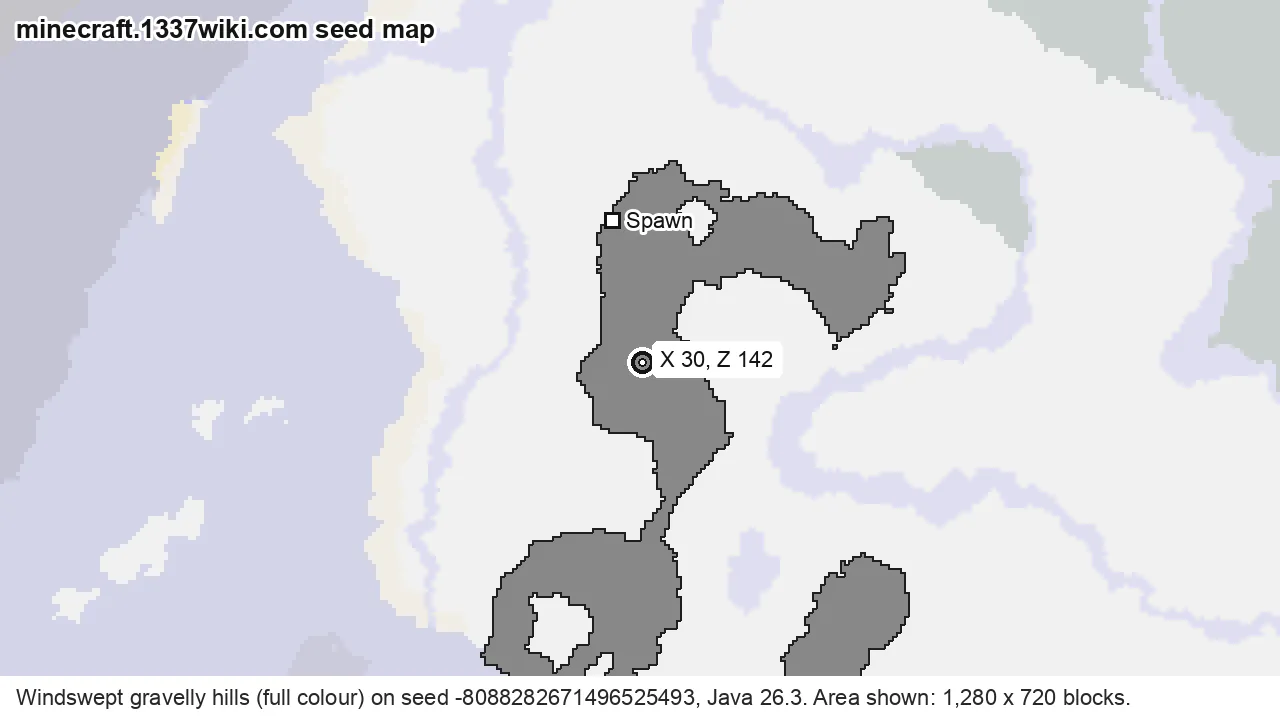
These three Java 26.3 seeds put windswept gravelly hills close to spawn. Each coordinate is inside the biome, checked at block level.
| Seed | Gravelly hills at | From spawn | Map |
|---|---|---|---|
-8088282671496525493 |
X 30, Z 142 | 145 blocks | Open on the map |
1389029798597448631 |
X -30, Z 14 | 33 blocks | Open on the map |
-3063940091273390729 |
X -82, Z -382 | 71 blocks | Open on the map |
With cheats on, /locate biome minecraft:windswept_gravelly_hills gives the nearest one. Without cheats, paste your seed into the biome finder to see every patch around spawn. These are Java seeds; Bedrock worlds from the same number are different.
What you find here
Gravel and flint
Gravel falls when the block under it is removed, so dig from the top of a slope down, not from underneath. Each gravel block you break has a chance to drop flint instead of itself, which makes this the easiest place to stock up on flint for arrows and flint and steel.
Emerald ore
Emerald ore only generates in the mountain biomes and in three windswept biomes: windswept hills, windswept forest and this one. It gets more common the higher you go, so the stone in the upper slopes is the part worth mining.
Infested stone
At Y 63 and below, some of the stone here is infested: it looks like normal stone, breaks faster, and releases a silverfish when it does. If a block breaks suspiciously quickly, expect company.
Mobs
Llamas spawn here in herds, along with sheep, pigs, cows and chickens. Goats do not spawn in this biome; they live in the snowy slopes and peaks. On the high ground the snow and steep drops make fall damage the main danger, so carry a water bucket.
What changed in 2025-26
In Spring to Life (Java 1.21.5, March 2025), pigs, cows and chickens that spawn here are the cold variants, and cold chickens lay blue eggs. Sheep spawn with cold-biome wool colors, so black is the most common. Fallen oak and spruce trees now generate here, some covered in mushrooms or vines, and the new bush block grows in small patches.
Source: the official 1.21.5 release notes.
How we measured
The numbers on this page come from our own seed map engine, running Java Edition 26.3 world generation. We generated 300 random seeds and sampled every 16th block across a 10,240 by 10,240 block square centered on each world’s spawn. “How common” is the biome’s share of those samples; “distance from spawn” is how far the nearest sample of the biome was. The seeds above were picked from the same run, and each coordinate was re-checked at block level.