Updated for Java Edition 26.3 (October 2026).
The deep dark is a cave biome near the bottom of the Overworld, covered in sculk and home to ancient cities and the warden. No mobs spawn here on their own, but naturally generated sculk shriekers can summon a warden. Come for ancient city loot, such as Swift Sneak books and echo shards, and move quietly.
| Dimension | Overworld, underground |
|---|---|
| Where it generates | Deep below the surface; the deeper you go, the more of it there is (our sample) |
| How common | 9.1% of a horizontal slice at Y -52 in our sample (about 1 block in 11) |
| Distance from spawn | Median 442 blocks, measured horizontally; within 1,000 blocks in 82% of seeds, within 2,000 in 299 of 300 (our sample) |
| Mobs | None spawn naturally, not even bats. The warden appears only when a natural sculk shrieker summons it |
| Notable blocks | Sculk, sculk veins, sculk sensors, sculk shriekers, sculk catalysts; reinforced deepslate in ancient cities |
| Structures | Ancient cities, which generate nowhere else; mineshafts don’t generate here |
| Biome ID | minecraft:deep_dark |
| Added in | Java Edition 1.19 (The Wild Update, 2022) |
What Y level is the deep dark?
There is no fixed layer, but the deeper you dig, the more of it there is. In our sample of 300 Java 26.3 seeds, the deep dark covered about 0.8% of a horizontal slice at Y 0, 2.5% at Y -24 and 9.1% at Y -52. So aim for the bottom of the world: around Y -50 is a good depth to search, and it is also roughly where ancient cities sit, with their floor at about Y -51.
At Y -52 the biome is not hard to reach. The median horizontal distance from spawn to the nearest deep dark was 442 blocks in our sample, and 82% of seeds had some within 1,000 blocks. A long tunnel or a big cave system at that depth will usually run into one. You know you have arrived when the floor and walls turn almost black with sculk.
How to find the deep dark
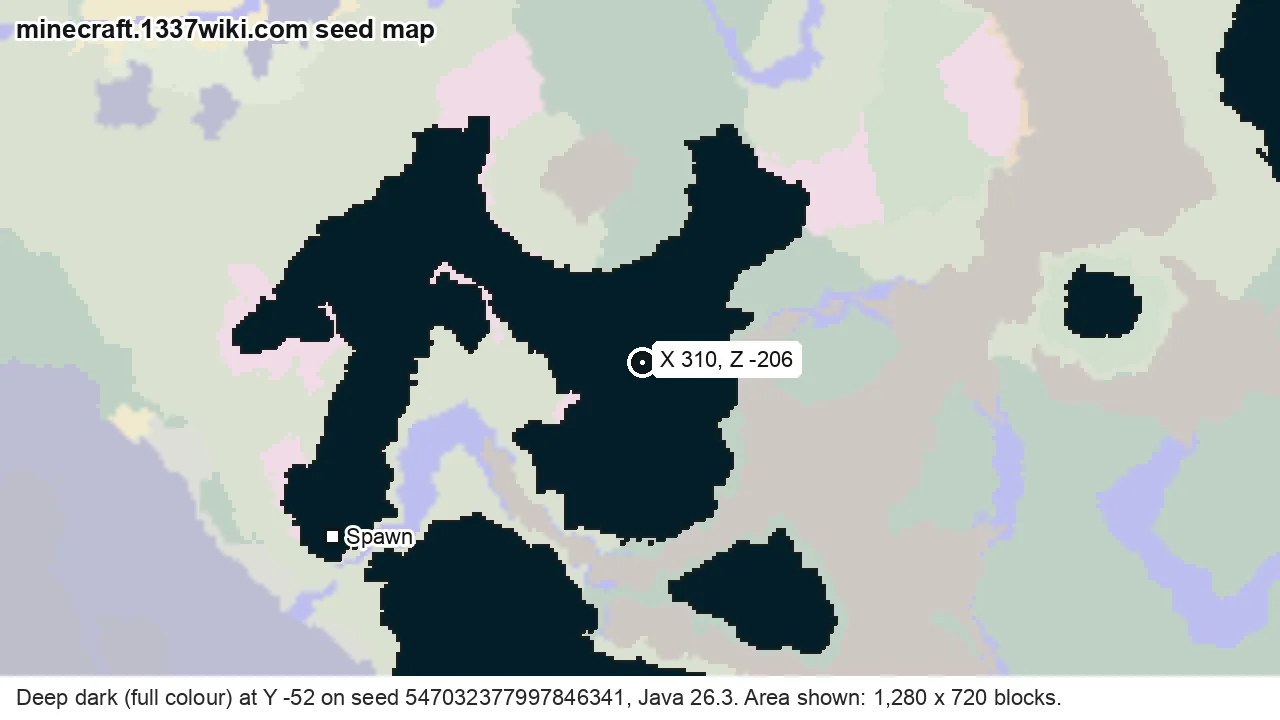
These three Java 26.3 seeds have deep dark a few hundred blocks from spawn. Each coordinate is inside the biome at Y -52, checked at block level, and the map links open at that depth.
| Seed | Deep dark at (X, Y, Z) | From spawn | Map |
|---|---|---|---|
547032377997846341 |
X 310, Y -52, Z -206 | 355 blocks | Open on the map |
4711785765194039058 |
X -118, Y -52, Z 194 | 227 blocks | Open on the map |
3963837725665925714 |
X -202, Y -52, Z -6 | 250 blocks | Open on the map |
In your own world, /locate biome minecraft:deep_dark (cheats on) returns the nearest deep dark with its Y coordinate, and /locate structure minecraft:ancient_city finds the nearest city. Without cheats, paste your seed into the biome finder or the ancient city finder. These are Java seeds; the same number on Bedrock gives a different world.
Deep dark blocks
Almost everything that makes the deep dark dangerous is a sculk block. Learn these five before you go in:
| Block | What it does |
|---|---|
| Sculk | Covers the floor and walls. Harmless on its own |
| Sculk vein | A thin layer of sculk on the sides of blocks. Also harmless |
| Sculk sensor | Detects vibrations (footsteps, block breaking, landing projectiles) within 8 blocks and sends a redstone signal, which can set off a nearby shrieker |
| Sculk shrieker | Shrieks when a sensor near it fires or you step on it, giving you the Darkness effect. Natural shriekers can summon the warden |
| Sculk catalyst | When a mob dies near it, it uses the mob’s experience to spread more sculk |
The sculk blocks drop experience instead of themselves unless you mine them with Silk Touch, and a hoe is the fastest tool for them. A shrieker you place yourself can never summon a warden. In ancient cities you will also find reinforced deepslate, which can’t be broken in Survival.
The warden, and how not to wake it
Every time a natural shrieker goes off near you, your warning level goes up. The fourth shriek summons a warden, which digs its way out of the ground nearby. It is blind and hunts by vibration and smell, has 500 health and hits very hard. Running is better than fighting. If it detects nothing for 60 seconds, it digs back down and disappears.
Staying quiet comes down to a few habits. Sneak: crouch-walking doesn’t set off sculk sensors. Lay wool or carpet over paths you use often, since walking on wool makes no vibrations and wool blocks stop vibrations passing through (since 26.3, wool stairs and slabs do the same). Throw a snowball to make a vibration somewhere else and pull a sensor’s or the warden’s attention away. And avoid breaking or placing blocks near sensors, because both count as vibrations.
Ancient cities
Ancient cities generate only in the deep dark, and no mobs spawn inside them. Their chests hold loot you can’t get anywhere else: Swift Sneak enchanted books, echo shards (eight and a compass make a recovery compass) and disc fragments for the music disc “5”, plus enchanted golden apples and enchanted diamond gear. See our ancient city guide for the layout and the safest route through.
What changed in 2025-26
In Wilderness Bound (Java 26.3, September 2026), abandoned camp chests can contain a Buried Ancient City Map, a new explorer map that leads to an ancient city.
In Spring to Life (Java 1.21.5, March 2025), the deep dark counts as a cold biome for the new farm animal variants, so a pig, cow or chicken spawned here (with a spawn egg, for example) comes out as the cold variant. They don’t spawn here naturally.
Source: the official 26.3 and 1.21.5 release notes.
On Bedrock, version 26.50 made bats spawn in every Overworld biome except the deep dark (Bedrock 26.50 changelog). Java already had no bat spawns here, so on both editions the deep dark stays free of bats.
How we measured
The numbers on this page come from our own seed map engine, running Java Edition 26.3 world generation. We generated 300 random seeds and, because the deep dark is a cave biome, sampled every 16th block across a 10,240 by 10,240 block square centered on each world’s spawn in three horizontal slices underground, at Y 0, Y -24 and Y -52. “How common” is the deep dark’s share of a slice (9.1% is the Y -52 slice, not the surface). “Distance from spawn” is the horizontal distance to the nearest deep dark sample in those slices; it ignores how far down you have to dig. The seeds above were picked from the same run, and each coordinate was re-checked at block level.