Updated for Java Edition 26.3 (October 2026).
The deep lukewarm ocean is the deep version of the lukewarm ocean: the same mild, light-blue water with kelp, seagrass and tropical fish, over a much deeper floor. That depth is why you come here, because ocean monuments only generate in deep oceans. In our sample of 300 Java 26.3 seeds, every world had one, at a median 1,361 blocks from spawn.
| Dimension | Overworld |
|---|---|
| Where it generates | Open sea in mild to warm regions, almost always surrounded by shallower lukewarm ocean |
| How common | 2.4% of the surface in our sample (about 1 block in 40) |
| Distance from spawn | Median 1,361 blocks; within 1,000 blocks in 37% of seeds, within 2,000 in 71% (our sample) |
| Mobs | Tropical fish, cod, pufferfish, squid, dolphins, nautiluses and drowned; guardians at monuments |
| Notable blocks | Kelp, seagrass and tall seagrass, patches of sand, gravel and clay on the floor |
| Structures | Ocean monuments, warm ocean ruins, shipwrecks, ruined portals |
| Climate | Temperature 0.5, downfall 0.5 |
| Biome ID | minecraft:deep_lukewarm_ocean |
| Added in | Java Edition 1.13 (Update Aquatic, 2018) |
Deep lukewarm ocean vs lukewarm ocean
From a boat they look the same. The differences are underwater: the deep version has a lower floor, ocean monuments, and fewer cod. The table adds the plain deep ocean, the other deep ocean you are likely to meet nearby.
| Feature | Deep lukewarm ocean | Lukewarm ocean | Deep ocean |
|---|---|---|---|
| Floor | Deep | Shallow | Deep |
| Ocean monuments | Yes | No | Yes |
| Ocean ruins | Warm (sandstone) | Warm (sandstone) | Cold (stone brick) |
| Fish | Tropical fish, cod, pufferfish | Tropical fish, cod, pufferfish | Cod only |
| Coral and sea pickles | None in all three; they belong to the warm ocean | ||
| How common (our sample) | 2.4% of the surface | 4.6% | 3.7% |
| Median distance from spawn (our sample) | 1,361 blocks | 970 blocks | 888 blocks |
So if you want tropical fish and pufferfish as well as a monument, the deep lukewarm ocean is the one to look for. If you only need a monument, a plain deep ocean is usually closer to spawn.
How to find a deep lukewarm ocean
Find a lukewarm ocean and head away from land. In our sample, 80% of a deep lukewarm ocean’s edge touched lukewarm ocean, 12% deep ocean, 5% warm ocean and 2% mushroom fields. Apart from mushroom islands, it doesn’t touch land. From a boat, the sign is the floor dropping out of sight while the water stays light blue. Mushroom islands are a useful landmark: in our sample, 22% of the mushroom fields’ edge touched a deep lukewarm ocean.
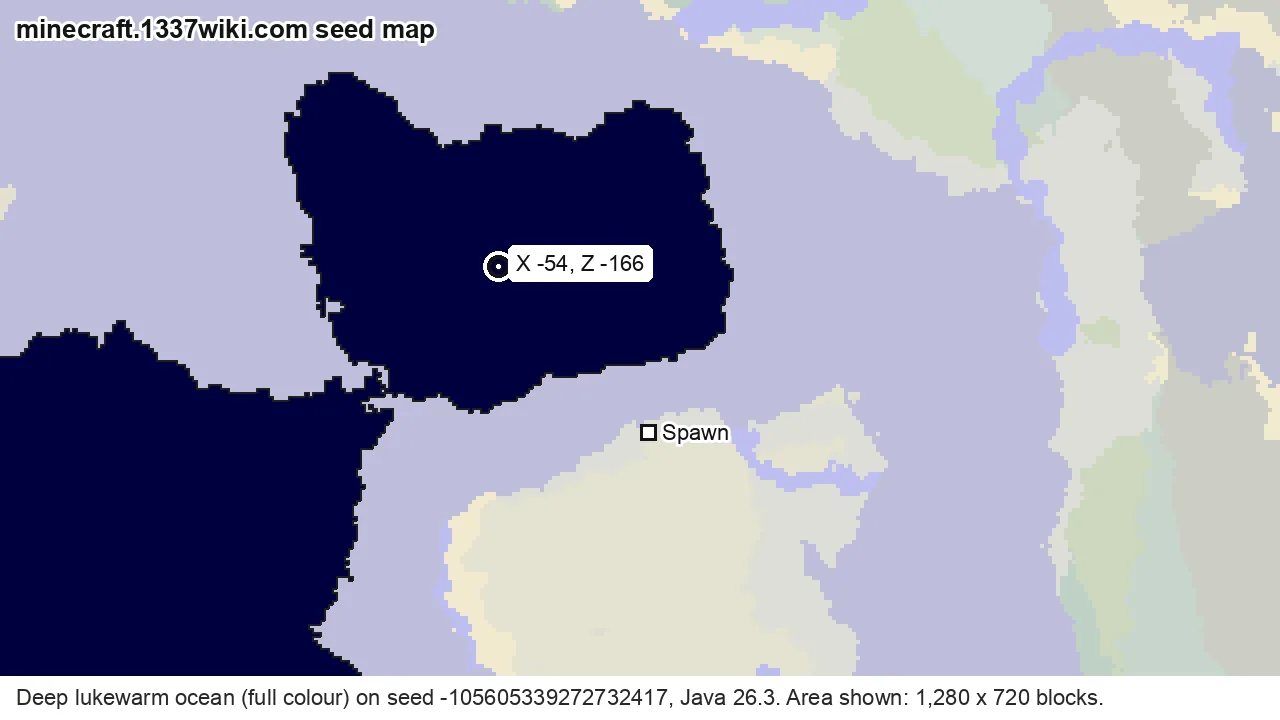
These three Java 26.3 seeds have a deep lukewarm ocean within a few hundred blocks of spawn. Each coordinate is inside the biome, checked at block level.
| Seed | Deep lukewarm ocean at | From spawn | Map |
|---|---|---|---|
-105605339272732417 |
X -54, Z -166 | 224 blocks | Open on the map |
-1003242504081753498 |
X 194, Z 202 | 206 blocks | Open on the map |
4177139319713483003 |
X -18, Z -246 | 361 blocks | Open on the map |
In a world you already have, /locate biome minecraft:deep_lukewarm_ocean finds the nearest one (cheats on), or paste your seed into the biome finder to see every ocean type around spawn. To go straight to a monument, use our ocean monument finder. These are Java seeds; the same number on Bedrock gives a different world.
Ocean monuments
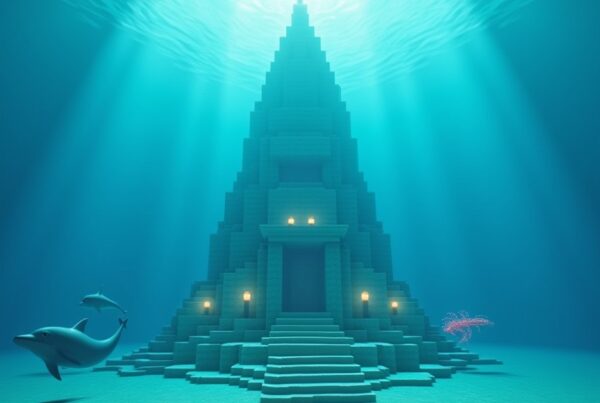
Ocean monuments generate only in the four deep ocean biomes, and this is one of them. A monument is a large prismarine building guarded by guardians and three elder guardians. Elder guardians give you Mining Fatigue when you get close, so plan to deal with them before you start mining. Inside are sponge rooms, and the core holds eight blocks of gold. Bring Water Breathing potions or a turtle shell, and a Respiration helmet if you have one.
Mobs in the deep lukewarm ocean
Tropical fish are the most common fish here, followed by cod and pufferfish. Cod are less common than in the shallow lukewarm ocean. Squid and small groups of dolphins swim in the open water. Feed a dolphin raw cod and it will swim toward the nearest shipwreck, ocean ruin or buried treasure, and swimming next to one gives you Dolphin’s Grace.
Since Java 1.21.11 the nautilus spawns here, as in every ocean. You tame it with pufferfish, and this biome has both in the same water. The coral variant of the zombie nautilus is a warm ocean mob, so it doesn’t appear here.
The hostile mob is the drowned, which may carry a trident. Guardians and elder guardians stay at their monument. Turtles and salmon do not spawn in this biome.
Is there coral or buried treasure here?
No to both. Coral reefs and sea pickles only generate in the warm ocean. Buried treasure only generates under beaches, so a treasure map from a shipwreck here always leads to a beach. Warm ocean ruins and shipwrecks are the loot structures on this sea floor; ruined portals can also generate here in their ocean form.
What changed in 2025-26
In Mounts of Mayhem (Java 1.21.11, December 2025), the nautilus, a neutral aquatic mob you can tame with pufferfish and ride, started spawning in all ocean biomes, the deep lukewarm ocean included.
In Spring to Life (Java 1.21.5, March 2025), the deep lukewarm ocean was listed as a warm biome for the new farm animal variants. Pigs, cows and chickens don’t spawn here naturally, but one spawned here (with a spawn egg, for example) comes out as the warm variant.
Source: the official 1.21.11 and 1.21.5 release notes.
Java vs Bedrock
Pufferfish only started spawning in this biome on Bedrock in version 1.21.130 (Bedrock 1.21.130 changelog); on Java they were already part of its fish. The seeds and statistics on this page are for Java Edition only.
How we measured
The numbers on this page come from our own seed map engine, running Java Edition 26.3 world generation. We generated 300 random seeds and sampled every 16th block across a 10,240 by 10,240 block square centered on each world’s spawn. “How common” is the biome’s share of those samples; “distance from spawn” is how far the nearest sample of the biome was. The seeds above were picked from the same run, and each coordinate was re-checked at block level.