Updated for Java Edition 26.3 (October 2026).
Windswept hills is a rugged Overworld biome of steep grass and stone hills with a few scattered oak and spruce trees. It is the old Extreme Hills biome. Llamas spawn here, and emerald ore is hidden in the stone. In our sample of 300 Java 26.3 seeds it covered only 0.23% of the surface, but every seed had some.
| Dimension | Overworld |
|---|---|
| Where it generates | Hilly ground at the edge of forest and plains, sometimes next to windswept forest |
| How common | 0.23% of the surface in our sample (about 1 block in 430); present in all 300 seeds |
| Distance from spawn | Median 1,419 blocks; within 1,000 blocks in 35% of seeds, within 2,000 in 69% (our sample) |
| Mobs | Llamas, sheep, pigs, cows, chickens; silverfish in infested stone; the usual hostile mobs at night |
| Notable blocks | Grass with patches of bare stone, emerald ore, infested stone, bushes, snow on the highest ground |
| Structures | Ruined portals, mineshafts, trial chambers; no villages or pillager outposts |
| Climate | Temperature 0.2, downfall 0.3; rain at low levels, snow up high |
| Biome ID | minecraft:windswept_hills |
| Added in | Beta 1.8 as Extreme Hills; renamed Mountains in Java 1.13 and Windswept Hills in 1.18 |
How to find windswept hills
Look at the edge of forests. In our sample, the biome’s edge touched forest 40% of the time and plains 22%, then windswept forest, swamp (6% each) and snowy taiga (5%). From an oak forest or open plains, head for any sudden cluster of steep grey-and-green hills with almost no trees on them.
The patches are small, so they are easy to walk past. The median distance from spawn to the nearest one was 1,419 blocks, and about a third of seeds had one within 1,000 blocks.
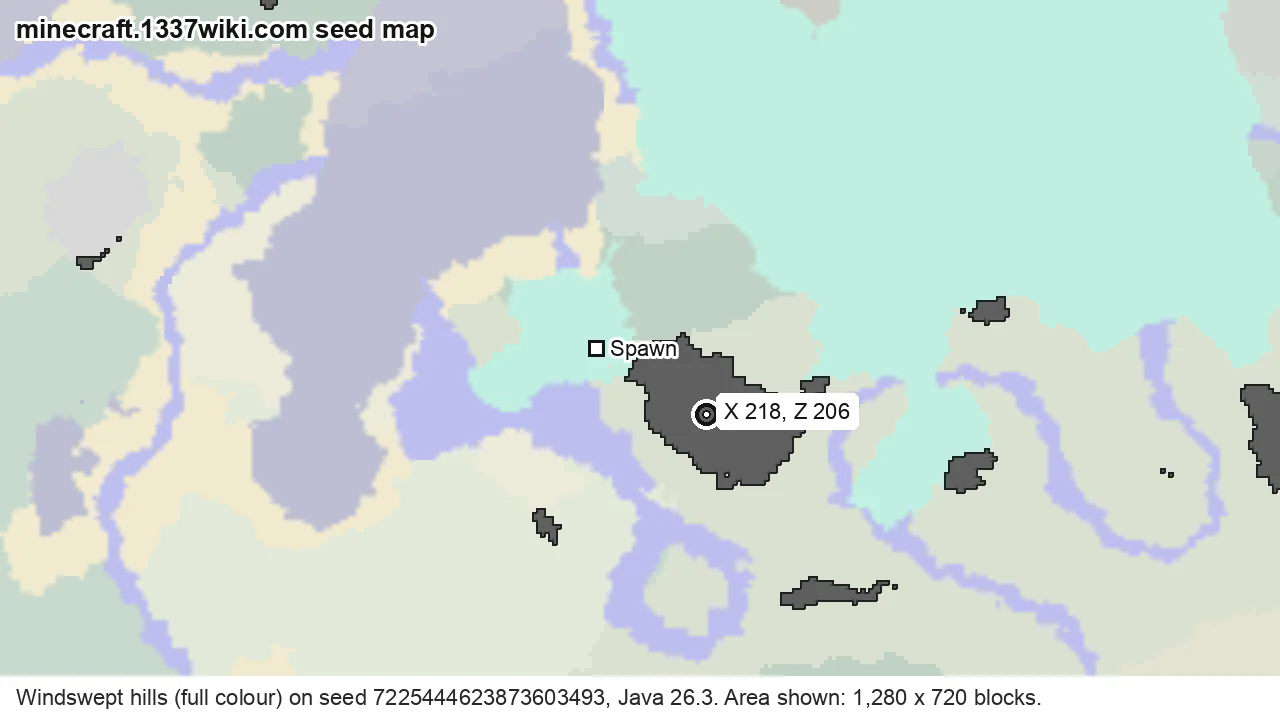
These three Java 26.3 seeds have windswept hills a short walk from spawn. Each coordinate is inside the biome, checked at block level.
| Seed | Windswept hills at | From spawn | Map |
|---|---|---|---|
7225444623873603493 |
X 218, Z 206 | 128 blocks | Open on the map |
-8687070917831850527 |
X -62, Z -158 | 119 blocks | Open on the map |
-723594680167601325 |
X -558, Z -298 | 123 blocks | Open on the map |
With cheats on, /locate biome minecraft:windswept_hills finds the nearest one; without them, paste your seed into the biome finder. These are Java seeds; on Bedrock the same number gives a different world.
Is windswept hills a cold biome?
Partly. Its temperature is 0.2, which is cool but above freezing, so at normal heights it rains here. Temperature drops as you climb, and on the highest hilltops (above roughly Y 120) it snows instead and snow settles on the ground. For farm animals the game counts it as a cold biome: since Java 1.21.5, pigs, cows and chickens that spawn here are the cold variants, and sheep are most often black.
Is windswept hills a mountain biome?
Not anymore. Before Java 1.18 this biome was Extreme Hills (called Mountains from 1.13), and it was the game’s mountain biome. Caves & Cliffs: Part II added separate, much taller mountain biomes: meadows, groves, snowy slopes and the jagged, frozen and stony peaks. Windswept hills became one of three “windswept” hill biomes, and goats, which live on the new mountains, don’t spawn here.
What you find in windswept hills
Llamas and other mobs
Llamas spawn in herds of four to six, along with sheep, pigs, cows and chickens. Tame a llama by mounting it repeatedly until hearts appear, then put a chest on it for extra storage; lead one with a lead and others nearby follow in a caravan. At night the standard hostile mobs spawn, and steep drops make skeleton knockback more dangerous than usual.
Emeralds and infested stone
Emerald ore generates only in the mountain biomes and the windswept hills family, so the stone under these hills is one of the few places to mine it. Watch for infested stone while you dig: it looks like normal stone, but a silverfish pops out when you break it. Hit one and others in nearby infested blocks join in.
Trees and plants
Trees are scattered oaks and spruces, enough for a start but not for a big build. Grass is sparse, with flowers, mushrooms, pumpkins and, since 1.21.5, small patches of bushes and fallen logs.
Windswept hills vs the other windswept biomes
| Feature | Windswept hills | Windswept forest | Windswept gravelly hills |
|---|---|---|---|
| Trees | A few oaks and spruces | Many oaks and spruces | A few oaks and spruces |
| Ground | Grass and stone | Grass and stone | Gravel, grass and stone |
| Abandoned camps (26.3) | No | Yes | No |
| How common (our sample) | 0.23% of the surface | 0.17% | 0.08% |
| Median distance from spawn (our sample) | 1,419 blocks | 1,762 blocks | 2,371 blocks |
| Mobs, ores, climate | Same: llamas and farm animals, emerald ore and infested stone, temperature 0.2 | ||
In our sample of 300 Java 26.3 seeds, windswept hills was the most common of the three and the closest to spawn.
What changed in 2025-26
The 2026 drops added nothing specific to windswept hills. In Spring to Life (Java 1.21.5, March 2025), pigs, cows and chickens that spawn here became the cold variants (cold chickens lay blue eggs), and babies bred by players take a parent’s variant instead. Sheep spawn with cold-biome wool colors, so black is the most common. Bushes, a new decorative plant, generate in small patches, and fallen oak and spruce trees appear on the ground, some covered in mushrooms or vines.
Source: the official 1.21.5 release notes.
How we measured
The numbers on this page come from our own seed map engine, running Java Edition 26.3 world generation. We generated 300 random seeds and sampled every 16th block across a 10,240 by 10,240 block square centered on each world’s spawn. “How common” is the biome’s share of those samples; “distance from spawn” is how far the nearest sample of the biome was. The seeds above were picked from the same run, and each coordinate was re-checked at block level.