Updated for Java Edition 26.3 (October 2026).
The swamp is a flat, waterlogged Overworld biome of murky green water, vine-covered oak trees, lily pads and blue orchids. It is the only biome with witch huts and one of two where slimes spawn on the surface. In our sample of 300 Java 26.3 seeds, every world had one, at a median of 1,717 blocks from spawn.
| Dimension | Overworld |
|---|---|
| Where it generates | Low, wet ground at sea level, mostly between forests, plains and the coast |
| How common | 0.99% of the surface in our sample (about 1 block in 100) |
| Distance from spawn | Median 1,717 blocks; within 1,000 blocks in 28% of seeds, within 2,000 in 58% (our sample) |
| Mobs | Frogs, sheep, pigs, chickens, cows; at night slimes, witches, bogged and the usual hostile mobs |
| Notable blocks | Blue orchids, lily pads, vines, clay, mushrooms, firefly bushes |
| Structures | Swamp huts (witch huts), abandoned camps (26.3), swamp-style ruined portals, buried fossils |
| Climate | Temperature 0.8, downfall 0.9 |
| Biome ID | minecraft:swamp (called swampland before Java 1.13) |
How to find a swamp
Swamps sit on flat ground at about sea level, so look low down rather than on hills. In our sample, 19% of a swamp’s edge touched forest, 18% plains, 14% beach, 9% river and 7% taiga. Walk through temperate forest and plains toward the coast and watch for the colour change: swamp grass and leaves are a dull olive green, and the water turns a murky grey-green.
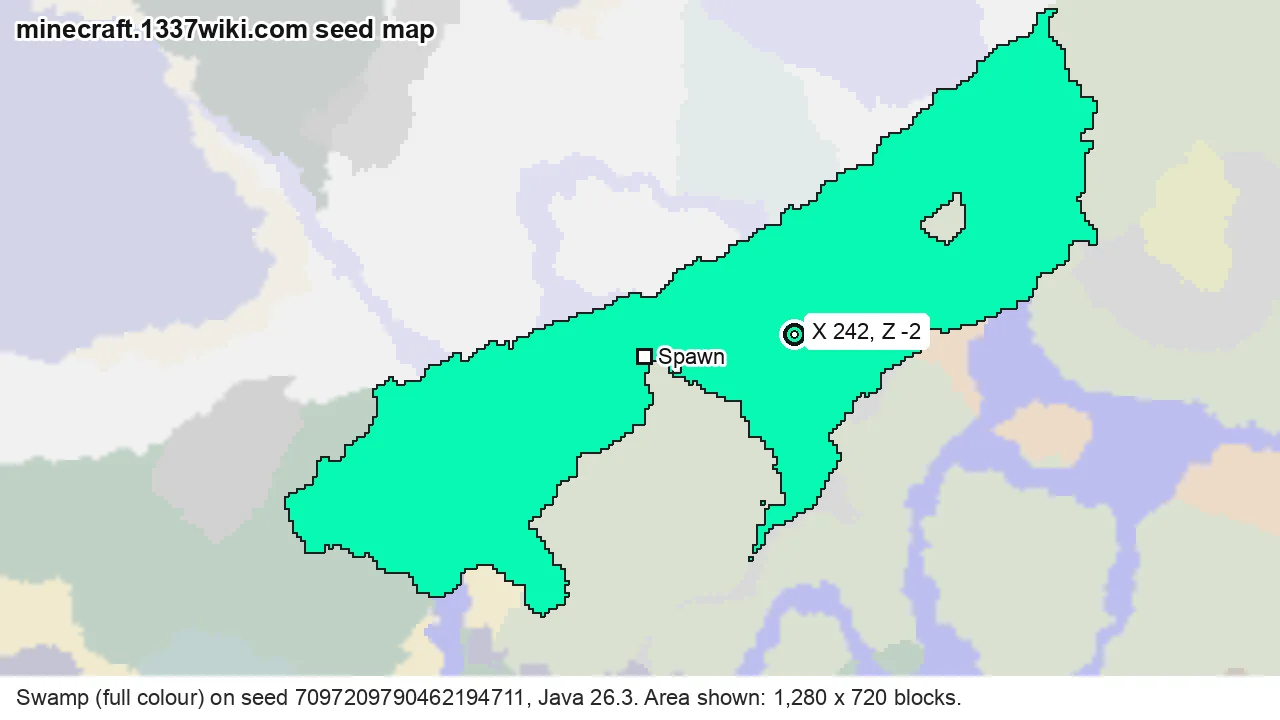
These three Java 26.3 seeds put a swamp close to world spawn. Each coordinate is inside the swamp, checked at block level.
| Seed | Swamp at | From spawn | Map |
|---|---|---|---|
7097209790462194711 |
X 242, Z -2 | 152 blocks | Open on the map |
7225444623873603493 |
X 94, Z 126 | 20 blocks | Open on the map |
-8926710580088322198 |
X 446, Z 302 | 462 blocks | Open on the map |
Already in a world? Type /locate biome minecraft:swamp (cheats on) for the nearest one, or paste your seed into the biome finder to see every swamp around spawn. These are Java seeds; the same number on Bedrock gives a different world.
Do slimes spawn in swamps?
Yes, and on the surface, which is the easy way to get slimeballs early. Swamps and mangrove swamps are the only biomes where slimes spawn above ground outside slime chunks. In Java they spawn between Y 51 and Y 69 in light level 7 or lower, and how many you get depends on the moon: most at full moon, none at new moon. Light the area you don’t want them in, and wait on a dark patch of swamp on a full-moon night. Underground, slimes still use slime chunks as everywhere else.
Frogs give you a second route. A frog eats small slimes and each one drops a slimeball.
Witch huts: only in swamps
Witch huts, also called swamp huts, generate only in the swamp biome. They do not generate in mangrove swamps. Each hut stands on stilts over the water, contains a cauldron, and generates with a witch and a black cat. Witches keep spawning inside the hut’s area at night, which is why huts are the usual base for a witch farm (redstone, glowstone dust, sugar, gunpowder and glass bottles).
Witches can also spawn anywhere in a swamp at night, the same as in most Overworld biomes; the hut just concentrates them.
What else spawns in a swamp
Frogs are the swamp’s own animal. Their colour depends on the biome where a tadpole grows up: swamps are temperate, so frogs that grow here are orange, while the warm mangrove swamp gives white frogs and cold biomes give green ones. Sheep, pigs, chickens and cows spawn as in other grassy biomes.
At night, the bogged replaces some of the skeletons. It is a mossy skeleton that shoots poison arrows, and it spawns in swamps and mangrove swamps. Zombies, spiders, creepers, endermen and witches round out the list. Drowned do not spawn in swamp water; they belong to rivers and oceans.
Blocks worth collecting
Blue orchids grow naturally only in swamps and give light blue dye. Lily pads cover the water and make a path you can walk on. Clay sits in the shallow pools, mushrooms grow more often than in most biomes, and the oak trees, which can grow right in the water, are hung with vines you can climb. Since Java 1.21.5, firefly bushes grow here, mostly next to water; they glow faintly and give off firefly particles at night. Dig down and you may also hit a fossil, a skeleton made of bone blocks.
Swamp vs mangrove swamp
The mangrove swamp is a separate, warmer biome with its own trees and mud. Here is how the two compare.
| Feature | Swamp | Mangrove swamp |
|---|---|---|
| How common (our sample) | 0.99% of the surface | 0.5% of the surface |
| Median distance from spawn (our sample) | 1,717 blocks | 2,384 blocks |
| Usual neighbours (our sample) | Forest, plains, beach | Savanna, desert, beach |
| Witch huts | Yes | No |
| Surface slimes, witches, bogged | Both | |
| Frog colour | Orange (temperate) | White (warm) |
| Other animals | Sheep, pigs, chickens, cows | None besides frogs; tropical fish in the water |
| Trees and ground | Oak with vines, grass, clay | Mangroves with roots, mud |
| Blue orchids | Yes | No |
What changed in 2025-26
In Wilderness Bound (Java 26.3, September 2026), abandoned camps can generate in swamps with their own swamp design, and camp chests can hold a map to a swamp abandoned camp. The old Swamp Hut Explorer Map is now its own item, the Swamp Hut Map.
In Spring to Life (Java 1.21.5, March 2025), firefly bushes were added and generate next to water in swamps. They give off light level 2 and play ambient sounds at night.
Source: the official 26.3 and 1.21.5 release notes.
How we measured
The numbers on this page come from our own seed map engine, running Java Edition 26.3 world generation. We generated 300 random seeds and sampled every 16th block across a 10,240 by 10,240 block square centered on each world’s spawn. “How common” is the swamp’s share of those samples; “distance from spawn” is how far the nearest swamp sample was. The seeds above were picked from the same run, and each coordinate was re-checked at block level.