Updated for Java Edition 26.3 (October 2026).
The old growth spruce taiga is a cold Overworld forest of giant 2×2 spruce trees with leaves from top to bottom, over a floor of podzol, coarse dirt and mossy cobblestone boulders. It used to be called the Mega Spruce Taiga, then the Giant Spruce Taiga. Come for huge spruce logs, sweet berries and chestnut wolves.
| Dimension | Overworld |
|---|---|
| Where it generates | Cold, wet lowland forest, usually bordering rivers and regular taiga |
| How common | 0.60% of the surface in our sample (about 1 block in 170) |
| Distance from spawn | Median 1,294 blocks; within 1,000 blocks in 40% of seeds, within 2,000 in 77% (our sample) |
| Mobs | Wolves (the chestnut variant), foxes, rabbits and farm animals, plus the usual hostile mobs at night |
| Notable blocks | Podzol, coarse dirt, mossy cobblestone boulders, ferns and large ferns, sweet berry bushes, mushrooms |
| Structures | Trail ruins, ruined portals, abandoned camps (26.3) |
| Climate | Temperature 0.25, downfall 0.8 |
| Biome ID | minecraft:old_growth_spruce_taiga |
| Added in | Java Edition 1.7 as Mega Spruce Taiga; renamed Giant Spruce Taiga in 1.13 and Old Growth Spruce Taiga in 1.18 |
Old growth spruce taiga vs old growth pine taiga
Look at the tops of the giant trees. In a spruce taiga they are leafy cones all the way down; in a pine taiga they are tall bare trunks with a small tuft of leaves at the top. The wolves differ too. Almost everything else is shared.
| Feature | Old growth spruce taiga | Old growth pine taiga |
|---|---|---|
| Giant trees | Leaves all the way down in a full cone | Bare trunks with a small tuft of leaves at the top (pine shape) |
| Wolf variant | Chestnut wolf | Black wolf |
| Temperature | 0.25 | 0.3 |
| How common (our sample) | 0.60% of the surface | 0.61% of the surface |
| Median distance from spawn (our sample) | 1,294 blocks | 1,276 blocks |
| Ground | Same: podzol, coarse dirt, mossy cobblestone boulders, ferns | |
Neither one is rarer. In our sample of 300 Java 26.3 seeds they cover almost the same share of the world and sit about the same distance from spawn, so which one you meet first is down to your seed. If you want a chestnut wolf, it has to be the spruce version.
Searching for “giant spruce taiga hills”? That biome was removed in Java 1.18, when hills variants were merged into their parent biomes. Hilly old growth spruce forest is now just old growth spruce taiga.
How to find an old growth spruce taiga
Rivers are the best lead. In our sample, the biome’s edge touched a river 40% of the time and regular taiga 30%. It reaches the coast too: beach 8% and cold ocean 5%, with dark forest at 5%. Follow a river through ordinary taiga and watch for the trees doubling in width, with orange-brown podzol underneath.
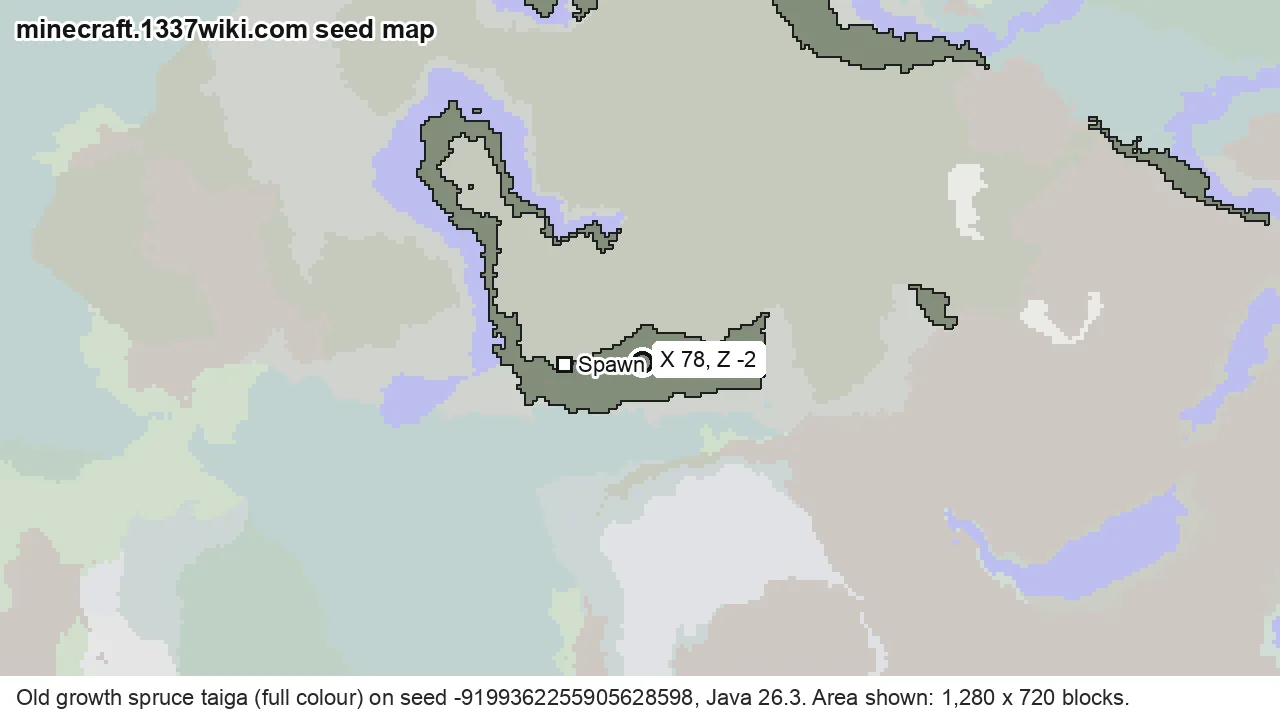
These three Java 26.3 seeds start you in or right next to one. Each coordinate is inside the biome, checked at block level.
| Seed | Spruce taiga at | From spawn | Map |
|---|---|---|---|
-9199362255905628598 |
X 78, Z -2 | 78 blocks | Open on the map |
-2296547651928940686 |
X 454, Z 130 | 63 blocks | Open on the map |
6344123284989658485 |
X -250, Z 86 | 264 blocks | Open on the map |
Locate command
With cheats on, type /locate biome minecraft:old_growth_spruce_taiga and the game prints the coordinates of the nearest one; clicking them fills in a teleport command. Without cheats, paste your seed into the biome finder to see every old growth spruce taiga around spawn. The seeds above are Java seeds; the same number on Bedrock gives a different world.
What the biome is good for
Spruce wood
A giant spruce has a 2×2 trunk, so every block of height gives four logs. Plant four spruce saplings in a square and bone meal them, and they grow into a giant tree of their own: either the full-cone spruce or the bare pine shape, at random. That makes a small spruce farm here very productive.
Podzol, mushrooms and berries
Podzol is the orange-brown soil under the big trees. Mushrooms can be planted on it at any light level, and grass never spreads over it. Mine it with Silk Touch to keep it; otherwise it drops dirt. Brown and red mushrooms grow wild on the forest floor, and sweet berry bushes give you an early food source. Walking through a grown berry bush hurts, so pick the berries instead of pushing through.
Chestnut wolves and foxes
Wolves spawn here in packs, and in this biome they are the chestnut variant. Tame one with bones and it keeps its coat. Foxes spawn here as well; they hunt chickens and rabbits and sometimes carry an item in their mouth.
Trail ruins and camps
Trail ruins can generate here. They are mostly buried, so look for a few terracotta or brick blocks in the ground and bring a brush for the suspicious gravel. Since Java 26.3, abandoned camps generate here too, with their own spruce taiga design.
What changed in 2025-26
In Wilderness Bound (Java 26.3, September 2026), abandoned camps can generate in old growth spruce taigas, with a design for this biome. Spruce leaves no longer drop falling-leaf particles (they gained them in 1.21.5).
In Spring to Life (Java 1.21.5, March 2025), pigs, cows and chickens that spawn here are the cold variants, and cold chickens lay blue eggs. Sheep spawn with cold-biome wool colors, so black is the most common. Fallen spruce trees now generate on the forest floor, some covered in mushrooms or vines.
Source: the official 26.3 and 1.21.5 release notes.
Java vs Bedrock
On Bedrock, since version 1.21.100, every trunk block of a giant spruce sits on podzol and the podzol patches around these trees are larger (Bedrock 1.21.100 changelog). The seeds and statistics on this page are for Java Edition only.
How we measured
The numbers on this page come from our own seed map engine, running Java Edition 26.3 world generation. We generated 300 random seeds and sampled every 16th block across a 10,240 by 10,240 block square centered on each world’s spawn. “How common” is the biome’s share of those samples; “distance from spawn” is how far the nearest sample of the biome was. The seeds above were picked from the same run, and each coordinate was re-checked at block level.