Updated for Java Edition 26.3 (October 2026).
Sunflower plains are a plains variant covered in fields of tall sunflowers, the only place they grow naturally. Otherwise they play like plains: flat grass, few trees, horses and donkeys. In our sample of 300 Java 26.3 seeds, 46% of worlds had one within 1,000 blocks of spawn. Come for yellow dye, horses and flat building ground.
| Dimension | Overworld |
|---|---|
| Where it generates | Flat temperate lowland, usually along rivers or inside regular plains |
| How common | 0.66% of the surface in our sample (about 1 block in 150) |
| Distance from spawn | Median 1,089 blocks; within 1,000 blocks in 46% of seeds, within 2,000 in 87% (our sample) |
| Mobs | Horses, donkeys, sheep, pigs, cows and chickens, plus the usual hostile mobs at night |
| Notable blocks | Sunflowers, tall grass, plains flowers, lone oak trees (some with bee nests), fallen oak trees |
| Structures | Ruined portals; no villages or pillager outposts |
| Climate | Temperature 0.8, downfall 0.4 (same as plains) |
| Biome ID | minecraft:sunflower_plains |
| Added in | Java Edition 1.7 (2013) |
How rare are sunflower plains?
Uncommon, but rarely far away. In our sample of 300 Java 26.3 seeds, sunflower plains covered 0.66% of the surface, about one fifteenth as much as regular plains (10%). All 300 seeds had some within 5,000 blocks of spawn, and the median distance to the nearest one was 1,089 blocks. That makes them about as common as a flower forest (0.64% in the same sample), while a meadow was usually closer to spawn (median 786 blocks).
Sunflower plains vs plains
Apart from the sunflowers, the two biomes share almost everything. The one difference that matters in survival is structures:
| Feature | Sunflower plains | Plains |
|---|---|---|
| Sunflowers | Large patches | None |
| Villages and pillager outposts | No | Yes |
| Bushes (since 1.21.5) | No | Small patches |
| Animals | Same: horses, donkeys, sheep, pigs, cows, chickens | |
| Trees | Same: a few lone oaks, some with bee nests | |
| How common (our sample) | 0.66% of the surface | 10% of the surface |
| Median distance from spawn (our sample) | 1,089 blocks | 184 blocks |
Can villages spawn in sunflower plains?
Not on Java Edition. Plains villages generate in plains and meadows, but not in sunflower plains, and the same goes for pillager outposts. You will still often find a village right beside the sunflowers, because regular plains made up 27% of the sunflower plains’ border in our sample. To find one, paste your seed into the village finder.
How to find sunflower plains
In our sample, the sunflower plains’ edge touched a river 37% of the time, plains 27%, cherry grove 6% and beach 6%. Follow a river through open plains and watch for the yellow: sunflowers are two blocks tall and show up from a long way off. If you have found a cherry grove, check the low ground around it; 16% of the cherry grove’s border touched sunflower plains in our sample.
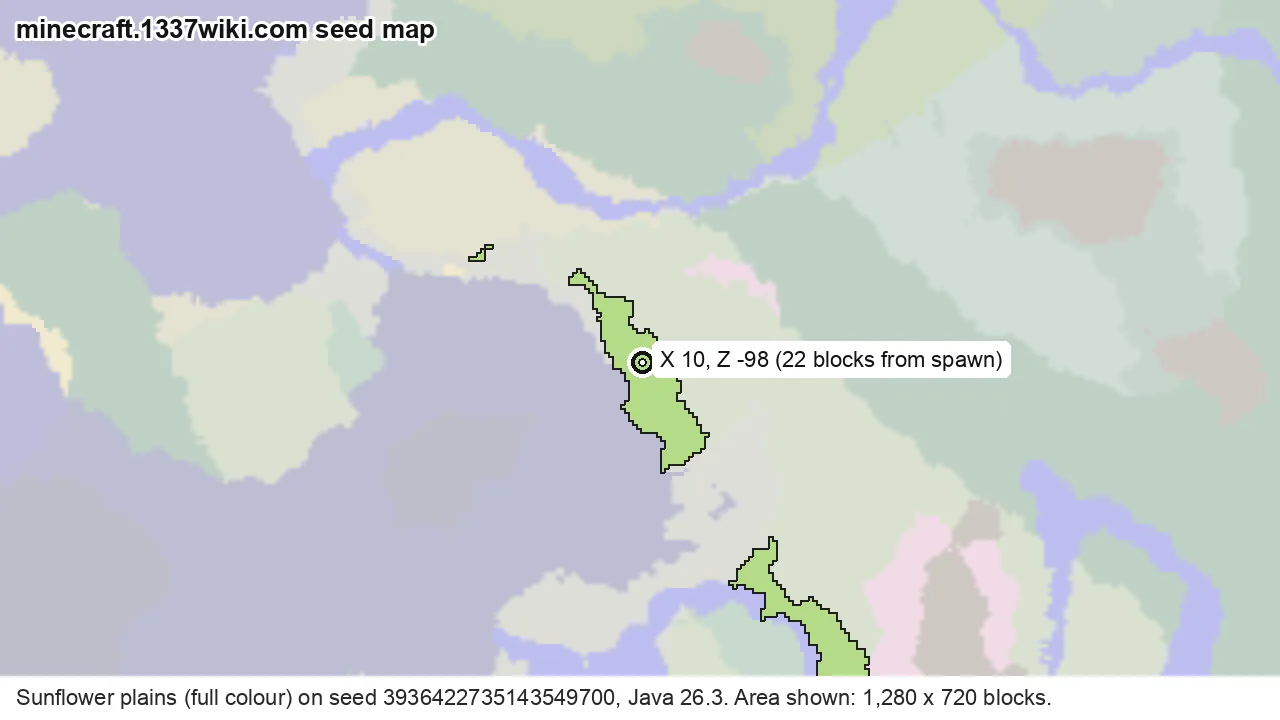
These three Java 26.3 seeds start you in or next to sunflower plains. Each coordinate is inside the biome, checked at block level.
| Seed | Sunflower plains at | From spawn | Map |
|---|---|---|---|
3936422735143549700 |
X 10, Z -98 | 22 blocks | Open on the map |
6519463351830817657 |
X 122, Z -326 | 27 blocks | Open on the map |
-9021310916434596495 |
X 238, Z -26 | 224 blocks | Open on the map |
In a world you already have, /locate biome minecraft:sunflower_plains finds the nearest one (cheats on), or paste your seed into the biome finder. These are Java seeds; Bedrock worlds from the same number are different.
What sunflower plains are good for
Sunflowers and yellow dye
This is the only biome where sunflowers generate. Break one for a sunflower item and craft it into two yellow dye. You never need to come back for more: use bone meal on a sunflower and it drops a copy, so a single plant is a renewable dye source. The flower heads always face east, which works as a compass when you have lost your bearings.
Horses and donkeys
Horses spawn in herds of two to six and donkeys in groups of one to three. Tame either one by riding it with an empty hand until it stops throwing you off, then put a saddle on it to steer. A donkey with a chest gives you 15 extra slots, and breeding a horse with a donkey gives you a mule, which can carry a chest too.
Bees
Trees are rare here, just a lone oak now and then, but about one in 20 of them carries a bee nest. Put a campfire under the nest before you harvest it so the bees stay calm.
Building
Flat grass with almost no trees is the easiest ground in the game to build or farm on. The sunflowers break with one hit, so clearing a plot takes seconds.
What changed in 2025-26
In Spring to Life (Java 1.21.5, March 2025), fallen oak trees started generating in sunflower plains, some covered in mushrooms or vines. Wilderness Bound (Java 26.3, September 2026) did not change this biome.
Source: the official 1.21.5 release notes.
How we measured
The numbers on this page come from our own seed map engine, running Java Edition 26.3 world generation. We generated 300 random seeds and sampled every 16th block across a 10,240 by 10,240 block square centered on each world’s spawn. “How common” is the biome’s share of those samples; “distance from spawn” is how far the nearest sample of the biome was. The seeds above were picked from the same run, and each coordinate was re-checked at block level.