Updated for Java Edition 26.3 (October 2026).
A sparse jungle is a warm, open jungle biome: scattered small jungle trees, oaks and leafy bushes over grass, with no giant trees and no bamboo. It is not rare. In our sample of 300 Java 26.3 seeds, about half had one within 1,000 blocks of spawn. Come for easy jungle wood, cocoa beans and rusty wolves.
| Dimension | Overworld |
|---|---|
| Where it generates | Warm, humid lowland, usually along rivers and on the edge of plains or bamboo jungle |
| How common | 1.4% of the surface in our sample (about 1 block in 70) |
| Distance from spawn | Median 1,049 blocks; within 1,000 blocks in 49% of seeds, within 2,000 in 82% (our sample) |
| Mobs | Wolves (the rusty variant), sheep, pigs, cows and chickens, plus the usual hostile mobs at night |
| Notable blocks | Small jungle trees with cocoa pods and vines, oak trees, jungle bushes, occasional melons, fallen jungle trees |
| Structures | Abandoned camps (26.3), ruined portals; no jungle temples |
| Climate | Temperature 0.95, downfall 0.8 |
| Biome ID | minecraft:sparse_jungle |
| Added in | Java Edition 1.7 as Jungle Edge; renamed Sparse Jungle in 1.18 |
Is a sparse jungle rare?
No. In our sample of 300 Java 26.3 seeds, sparse jungle covered 1.4% of the surface and turned up in every one of the 300 worlds. The nearest one was a median 1,049 blocks from spawn, and 99.7% of seeds had one within 5,000 blocks. That puts it a little behind the regular jungle (1.9% of the surface in the same sample) and well ahead of the bamboo jungle (0.6%). The only catch is climate: it generates in warm, humid parts of the world, so head away from snow and spruce forests.
Sparse jungle vs jungle
The two share a climate and most of their blocks, but the sparse jungle has far fewer trees, and that changes which mobs and structures you get:
| Feature | Sparse jungle | Jungle |
|---|---|---|
| Trees | Scattered small jungle trees, oaks and jungle bushes | Dense canopy with giant 2×2 jungle trees |
| Bamboo | None | Scattered patches |
| Parrots, ocelots, pandas | Don’t spawn | Parrots and ocelots spawn; pandas rarely |
| Wolves | Rusty wolf packs | None |
| Melons | Rare patches | Common |
| Jungle temples, trail ruins | No | Yes |
| How common (our sample) | 1.4% of the surface | 1.9% of the surface |
| Median distance from spawn (our sample) | 1,049 blocks | 1,021 blocks |
Does a sparse jungle have bamboo?
No. Bamboo doesn’t generate in sparse jungles at all; it grows in small patches in regular jungles and covers the ground in bamboo jungles. The good news is that bamboo jungles are often next door. In our sample, 11% of the sparse jungle’s border touched a bamboo jungle, and 28% of the bamboo jungle’s border touched a sparse jungle, so walk along the edge and look for the tall green stalks.
Does a sparse jungle have parrots?
Not on Java Edition. Parrots, ocelots and pandas spawn in jungles and bamboo jungles, but none of them spawn naturally in a sparse jungle. If you see one, it wandered in from a neighbouring jungle.
How to find a sparse jungle
In our sample, the sparse jungle’s edge touched a river 34% of the time, plains 22%, bamboo jungle 11% and forest 7%. So the quickest way on foot is to follow a river through warm country and watch for the point where plains or forest give way to short jungle trees with vines. Unlike a regular jungle, it often sits right against open plains, which makes it easy to spot from a distance.
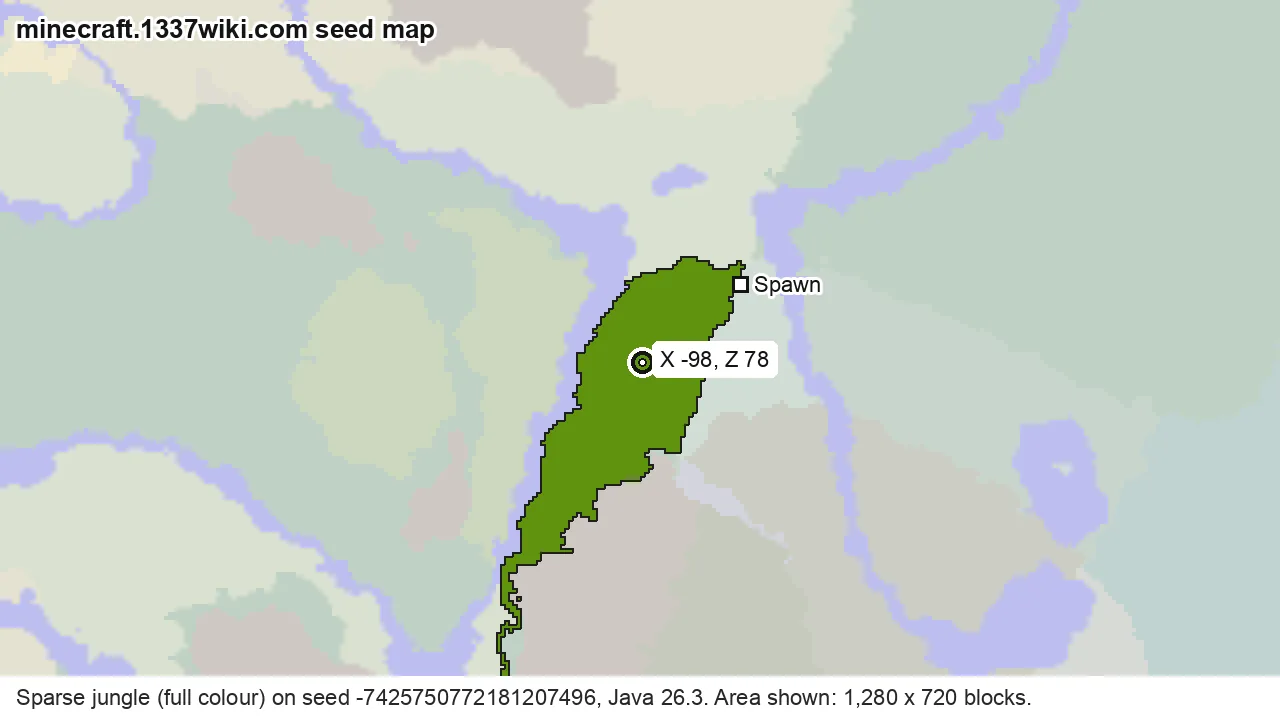
These three Java 26.3 seeds put a sparse jungle a short walk from spawn. Each coordinate is inside the biome, checked at block level.
| Seed | Sparse jungle at | From spawn | Map |
|---|---|---|---|
-7425750772181207496 |
X -98, Z 78 | 125 blocks | Open on the map |
-3322950757251350999 |
X 118, Z 30 | 26 blocks | Open on the map |
4436417733091714673 |
X -34, Z 22 | 40 blocks | Open on the map |
In a world you already have, /locate biome minecraft:sparse_jungle finds the nearest one (cheats on), or paste your seed into the biome finder to see every sparse jungle around spawn. These are Java seeds; the same number on Bedrock gives a different world.
What a sparse jungle is good for
Jungle wood and cocoa
The trees are short and far apart, so you can cut jungle logs without climbing through a canopy. Some of the small jungle trees carry cocoa pods on their trunks. Take a few: cocoa beans planted on the side of a jungle log grow into new pods, which gives you brown dye and cookies for the rest of the game. If you want giant trees back at base, plant four jungle saplings in a 2×2 square.
Melons
Melons do generate here, but in far fewer patches than in a regular jungle, so treat one as a lucky find. Break a melon for slices, then craft a slice into seeds to start a farm.
Rusty wolves
Wolves spawn here in packs of two to four, and in this biome they are the rusty variant, which you won’t find anywhere else. Tame one with bones. A tamed wolf keeps its variant, so a rusty wolf stays rusty.
Abandoned camps
Since Java 26.3, abandoned camps can generate in sparse jungles, built in a design for this biome, with chests and barrels of loot.
What changed in 2025-26
In Wilderness Bound (Java 26.3, September 2026), abandoned camps can generate in sparse jungles, with their own sparse jungle design.
In Spring to Life (Java 1.21.5, March 2025), pigs, cows and chickens that spawn here are the warm variants, and warm chickens lay brown eggs. Babies bred by players take a parent’s variant instead. Sheep spawn with warm-biome wool colors, so brown is the most common. Fallen jungle trees now generate on the ground, some covered in mushrooms or vines.
Source: the official 26.3 and 1.21.5 release notes.
How we measured
The numbers on this page come from our own seed map engine, running Java Edition 26.3 world generation. We generated 300 random seeds and sampled every 16th block across a 10,240 by 10,240 block square centered on each world’s spawn. “How common” is the biome’s share of those samples; “distance from spawn” is how far the nearest sample of the biome was. The seeds above were picked from the same run, and each coordinate was re-checked at block level.