Updated for Java Edition 26.3 (October 2026).
The warped forest is a teal Nether forest of huge warped fungi growing out of warped nylium. Only endermen and striders spawn here, which makes it the calmest place to build in the Nether. It is the rarest Nether biome in our sample, yet the median distance from the Nether’s 0,0 to the nearest one was just 186 blocks.
| Dimension | Nether |
|---|---|
| Where it generates | Anywhere in the Nether, mostly bordering nether wastes and crimson forests |
| How common | 8% of the Nether in our sample (nether wastes 36%, crimson forest 22%, soul sand valley 17%, basalt deltas 16%) |
| Distance from 0,0 | Median 186 blocks from the Nether’s 0,0; within 1,000 blocks in all 300 seeds (our sample) |
| Mobs | Endermen, and striders on lava |
| Notable blocks | Warped nylium, huge warped fungi (warped stems, warped wart blocks, shroomlights), twisting vines, warped roots, nether sprouts |
| Structures | Bastion remnants, Nether fortresses, ruined portals |
| Biome ID | minecraft:warped_forest |
| Added in | Java Edition 1.16 (Nether Update, 2020) |
What mobs spawn in a warped forest?
Two: endermen on the ground and striders on the lava. Nothing else spawns here naturally, so there are no ghasts, hoglins, piglins or zombified piglins to deal with. That is why players pick it for a Nether base or a stop on a Nether highway.
Why do endermen spawn in warped forests?
Endermen are the only hostile mob on the warped forest’s spawn list, so every hostile spawn here is an enderman. They still need a spot three blocks tall to appear. Endermen also spawn in the nether wastes and soul sand valley, but in those biomes they share the space with other mobs.
That makes the warped forest the best Nether biome for ender pearls. Two tips keep it safe. Wear a carved pumpkin on your head and endermen won’t get angry when you look at them. Or stand under a ceiling two blocks high: you fit, a three-block-tall enderman doesn’t, and you can hit it while it can’t reach you. A sword with Looting raises the pearl drop.
Do piglins spawn in warped forests?
No. Piglins don’t spawn in the warped forest, and neither do hoglins (they avoid warped fungus anyway). You can still meet piglins here in two ways: they wander in from a nearby crimson forest or nether wastes, or a bastion remnant generated inside the warped forest comes with its own piglins.
What Y level is the warped forest?
Any. In Java, a Nether biome isn’t a layer: the biome at a given X and Z runs from the bottom of the Nether up to the ceiling. When we checked a warped forest with our seed map engine at Y 5, 32, 64, 100 and 120, its edges moved by three blocks at most. So find one on the map by X and Z, and it will be there at whatever height you dig in.
Warped forest blocks and wood
Huge warped fungi are the Nether’s trees. Their stems give warped stems, hyphae and planks, and Nether wood never burns, so it is the safest wood for anything near lava. The caps are warped wart blocks, and the glowing blocks inside them are shroomlights, a full-brightness light you can’t craft.
There is no warped sapling. The warped fungus is the sapling: plant it on warped nylium and use bone meal, and it grows into a huge warped fungus. Using bone meal on warped nylium itself sprouts warped roots, fungi and nether sprouts around it. Nylium needs Silk Touch to pick up; without it, it drops netherrack.
Twisting vines grow upward from the ground, the opposite of the crimson forest’s weeping vines, and you can climb them like a ladder. Warped fungus has two more uses: hoglins stay away from it, and on a fishing rod it makes a warped fungus on a stick, which steers a saddled strider across lava. You will also see the odd crimson root and crimson fungus mixed into the undergrowth.
How to find a warped forest
Step through a portal near Overworld spawn and one is often close. In our sample of 300 Java 26.3 seeds, the median distance from the Nether’s 0,0 to the nearest warped forest was 186 blocks, a quarter of seeds had one within 91 blocks, and every seed had one within 1,000.
Its edges touched nether wastes 61% of the time, a crimson forest 22% and basalt deltas 17%. In our sample it never bordered a soul sand valley directly, so if you are in a valley, cross the nether wastes first. Look for teal ground and blue-green fungi.
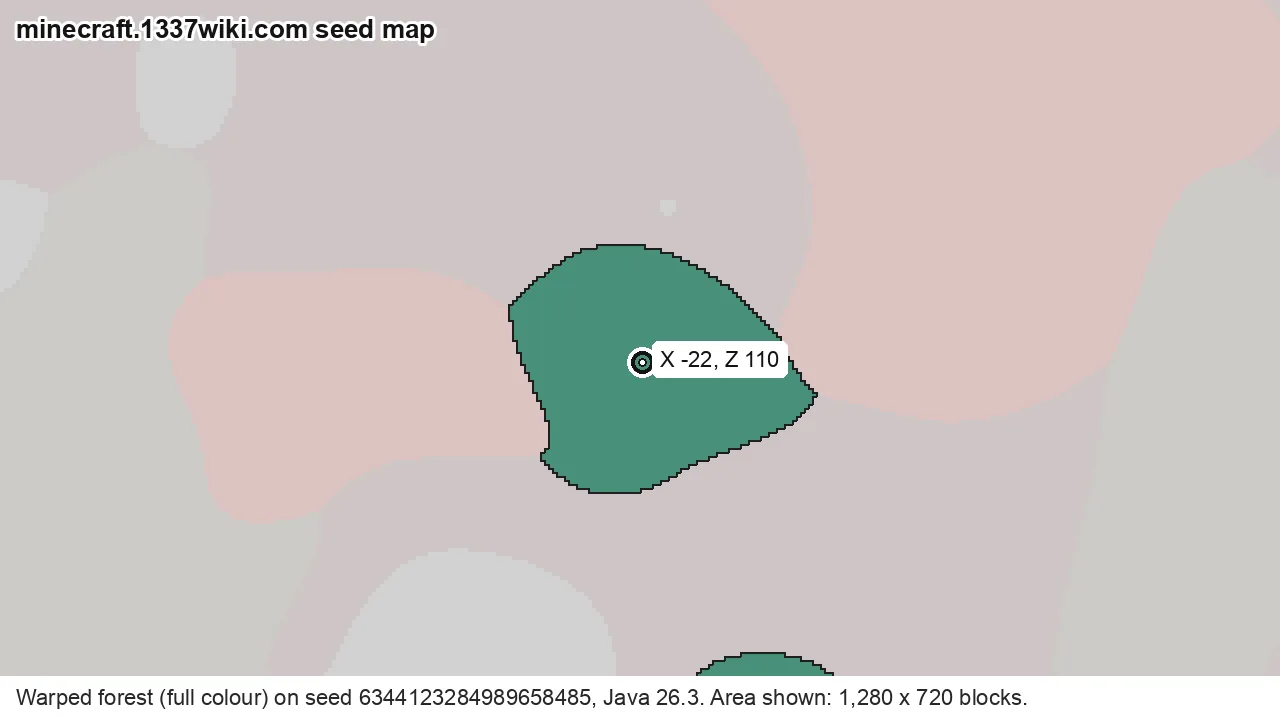
These Java 26.3 seeds have a warped forest right at the Nether’s center. Coordinates are Nether coordinates, checked at block level.
| Seed | Warped forest at (Nether) | From 0,0 | Map |
|---|---|---|---|
6344123284989658485 |
X -22, Z 110 | 112 blocks | Open on the map |
-6828404885034942496 |
X -6, Z -42 | 42 blocks | Open on the map |
1563540211394508697 |
X 10, Z -94 | 95 blocks | Open on the map |
With cheats on, /locate biome minecraft:warped_forest run in the Nether gives the nearest one. You can also paste your seed into the biome finder. One block in the Nether is eight in the Overworld, so a warped forest 100 blocks from the Nether’s 0,0 lines up with a spot about 800 blocks from the Overworld’s 0,0 when you plan a portal link.
What changed in 2025-26
In Mounts of Mayhem (Java 1.21.11, December 2025), Nether fog stopped depending on your render distance setting. It now always applies from 10 to 96 blocks, whatever your settings.
In Spring to Life (Java 1.21.5, March 2025), the warped forest counts as a warm biome for the new farm animal variants, so a pig, cow or chicken spawned here (with a spawn egg, for example) comes out as the warm variant. They don’t spawn here naturally.
Source: the official 1.21.11 and 1.21.5 release notes.
Java vs Bedrock
Java warped forests mix in a few crimson roots and crimson fungi among the warped plants. Bedrock didn’t until version 1.21.130, which added them to match (Bedrock 1.21.130 changelog). The seeds and statistics on this page are for Java Edition only.
How we measured
The numbers on this page come from our own seed map engine, running Java Edition 26.3 world generation. We generated 300 random seeds and sampled every 16th block across a 10,240 by 10,240 block square of the Nether centered on 0,0, at about Y 60. “How common” is the biome’s share of those samples; “distance from 0,0” is how far the nearest sample of the biome was. The seeds above were picked from the same run, and each coordinate was re-checked at block level.