Updated for Java Edition 26.3 (October 2026).
The pale garden is a gray, moss-covered forest of pale oak trees that grows inside and along the edges of dark forests. It is the rarest Overworld surface biome in our sample of 300 Java 26.3 seeds, yet 299 of them had one. Go there for pale oak wood, eyeblossoms and the creaking.
| Dimension | Overworld |
|---|---|
| Where it generates | Inside or beside a dark forest, sometimes next to birch forest or meadow |
| How common | 0.03% of the surface in our sample (about 1 block in 3,600) |
| Distance from spawn | Median 1,775 blocks; within 1,000 blocks in 21% of seeds, within 2,000 in 56% (our sample) |
| Mobs | The creaking at night, plus the usual hostile mobs; no animals spawn here |
| Notable blocks | Pale oak trees, pale moss and moss carpet, pale hanging moss, eyeblossoms, creaking hearts |
| Structures | Woodland mansions (since 1.21.5), abandoned camps (26.3), ruined portals |
| Climate | Temperature 0.7, downfall 0.8 (rain, like a dark forest) |
| Biome ID | minecraft:pale_garden |
| Added in | Java Edition 1.21.4 (The Garden Awakens, December 2024) |
How to find a pale garden
Find a dark forest first. In our sample, 76% of a pale garden’s edge touched dark forest, 10% birch forest and 8% meadow. Dark forests are far easier to reach: in the same 300 seeds the nearest one was a median 890 blocks from spawn. Walk or fly along the dark forest and look for trees that turn gray, with white moss hanging from the leaves. From the air, a pale garden shows up as a washed-out patch in the dark green canopy.
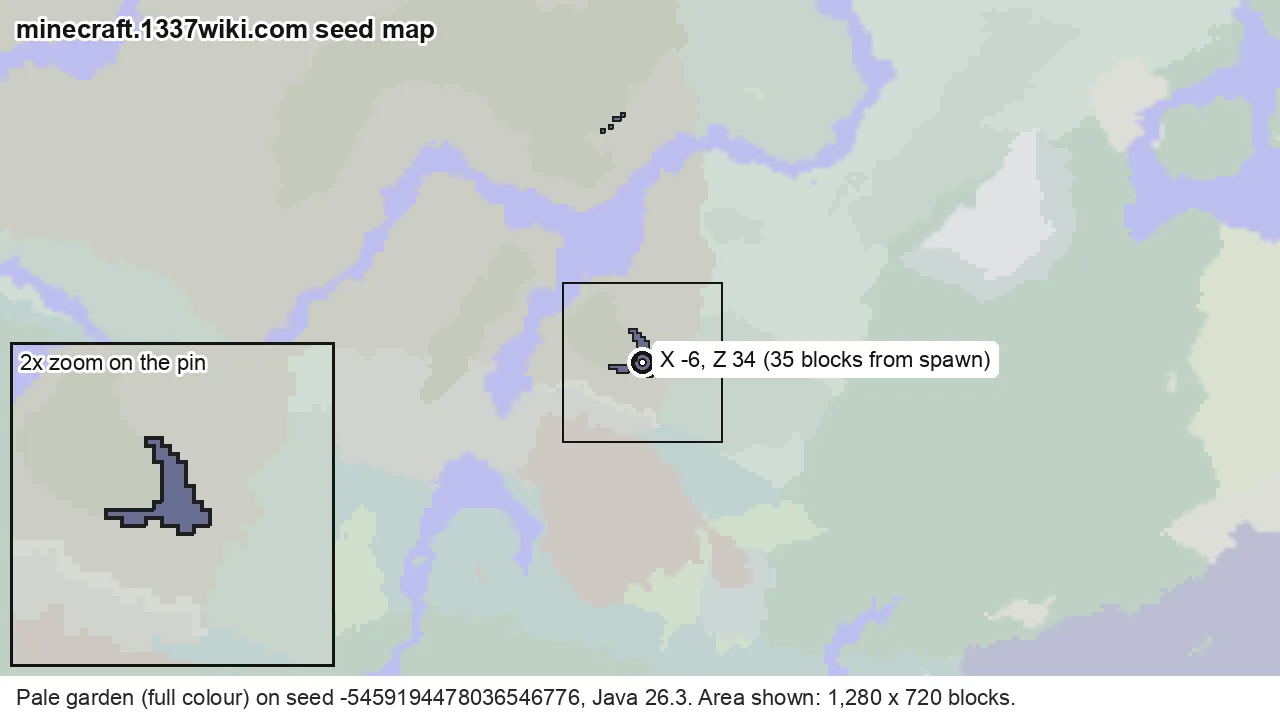
These three Java 26.3 seeds have a pale garden within 200 blocks of spawn, which is rare for this biome. Each coordinate is inside the pale garden, checked at block level.
| Seed | Pale garden at | From spawn | Map |
|---|---|---|---|
-5459194478036546776 |
X -6, Z 34 | 35 blocks | Open on the map |
2284249835534816152 |
X -78, Z 174 | 134 blocks | Open on the map |
-7425750772181207496 |
X -50, Z 194 | 200 blocks | Open on the map |
In a world you already have, /locate biome minecraft:pale_garden finds the nearest one (cheats on), or paste your seed into the biome finder to see every pale garden around spawn. These are Java seeds; the same number on Bedrock gives a different world.
The creaking, the pale garden’s mob
The creaking is the only mob unique to this biome, and it doesn’t spawn like other mobs. Creaking hearts generate inside the trunks of pale oak trees, and at night an active heart spawns a creaking nearby. Light level doesn’t matter, only the time of day, so torches won’t stop them. At sunrise the heart takes its creaking back.
A creaking only moves while nobody is looking at it, and hitting it does no damage. Each hit sends a trail of particles to its heart: follow the trail, break the heart in the trunk, and the creaking is gone. Every hit also makes the heart push 2 to 3 resin clumps onto nearby pale oak logs, so a creaking you keep hitting without breaking its heart is a resin farm. The creaking page covers the fight in detail.
Apart from creakings, the pale garden has the same night-time hostile mobs as a dark forest. What it lacks is animals: no cows, pigs, sheep or chickens spawn here, so bring food.
Pale oak wood and other blocks
Pale oak trees
Pale oaks are thick 2×2-trunk trees, similar to dark oaks. Their logs give the pale oak wood set, a near-white wood for planks, stairs, doors and the rest. Pale oak leaves drop saplings, and four saplings planted in a 2×2 square grow a new pale oak anywhere, not only in this biome. A tree you grow yourself comes out plain: no hanging moss, no moss on the ground and no creaking heart. Wandering traders can also sell pale oak saplings and logs.
Pale moss and hanging moss
Pale moss blocks and pale moss carpet cover the ground, and pale hanging moss drapes from the leaves. Placed pale moss carpet grows up onto the sides of blocks next to it, and bone meal makes it cover all of them at once.
Eyeblossoms
The eyeblossom is the pale garden’s flower. It stays closed by day and opens at night, when its eyes glow. Closed eyeblossoms craft into gray dye and open ones into orange dye. Bees that touch an open eyeblossom get poisoned, so keep them away from a honey farm. Using bone meal on grass inside a pale garden can grow more of them.
Pale garden loot
The biome has no loot of its own, but two structures can generate in it. Since Java 1.21.5, woodland mansions can appear in pale gardens as well as in dark forests, and some mansion chests hold resin clumps. Since 26.3, the pale garden has its own abandoned camp design, with chests and barrels of loot, and camps can contain an explorer map that leads to a pale garden camp. The woodland mansion finder shows where mansions are on your seed.
Pale garden vs dark forest
The game treats the pale garden as a variant of the dark forest, and they sit side by side. The differences that matter:
| Feature | Pale garden | Dark forest |
|---|---|---|
| Trees | Pale oak, with hanging moss and creaking hearts | Dark oak, plus huge mushrooms |
| Animals | None | Sheep, pigs, chickens, cows |
| Special mob | Creaking | None |
| Woodland mansions | Both | |
| How common (our sample) | 0.03% of the surface | 1.8% of the surface |
| Median distance from spawn (our sample) | 1,775 blocks | 890 blocks |
What changed in 2025-26
In Wilderness Bound (Java 26.3, September 2026), abandoned camps can generate in pale gardens with a design of their own, and an explorer map to a pale garden camp can turn up in camp loot.
In Spring to Life (Java 1.21.5, March 2025), pale gardens got bigger, taking over space that used to be dark forest, and woodland mansions can now generate in them. Creaking hearts got a dormant daytime texture and can’t spawn creakings or resin while dormant, and the switch between awake and dormant now follows the time of day only, not weather or brightness. Creakings can be named with a name tag, and a named creaking stays through the day. The biome’s ambient block sounds moved to the Ambient/Environment volume slider.
Source: the official 26.3 and 1.21.5 release notes.
How we measured
The numbers on this page come from our own seed map engine, running Java Edition 26.3 world generation. We generated 300 random seeds and sampled every 16th block across a 10,240 by 10,240 block square centered on each world’s spawn. “How common” is the pale garden’s share of those samples; “distance from spawn” is how far the nearest pale garden sample was. The seeds above were picked from the same run, and each coordinate was re-checked at block level.