Updated for Java Edition 26.3 (October 2026).
The deep frozen ocean is the deep version of the frozen ocean, further out to sea, with icebergs of packed ice and blue ice. It is one of the four deep oceans where ocean monuments generate, and the rarest of the nine ocean biomes in our sample of 300 Java 26.3 seeds. Come here for a monument, blue ice and polar bears.
| Dimension | Overworld |
|---|---|
| Where it generates | Far out from snowy coasts, almost always surrounded by the shallower frozen ocean |
| How common | 1.2% of the surface in our sample (about 1 block in 86) |
| Distance from spawn | Median 2,086 blocks; within 1,000 blocks in 23% of seeds, within 2,000 in 47% (our sample) |
| Mobs | Polar bears, salmon, squid, nautiluses, drowned; glow squid in underground water; guardians in monuments |
| Notable blocks | Icebergs of packed ice and blue ice, a seabed with patches of gravel, sand and clay. No kelp or seagrass |
| Structures | Ocean monuments, cold ocean ruins, shipwrecks, ruined portals; trial chambers and mineshafts under the seabed |
| Biome ID | minecraft:deep_frozen_ocean |
| Added in | Java Edition 1.13 (Update Aquatic, 2018) |
How to find a deep frozen ocean
Find a frozen ocean, then keep sailing away from land. In our sample, 83% of a deep frozen ocean’s edge touched frozen ocean, 14% touched deep cold ocean and 2% touched mushroom fields. So the route is nearly always snowy coast, then frozen ocean, then the deep version. A frozen ocean usually starts at a snowy beach or off snowy plains.
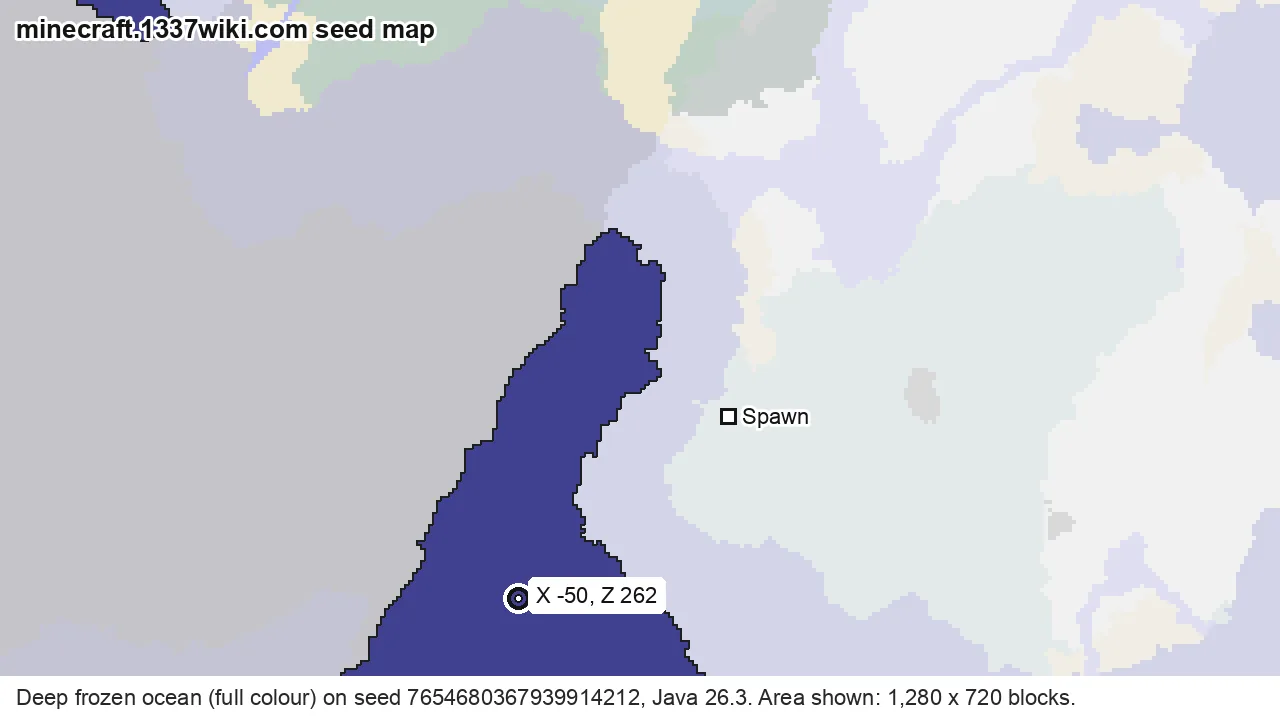
Because this ocean is usually far away, a seed that puts one near spawn saves a long boat trip. These three Java 26.3 seeds have one within 500 blocks of spawn. Each coordinate is inside the biome, checked at block level.
| Seed | Deep frozen ocean at | From spawn | Map |
|---|---|---|---|
7654680367939914212 |
X -50, Z 262 | 278 blocks | Open on the map |
2546873176684604958 |
X -118, Z -238 | 455 blocks | Open on the map |
-7703020730019599874 |
X -170, Z 314 | 442 blocks | Open on the map |
With cheats on, /locate biome minecraft:deep_frozen_ocean finds the nearest one. Or paste your seed into the biome finder. These are Java seeds; the same number on Bedrock gives a different world. Plan for a trip: 9 of our 300 seeds had no deep frozen ocean anywhere in the sampled area, and only 94% had one within 5,000 blocks of spawn.
Deep frozen ocean vs frozen ocean and deep cold ocean
The deep frozen ocean shares its mobs and icebergs with the frozen ocean, and its depth and monuments with the deep cold ocean. This is how the three compare:
| Feature | Deep frozen ocean | Frozen ocean | Deep cold ocean |
|---|---|---|---|
| Ocean monuments | Yes | No | Yes |
| Icebergs | Yes | Yes | No |
| Polar bears | Yes | Yes | No |
| Fish | Salmon | Salmon | Cod and salmon |
| Kelp and seagrass | No | No | Yes |
| How common (our sample) | 1.2% of the surface | 2.2% | 2.3% |
| Median distance from spawn (our sample) | 2,086 blocks | 1,701 blocks | 1,166 blocks |
So in our sample of 300 Java 26.3 seeds, the deep frozen ocean covered about half as much of the world as either neighbour and sat furthest from spawn. If all you want is a monument and you don’t care about ice, note that the deep cold ocean was closer to spawn in our sample; use the ocean monument finder to check your seed.
Ocean monuments
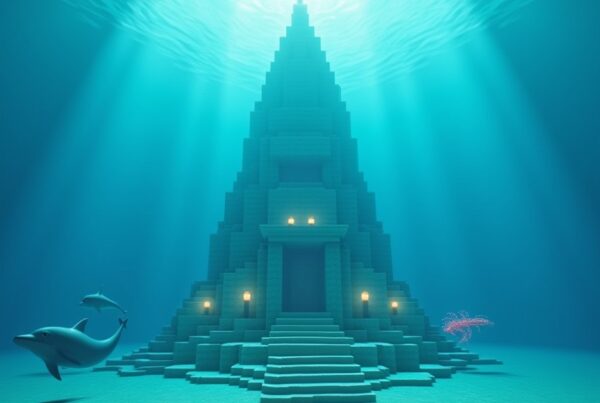
Monuments only generate in the four deep ocean biomes, and this is the frozen one. Inside you will find guardians, three elder guardians that give you Mining Fatigue, eight gold blocks hidden in the core, prismarine and wet sponges. Bring Respiration, Depth Strider or a conduit, and milk to clear the Mining Fatigue. A cartographer villager can sell an Ocean Monument Map (called the Ocean Monument Explorer Map before Java 26.3) that points to the nearest one.
What else you find here
Icebergs and blue ice
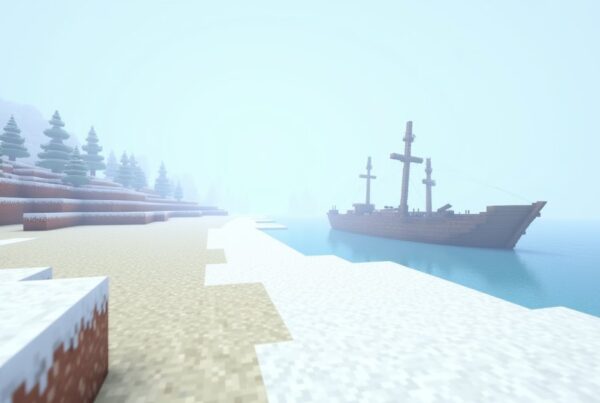
Icebergs are made of packed ice, and some are made of blue ice. Blue ice is the slipperiest block in the game, which makes it the block of choice for fast boat roads in the Nether. You need a tool with Silk Touch to collect packed ice or blue ice; without it they drop nothing. The alternative is crafting: nine packed ice make one blue ice.
Mobs
The mob list is the same as the frozen ocean’s. Polar bears are the only land animal, and here they can spawn on the ice and icebergs. They are neutral, but an adult attacks if you get close to its cub. In the water you get salmon and squid, but no cod, and since Java 1.21.11 the nautilus, which you can tame with pufferfish and ride with a saddle. Pufferfish don’t spawn here, so bring some. Drowned spawn in the water in the dark, and some carry a trident. Dolphins don’t spawn in the deep frozen ocean.
Ruins and shipwrecks
Cold ocean ruins, built of stone bricks, and shipwrecks generate on the seabed, and both can hold loot chests. A shipwreck’s map chest has a treasure map to buried treasure on a beach. Ruined portals can appear on the seabed too.
What changed in 2025-26
Nothing changed in deep frozen oceans in Wilderness Bound (Java 26.3, September 2026). The only related change is the map rename mentioned above.
In Mounts of Mayhem (Java 1.21.11, December 2025), the nautilus was added. It spawns in all ocean biomes, the deep frozen ocean included, and you can tame it with pufferfish and ride it.
In Spring to Life (Java 1.21.5, March 2025), the deep frozen ocean was listed as a cold biome for the new farm animal variants. Pigs, cows and chickens don’t spawn here naturally, but one spawned here (with a spawn egg, for example) comes out as the cold variant.
Source: the official 26.3, 1.21.11 and 1.21.5 release notes.
On Bedrock, version 1.21.100 changed the deep frozen ocean’s surface so that it is no longer covered by ice and is entirely open water (Bedrock 1.21.100 changelog).
How we measured
The numbers on this page come from our own seed map engine, running Java Edition 26.3 world generation. We generated 300 random seeds and sampled every 16th block across a 10,240 by 10,240 block square centered on each world’s spawn. “How common” is the deep frozen ocean’s share of those samples; “distance from spawn” is how far the nearest deep frozen ocean sample was. The seeds above were picked from the same run, and each coordinate was re-checked at block level.