Updated for Java Edition 26.3 (October 2026).
The forest is the plain oak-and-birch woodland of the Overworld, and in our sample of 300 Java 26.3 seeds it was the most common surface biome of all, covering 11% of the ground. Almost every world has one next to spawn. Come for easy wood, apples, flowers and the first wolf you can tame.
| Dimension | Overworld |
|---|---|
| Where it generates | Temperate lowland and hills, usually along rivers and next to plains |
| How common | 11% of the surface in our sample (about 1 block in 9), the most of any Overworld biome |
| Distance from spawn | Median 126 blocks; within 1,000 blocks in 99% of seeds, within 2,000 in all of them (our sample) |
| Mobs | Wolves, sheep, pigs, chickens and cows, plus the usual hostile mobs at night |
| Notable blocks | Oak and birch trees, fallen logs, leaf litter, bushes, lilacs, rose bushes, peonies, lilies of the valley |
| Structures | Abandoned camps (26.3), ruined portals; underground, mineshafts, strongholds and trial chambers |
| Climate | Temperature 0.7, downfall 0.8 |
| Biome ID | minecraft:forest |
| Added in | Java Edition Alpha 1.2.0 (Halloween Update, 2010) |
How to find a forest
You rarely need to look. In our sample the median distance from spawn to the nearest forest was 126 blocks, and a quarter of all seeds had one within 25 blocks. A forest’s edge touched a river 37% of the time, plains 17%, beach 7%, taiga 6% and birch forest 4%. If you spawn on open grass, follow the nearest river and the trees will start on one bank or the other.
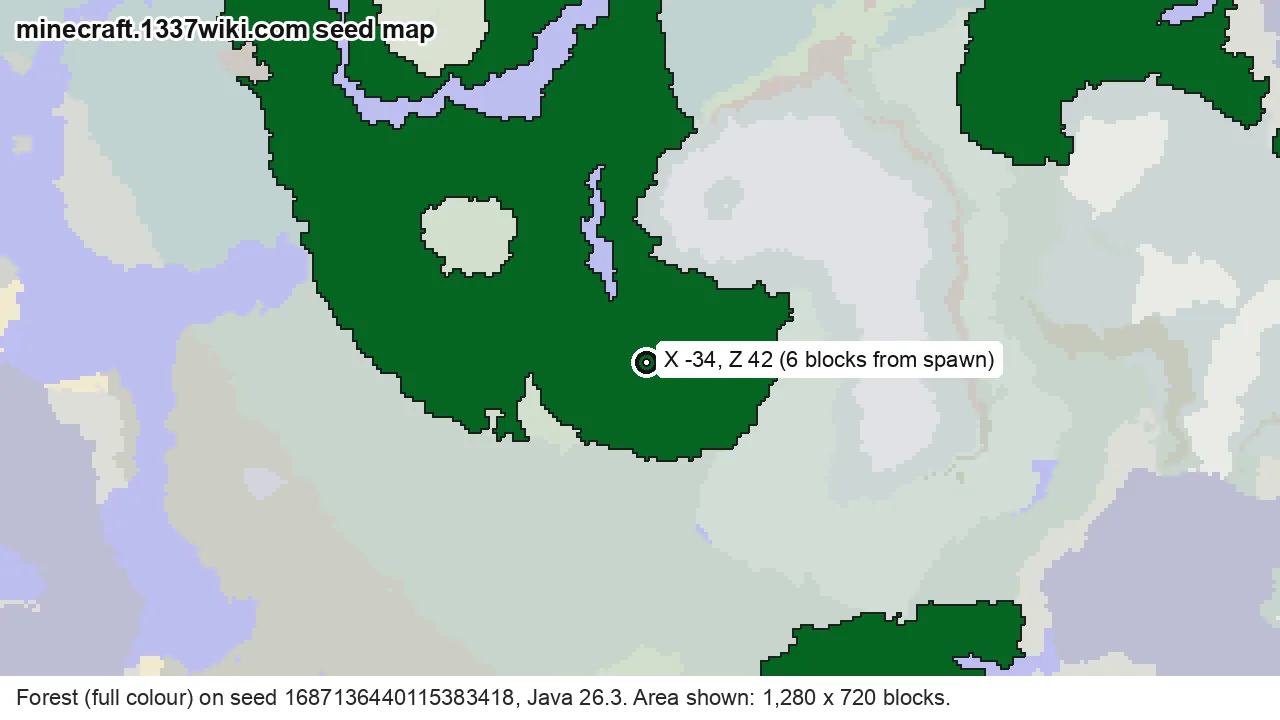
These three Java 26.3 seeds start you inside a forest or a short walk from one. Each coordinate is inside the forest, checked at block level.
| Seed | Forest at | From spawn | Map |
|---|---|---|---|
1687136440115383418 |
X -34, Z 42 | 6 blocks | Open on the map |
-1856171074832894972 |
X -102, Z -46 | 84 blocks | Open on the map |
-4929559873392127060 |
X 62, Z -66 | 91 blocks | Open on the map |
In a world you already have, /locate biome minecraft:forest finds the nearest one (cheats on), or paste your seed into the biome finder to see every forest around spawn. These are Java seeds; the same number on Bedrock gives a different world.
Forest types in Minecraft
“Forest” is one biome, minecraft:forest, but the game has several other wooded biomes with their own names, and people often mean one of those. The plain forest is the only one of the oak and birch woodlands where wolves spawn.
| Forest type | Trees | Wolves | How common (our sample) | Median distance from spawn (our sample) |
|---|---|---|---|---|
| Forest | Oak and birch | Yes | 11% of the surface | 126 blocks |
| Birch forest | Birch only | No | 2.1% | 604 blocks |
| Old growth birch forest | Very tall birch | No | 2.1% | 615 blocks |
| Dark forest | Dark oak canopy, huge mushrooms | No | 1.8% | 890 blocks |
| Flower forest | Oak and birch among dense flowers | No | 0.6% | 1,137 blocks |
| Dappled forest (26.3) | Poplars with red, orange and yellow leaves | No | 0.4% | 1,452 blocks |
| Windswept forest | Spruce and oak on steep hills | No (llamas instead) | 0.2% | 1,762 blocks |
| Taiga (spruce forest) | Spruce | Yes | 3.3% | 658 blocks |
Two more “forests” are in the Nether: the red crimson forest and the teal warped forest, which is the “blue forest” people search for. Their trees are giant fungi, and none of the Overworld numbers above apply to them.
Windswept forest vs taiga
Both are cold and full of spruce, but a windswept forest is a steep, stony hill biome with oaks mixed in, llamas instead of wolves, and emerald ore underground. A taiga is flatter spruce woodland with wolves, foxes and rabbits. Both have their own pages with seeds.
Mobs in the forest
Sheep, pigs, chickens and cows spawn here, so a forest gives you wool for a bed and food on the first day. Wolves spawn in small packs; forest wolves are the woods variant, with a darker brown coat. Tame one with bones and it keeps that coat. Farm animals here are the regular temperate variants.
At night you get the usual hostile mobs: zombies, skeletons, spiders, creepers, endermen and the odd witch. The trees break up your view, so a creeper can get close before you see it. Light the ground around your base and cut back the trees nearest to it.
Blocks and resources
Wood and apples
Oak and birch grow close together, including some big branching oaks, so one forest supplies enough logs for a whole early base. Oak leaves drop apples (a 0.5% chance per leaf block), which are early food and the base of a golden apple. Since Java 1.21.5, fallen oak and birch logs lie on the forest floor, some covered in mushrooms or vines, which gives you free wood without cutting a tree.
Flowers and plants
Forests grow tall flowers (lilacs, rose bushes and peonies) plus lilies of the valley, dandelions and poppies. Lilac, rose bush and peony give two dyes each, and lily of the valley is a source of white dye. You will also find mushrooms, pumpkin patches and sugar cane by the water. Bee nests do generate on forest trees, but rarely; a flower forest is a better place to find bees.
Leaf litter and bushes
Leaf litter covers patches of the ground. It is only placed when the world generates and never regrows, so pick it up if you want it for builds; you can also make more by smelting any leaves. Small bushes grow in patches too and drop only when broken with shears or a Silk Touch tool.
Structures in a forest
Since Java 26.3, abandoned camps generate in forests, with their own forest design and loot chests and barrels. Ruined portals can generate here as well, and mineshafts, strongholds and trial chambers sit underground. Villages and pillager outposts don’t generate inside a forest. You will often find a village nearby on the plains next door, since plains is the forest’s most common neighbour after rivers.
What changed in 2025-26
In Wilderness Bound (Java 26.3, September 2026), abandoned camps were added to forests, each with a design for this biome.
In Spring to Life (Java 1.21.5, March 2025), fallen oak and birch trees started generating here, some decorated with mushrooms or vines. Leaf litter, a new decorative block tinted by the biome, now covers parts of the forest floor and doesn’t regrow. Bushes, another new decorative block, grow in small patches.
Source: the official 26.3 and 1.21.5 release notes.
How we measured
The numbers on this page come from our own seed map engine, running Java Edition 26.3 world generation. We generated 300 random seeds and sampled every 16th block across a 10,240 by 10,240 block square centered on each world’s spawn. “How common” is the biome’s share of those samples; “distance from spawn” is how far the nearest sample of the biome was. The seeds above were picked from the same run, and each coordinate was re-checked at block level.