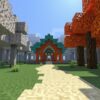
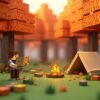
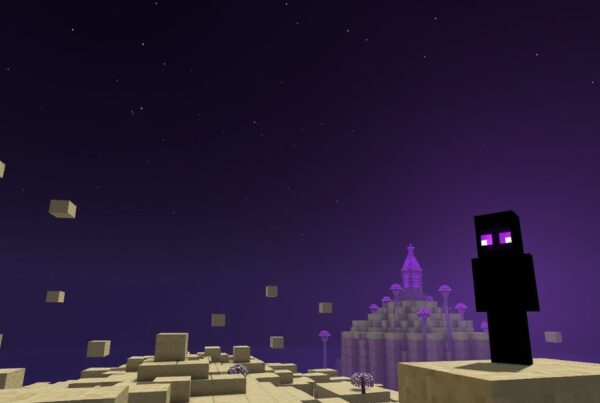
Updated for Java Edition 26.3 (October 2026).
The dark forest is a dense Overworld forest of thick dark oak trees and huge mushrooms, with a canopy so tight that the floor stays gloomy at noon. It is the only biome where dark oaks grow naturally and the main home of woodland mansions. In our sample of 300 Java 26.3 seeds, the median distance from spawn to the nearest one was 890 blocks.
| Dimension | Overworld |
|---|---|
| Where it generates | Temperate, humid lowland, often along rivers and next to birch forests |
| How common | 1.8% of the surface in our sample (about 1 block in 56) |
| Distance from spawn | Median 890 blocks; within 1,000 blocks in 57% of seeds, within 2,000 in 94% (our sample) |
| Mobs | Sheep, pigs, chickens and cows, plus the usual hostile mobs at night; no wolves |
| Notable blocks | Dark oak logs and leaves, huge red and brown mushrooms, leaf litter, fallen trees |
| Structures | Woodland mansions, ruined portals; underground, mineshafts and trial chambers |
| Climate | Temperature 0.7, downfall 0.8 (rains, never snows) |
| Biome ID | minecraft:dark_forest |
| Added in | Java Edition 1.7.2 (2013), as the roofed forest |
How to find a dark forest
Dark forests are easy to spot from a distance: a flat, almost black-green roof of leaves with red and brown mushroom caps poking through. In our sample, 41% of a dark forest’s edge touched a river, 14% old growth birch forest and 14% birch forest, with beaches (8%) and ocean (6%) next. So the quickest way to find one on foot is to follow a river through temperate country, and to pay attention whenever you walk into birch woods.
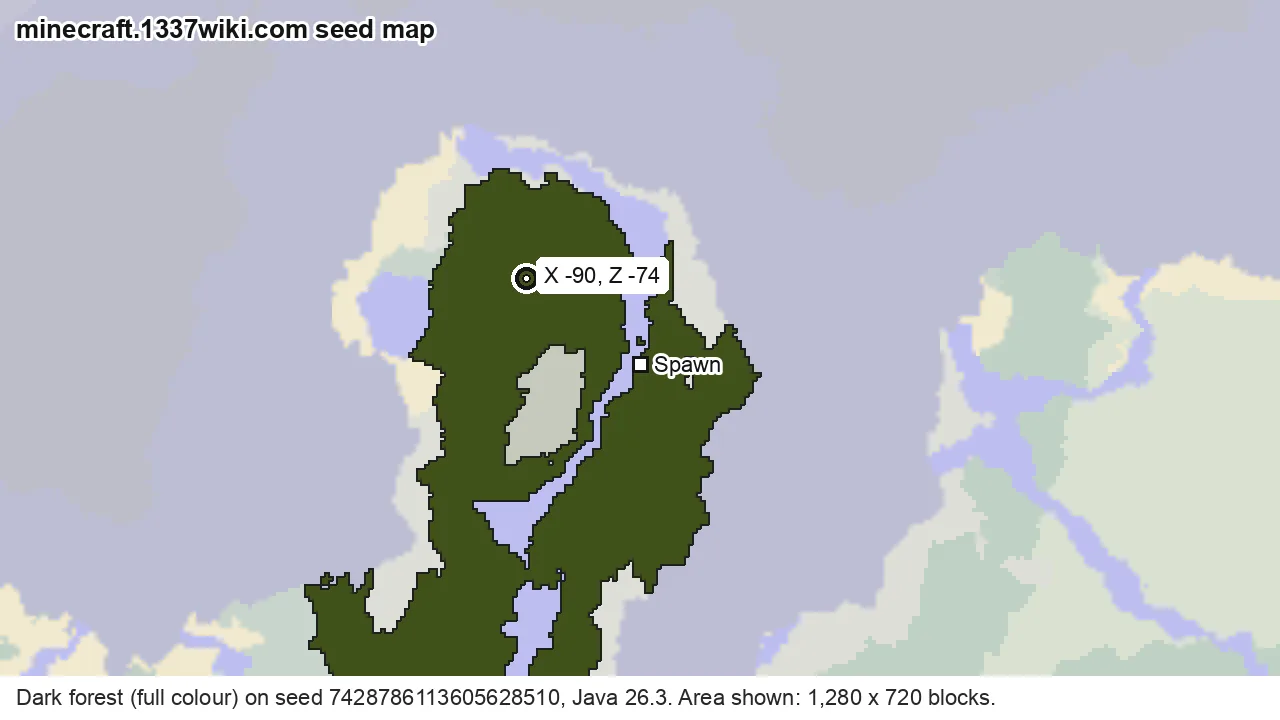
These three Java 26.3 seeds put a dark forest a short walk from world spawn. Each coordinate is inside the dark forest, checked at block level.
| Seed | Dark forest at | From spawn | Map |
|---|---|---|---|
7428786113605628510 |
X -90, Z -74 | 143 blocks | Open on the map |
4177139319713483003 |
X 38, Z 210 | 98 blocks | Open on the map |
8289391987304051587 |
X 262, Z 82 | 275 blocks | Open on the map |
Already in a world? Type /locate biome minecraft:dark_forest (cheats on) for the nearest one, or paste your seed into the biome finder to see every dark forest around spawn. These are Java seeds; the same number on Bedrock gives a different world.
Which structure in the dark forest hides illagers and rare loot?
The woodland mansion. It is a huge, multi-floor house built of dark oak and cobblestone, and in Java 26.3 it only generates in dark forests and pale gardens. Inside are vindicators with axes and evokers that summon vexes. Every evoker drops a totem of undying, which is the main reason to raid one.
Mansions are rare, and a dark forest near spawn does not mean a mansion near spawn. To find one, use /locate structure minecraft:woodland_mansion, our woodland mansion finder, or a Woodland Mansion Map from a cartographer villager. Since Java 26.3, chests at abandoned camps can also hold one of these maps.
What spawns in a dark forest
The passive spawns are the standard farm set: sheep, pigs, chickens and cows. Wolves and rabbits, which you might expect in a forest, do not spawn here in Java. At night you get the normal hostile list: zombies, skeletons, spiders, creepers, endermen, witches and the occasional zombie villager.
The canopy is what makes the biome dangerous. Zombies and skeletons only burn in direct sunlight, and dark oak leaves block most of it, so mobs left over from the night keep walking around under the trees long after sunrise. Clear a patch of leaves or light the ground before you build, and check your corners in the morning.
Trees, mushrooms and wood
Dark oaks have a 2×2 trunk and need four saplings planted in a square to grow, and since this is the only biome where they grow naturally, it is the place to collect dark oak saplings. Take a stack while you are here. Oak and birch trees grow between the dark oaks, and huge red and brown mushrooms fill the gaps. One huge mushroom gives a pile of mushroom blocks and mushrooms for stew, which makes this a decent food stop early on.
The forest floor also has grass, pumpkins, sugar cane by the water, and flowers such as lilacs, rose bushes and peonies. The grass here has its own darker tint, which helps you tell where the biome border is from the air.
Dark forest vs pale garden
The pale garden, added in Java 1.21.4, is officially a variation of the dark forest. It uses the same layout of thick 2×2 trees, but with pale oaks, pale moss and the creaking. No animals spawn there, and it is far rarer: 0.03% of the surface in our sample against 1.8% for the dark forest. Pale gardens nearly always sit inside or next to dark forests; in our sample, 76% of a pale garden’s edge touched dark forest. If you want a pale garden, search the dark forests first.
What happened to dark forest hills?
Dark forest hills no longer exist as a separate biome. Java 1.18 removed it, and the hilly versions of dark forest now come from the terrain itself rather than from a different biome. Before Java 1.13, the dark forest was called the roofed forest. If you were searching for the “deep dark forest”, you probably want the deep dark, a cave biome with the warden that has nothing to do with this forest.
What changed in 2025-26
In Wilderness Bound (Java 26.3, September 2026), the woodland mansion’s explorer map became its own item, the Woodland Mansion Map, and abandoned camps can carry one in their loot.
In Spring to Life (Java 1.21.5, March 2025), three things changed here. Pale gardens now take over more of the area that used to be dark forest, so dark forests are a little less widespread than before. Leaf litter, a new decorative block that only appears through world generation, now covers parts of the floor and is tinted by the biome. Fallen oak and birch trees also generate here, some topped with mushrooms or vines.
Source: the official 26.3 and 1.21.5 release notes.
How we measured
The numbers on this page come from our own seed map engine, running Java Edition 26.3 world generation. We generated 300 random seeds and sampled every 16th block across a 10,240 by 10,240 block square centered on each world’s spawn. “How common” is the dark forest’s share of those samples; “distance from spawn” is how far the nearest dark forest sample was. The seeds above were picked from the same run, and each coordinate was re-checked at block level.