Updated for Java Edition 26.3 (October 2026).
Ice spikes is a frozen Overworld biome of snow-covered flats studded with tall spires of packed ice. It forms inside snowy plains regions, usually along frozen rivers. It is one of the rarest surface biomes: in our sample of 300 Java 26.3 seeds it covered 0.21% of the land. Come for an almost endless supply of packed ice.
| Dimension | Overworld |
|---|---|
| Where it generates | Inside cold, flat snowy plains areas, usually next to frozen rivers, snowy slopes or snowy beaches |
| How common | 0.21% of the surface in our sample (about 1 block in 500) |
| Distance from spawn | Median 2,443 blocks; within 1,000 blocks in 15% of seeds, within 2,000 in 38%, within 5,000 in 90% (our sample) |
| Mobs | Rabbits (snow-coloured) and the occasional polar bear; at night strays instead of most skeletons, plus the usual hostile mobs |
| Notable blocks | Packed ice spikes and patches, snow blocks, frozen water (ice), a few spruce trees |
| Structures | Ruined portals; underground mineshafts and trial chambers. No villages or igloos. |
| Climate | Temperature 0.0, downfall 0.5 (snows, water freezes) |
| Biome ID | minecraft:ice_spikes |
| Added in | Java Edition 1.7.2 (2013) as Ice Plains Spikes; renamed Ice Spikes in 1.13 |
How rare is the ice spikes biome?
Very rare by area, though most worlds have one somewhere. In our sample of 300 Java 26.3 seeds, ice spikes covered 0.21% of the surface. Only eight surface biomes covered less, among them the cherry grove, mushroom fields and pale garden. The snowy plains around it covered 2.6%, about twelve times as much.
Distance is the bigger problem. The median distance from spawn to the nearest ice spikes was 2,443 blocks, and only five surface biomes were farther away on median: the three badlands biomes, mushroom fields and stony peaks. Still, 286 of the 300 seeds had ice spikes inside the 10,240-block square we sampled, and 90% had one within 5,000 blocks of spawn.
How to find ice spikes
Find snow first. In our sample, the edge of an ice spikes biome touched a frozen river 38% of the time and snowy plains 29%, followed by snowy slopes (8%), snowy beach (7%) and frozen ocean (6%). Once you reach a snowy plain, follow its frozen rivers: the spikes are tall enough to see from a long way off, and from the air they stand out clearly against flat white ground.
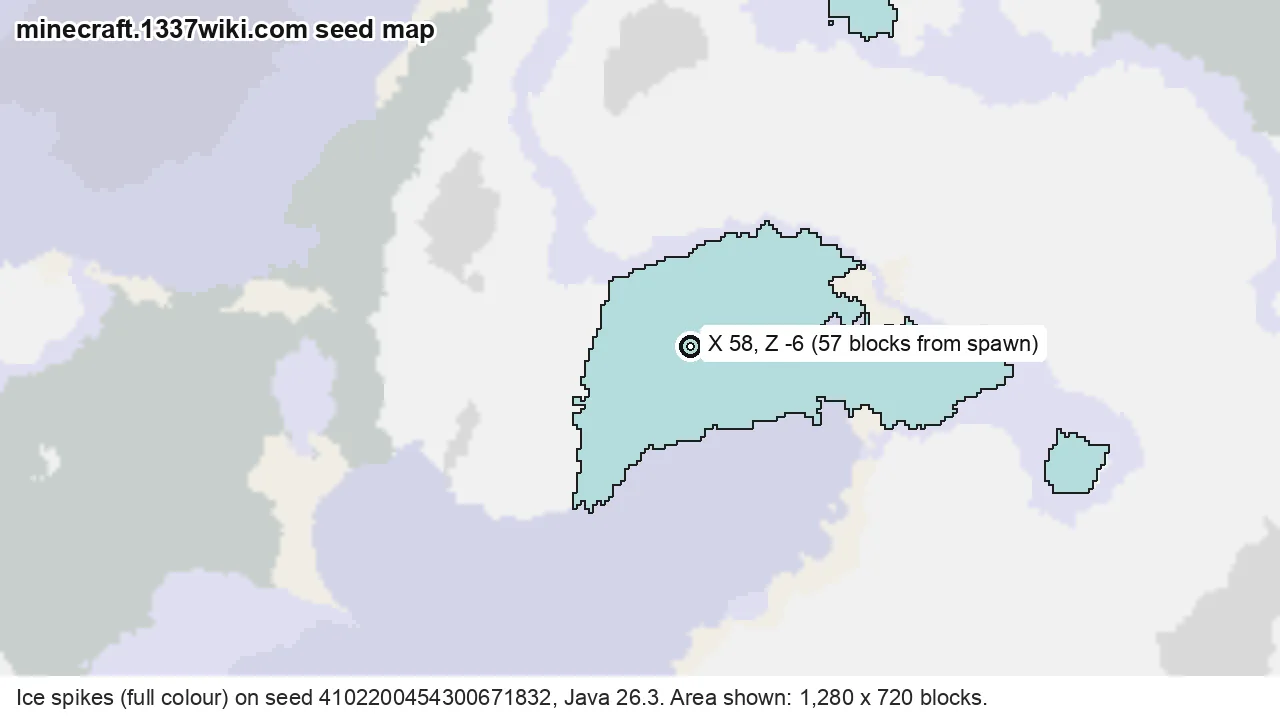
These three Java 26.3 seeds put ice spikes within 300 blocks of world spawn, so you skip the long search. Each coordinate is inside the biome, checked at block level.
| Seed | Ice spikes at | From spawn | Map |
|---|---|---|---|
4102200454300671832 |
X 58, Z -6 | 57 blocks | Open on the map |
7654680367939914212 |
X 438, Z -26 | 298 blocks | Open on the map |
-4963905823603534693 |
X -6, Z -218 | 218 blocks | Open on the map |
The command is /locate biome minecraft:ice_spikes (cheats on). Without cheats, paste your seed into the biome finder to see every ice spikes biome around spawn. These are Java seeds; the same number on Bedrock gives a different world.
Packed ice and other blocks
The spikes are solid packed ice. Most are short and wide, and a few tall, thin ones tower over the rest. Packed ice doesn’t melt, even next to torches, and nine of it crafts one block of blue ice. Boats slide very fast on both, which is why players use them for ice-boat roads. Break packed ice with a Silk Touch tool, or it drops nothing.
The ground is snow blocks rather than grass, with flat packed-ice patches around the spikes. The temperature is 0.0, so it snows instead of raining and open water freezes over. A few lone spruce trees grow here, but wood is scarce, so bring logs.
What spawns in ice spikes
Animals are few. Rabbits are the main one, in the snowy colours, and polar bears appear now and then. Polar bears are neutral but turn hostile near their cubs. No pigs, cows, chickens or foxes spawn here, so bring food.
At night, strays (skeletons that shoot arrows of Slowness) make up most of the skeleton spawns, alongside zombies, spiders, creepers, endermen and witches. Zombie horses, which spawn in snowy plains since Java 1.21.11, do not spawn in ice spikes.
Ice spikes vs snowy plains
Ice spikes is a rare variant inside snowy plains country. The climate and most mobs are the same, but the structures are not.
| Feature | Ice spikes | Snowy plains |
|---|---|---|
| How common (our sample) | 0.21% of the surface | 2.6% of the surface |
| Median distance from spawn (our sample) | 2,443 blocks | 1,527 blocks |
| Ground | Snow blocks, packed ice spikes | Snow-covered grass |
| Villages, igloos, pillager outposts | No | Yes |
| Zombie horses at night | No | Yes |
| Climate | Same: temperature 0.0, downfall 0.5 | |
| Rabbits, polar bears, strays | Both | |
Quick answers
Can igloos spawn in ice spikes?
No. Igloos generate in snowy plains, snowy taiga and snowy slopes, not in ice spikes. One can sit just over the border in the snowy plains next door.
Does powder snow generate in ice spikes?
No. Powder snow generates on snowy slopes and in groves, not here, so the snow in ice spikes is safe to walk on.
What temperature is the ice spikes biome?
0.0, the same as snowy plains. Anything below 0.15 gives snow instead of rain.
What changed in 2025-26
In Spring to Life (Java 1.21.5, March 2025), fallen trees were added to most biomes where their standing tree grows, so fallen spruce trees can now appear here, some covered in mushrooms or vines. Ice spikes was also listed as a cold biome for the new farm animal variants: pigs, cows and chickens don’t spawn here naturally, but one spawned here (with a spawn egg, for example) comes out as the cold variant.
Source: the official 1.21.5 release notes.
How we measured
The numbers on this page come from our own seed map engine, running Java Edition 26.3 world generation. We generated 300 random seeds and sampled every 16th block across a 10,240 by 10,240 block square centered on each world’s spawn. “How common” is the ice spikes biome’s share of those samples; “distance from spawn” is how far the nearest ice spikes sample was. The seeds above were picked from the same run, and each coordinate was re-checked at block level.