Updated for Java Edition 26.3 (October 2026).
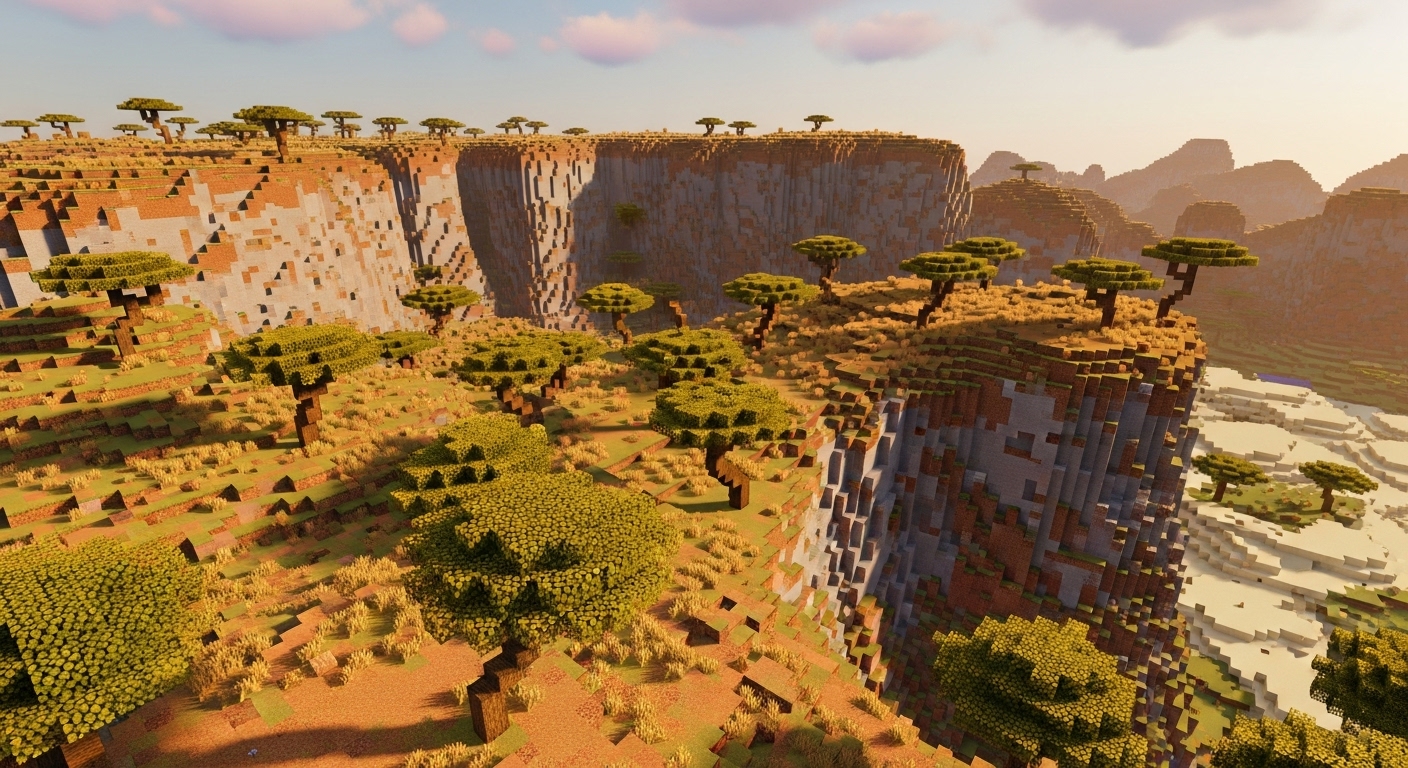
The savanna plateau is a hot, dry Overworld biome of raised, flat-topped ground dotted with acacia trees. It almost always sits right above a regular savanna, and it never rains there. Come for llamas, horses, armadillos and spotted wolves: in Java, this is the only savanna biome where wolves and llamas spawn.
| Dimension | Overworld |
|---|---|
| Where it generates | Raised, flat ground in hot, dry regions, usually surrounded by savanna |
| How common | 0.2% of the surface in our sample (about 1 block in 480) |
| Distance from spawn | Median 1,644 blocks; within 1,000 blocks in 29% of seeds, within 2,000 in 64% (our sample) |
| Mobs | Horses, donkeys, llamas, armadillos, wolves (the spotted variant) and farm animals, plus the usual hostile mobs at night |
| Notable blocks | Acacia trees with a few oaks, tall grass, fallen oak trees |
| Structures | Ruined portals, mineshafts underground; no villages or pillager outposts |
| Climate | Temperature 2.0; it never rains or snows |
| Biome ID | minecraft:savanna_plateau |
| Added in | Java Edition 1.7 (The Update that Changed the World, 2013) |
Savanna vs savanna plateau
The savanna plateau is the raised version of the savanna. The trees, grass and dry weather are the same; what changes is the height of the land, two extra animals and the structures you can find.
| Feature | Savanna | Savanna plateau |
|---|---|---|
| Terrain | Low, mostly flat or gently rolling | Raised, flat-topped ground above the surrounding land |
| Trees and plants | Same: acacia trees with a few oaks, tall grass, dry yellow-green grass | |
| Weather | Same: never rains or snows | |
| Wolves | No | Yes, the spotted variant |
| Llamas | No | Yes |
| Horses, donkeys, armadillos | Both | |
| Villages and pillager outposts | Yes | No |
| Abandoned camps (26.3) | Yes | No |
So if you want a savanna village, stay on the low ground. If you want a spotted wolf or a llama in a hot biome, climb onto the plateau. A village can still sit at the foot of a plateau, because the savanna around it is where villages are allowed to start.
How to find a savanna plateau
Expect a walk. In our sample of 300 Java 26.3 seeds, the savanna plateau covered about 0.2% of the land, and the median distance from spawn to the nearest one was 1,644 blocks. Only 29% of seeds had one within 1,000 blocks, but all except one had one within 5,000.
The plateau’s edge touched regular savanna 76% of the time in our sample, stony peaks 11% and forest 8%. So find a savanna first, then look for the flat shelf of higher ground with acacias on top. Where savanna starts climbing toward bare grey peaks is a good place to check.
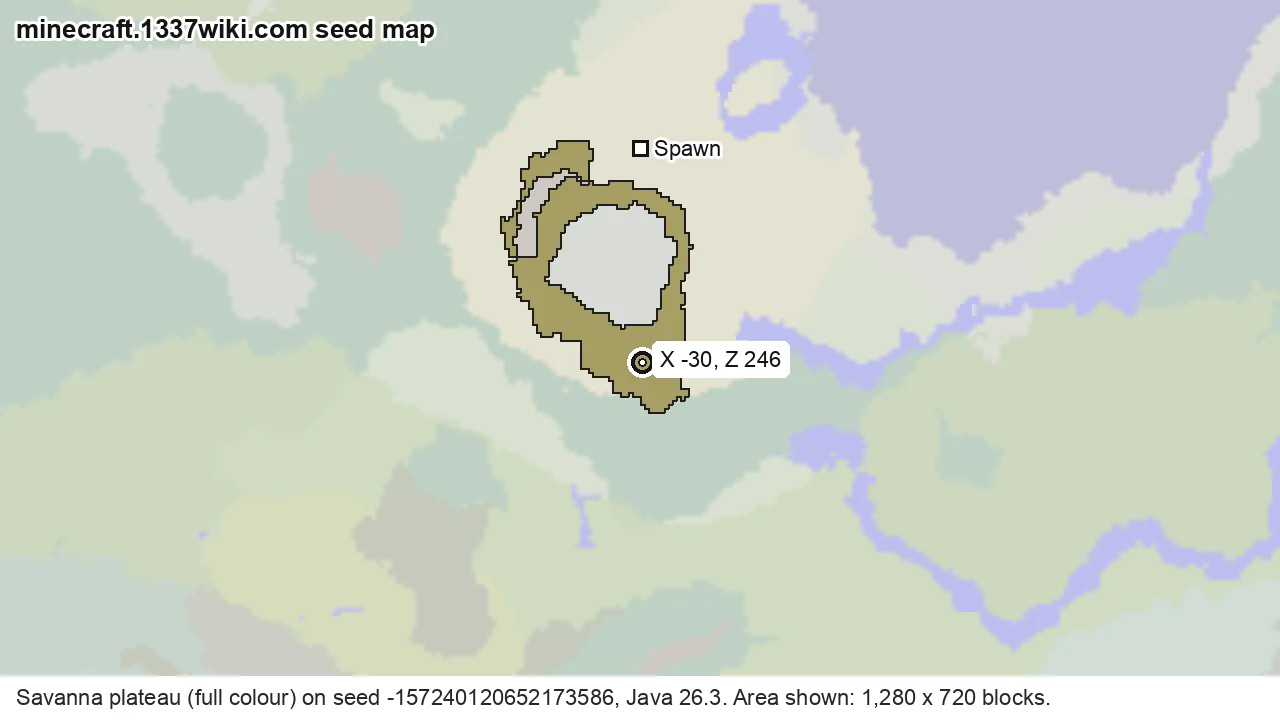
These three Java 26.3 seeds put a savanna plateau a short walk from spawn. Each coordinate is inside the biome, checked at block level.
| Seed | Savanna plateau at | From spawn | Map |
|---|---|---|---|
-157240120652173586 |
X -30, Z 246 | 214 blocks | Open on the map |
-4053015578178522146 |
X -62, Z -222 | 55 blocks | Open on the map |
4711785765194039058 |
X -106, Z -6 | 106 blocks | Open on the map |
In a world you already have, /locate biome minecraft:savanna_plateau finds the nearest one (cheats on), or paste your seed into the biome finder to see every plateau around spawn. These are Java seeds; the same number on Bedrock gives a different world.
What happened to the shattered savanna plateau?
It no longer exists as its own biome. Java 1.18 folded the shattered savanna and the shattered savanna plateau into one biome, the windswept savanna, which is where you now find the jagged, overhanging savanna terrain. The plain savanna plateau kept its name and still generates in 26.3, so minecraft:savanna_plateau is a valid biome ID in current Java.
Mobs on the savanna plateau
Wolves and armadillos
Wolves spawn here in packs, and on a savanna they are the spotted variant. Tame one with bones; it keeps its spotted coat. Armadillos spawn on the same ground, and brushing one drops scutes, which craft into wolf armor. That makes the plateau a one-stop trip for a well-protected dog.
Llamas, horses and donkeys
Llamas spawn in herds, and a llama with a chest carries items for you; lead one and others in its group follow in a caravan. Horses and donkeys spawn here too, as they do in the regular savanna. A horse is the fastest way across the open, flat land, and a donkey with a chest is a slower but roomier pack animal.
Farm animals
Sheep, pigs, cows and chickens spawn here. Since Java 1.21.5 the pigs, cows and chickens are the warm variants, warm chickens lay brown eggs, and sheep are most often brown.
Building on a plateau
The flat top is easy to build on and gives a long view over the savanna below. Acacia is the main wood, with its orange planks, and a few oaks give you a second wood type. It never rains here, even when the rest of the world is under a storm.
What changed in 2025-26
In Wilderness Bound (Java 26.3, September 2026), abandoned camps were added to many biomes, including the regular savanna. The savanna plateau is not on the list, so you won’t find a camp here.
In Spring to Life (Java 1.21.5, March 2025), pigs, cows and chickens that spawn here are the warm variants, and warm chickens lay brown eggs. Sheep spawn with warm-biome wool colors, so brown is the most common. Fallen oak trees now generate on the ground, some covered in mushrooms or vines.
Source: the official 26.3 and 1.21.5 release notes.
How we measured
The numbers on this page come from our own seed map engine, running Java Edition 26.3 world generation. We generated 300 random seeds and sampled every 16th block across a 10,240 by 10,240 block square centered on each world’s spawn. “How common” is the savanna plateau’s share of those samples; “distance from spawn” is how far the nearest savanna plateau sample was. The seeds above were picked from the same run, and each coordinate was re-checked at block level.