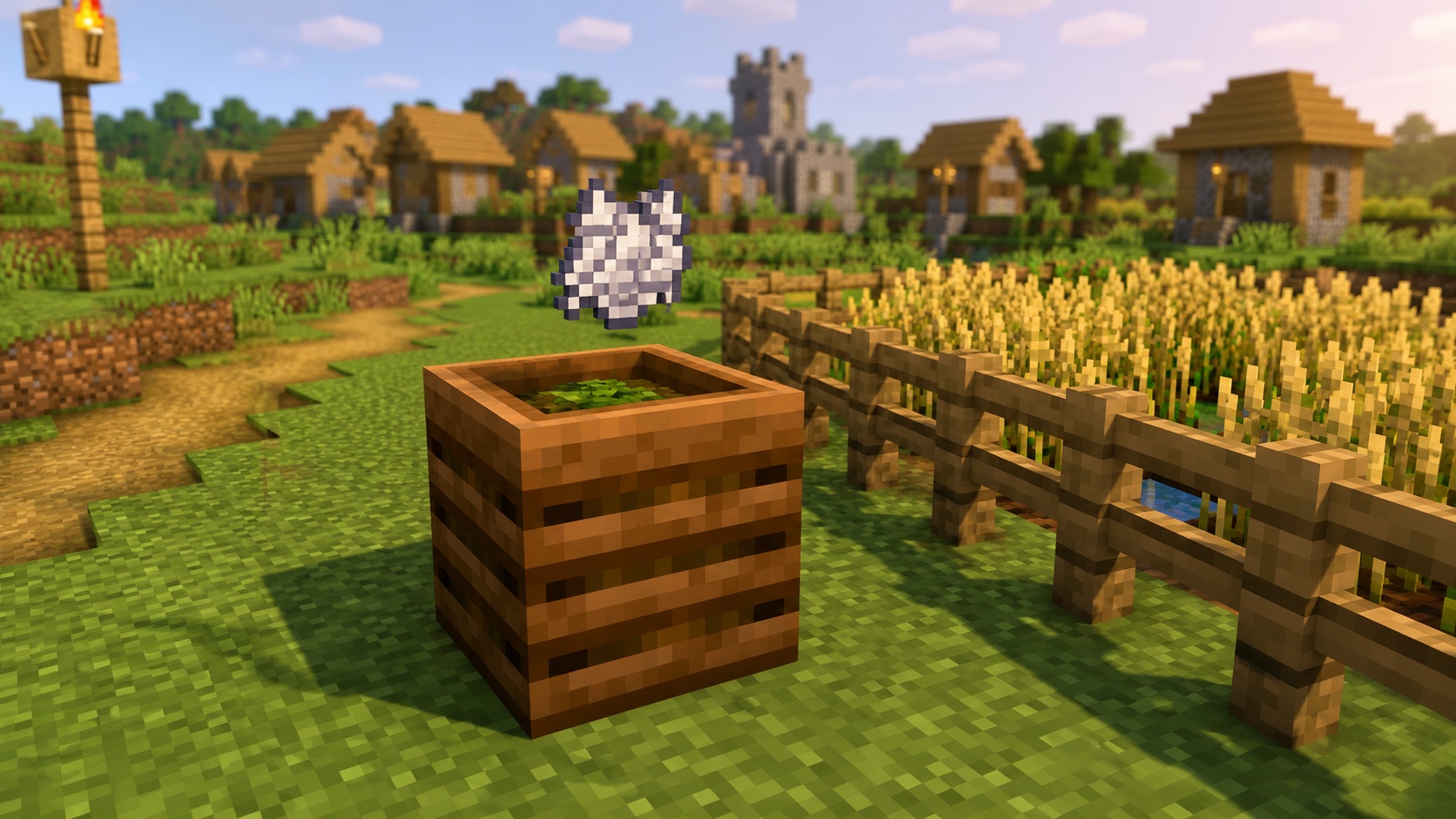
A composter is the easiest way to turn extra crops into bone meal in Minecraft. Drop in saplings, seeds, leaves, or food, and after enough successful additions you get one bone meal back. That makes it a quiet workhorse for any farm, a free source of dye fuel, and the job site block that turns an unemployed villager into a farmer.
This guide covers how to craft a composter, how to find one in villages, the fill mechanics that decide how fast it produces, the full success-rate tiers for every plant item, and the farms players actually build around it.
What a composter does
A composter is a utility block that converts plant matter into bone meal. You right-click (or use the use button on Bedrock) with a compostable item, and the item has a percentage chance to add one layer of compost to the block. Once the composter reaches its top layer, the next time you add any compostable, it pops out one bone meal and resets to empty.
It is also a workstation. An unemployed villager standing near an unclaimed composter will take the farmer profession the next time they search for a job site, which is the only direct way to make a farmer in a village without trading.
Why it matters
Bone meal speeds up crops, dyes wool and concrete, and crafts into bone blocks. Mob farms produce bones, but a composter lets you skip the skeleton step and turn surplus wheat or seeds into a steady bone meal supply. For builders, a composter also stacks visually as a wood barrel with a slatted top, which makes it useful as a kitchen or pantry decoration.
How to craft a composter
The recipe uses 7 wooden slabs of any single wood type or a mix of wood types. Place slabs in a U shape on a crafting table: three slabs across the bottom row, one slab on each side of the middle row, and one slab on each end of the top row, leaving the center column empty.
Any wood works: oak, spruce, birch, jungle, acacia, dark oak, mangrove, cherry, pale oak, crimson, warped, or bamboo slabs all count. You can mix them in the same recipe. Crafting one composter costs the equivalent of about 3.5 wood blocks, since each plank makes two slabs and each log makes four planks.
Where to find one without crafting
Composters generate naturally in villages as part of the farmer house and a few other plot variants. The biome-specific farmer house designs in plains, desert, savanna, snowy, and taiga villages all include composters, usually next to crop plots.
If you spawn near a village, grabbing a free composter is faster than gathering wood for slabs. You can mine it with any tool or your fist, and it always drops itself.
How the fill mechanic works
Internally a composter has eight states: empty, layers 1 through 7, and a “ready” state where it is full and the next interaction yields bone meal. Each compostable item you add has a fixed chance to add one layer. If the roll fails, nothing happens to the block but the item is still consumed.
When the composter is at layer 7 and you add another item, two things happen on a successful roll: the block briefly shows a particle pop, the item is consumed, and one bone meal is ejected on top. The block then resets to empty. On a failed roll at layer 7, the item is consumed and the block stays at layer 7, so you try again with the next item.
Because the rolls are independent, items with low success rates are not wasted, they just take more attempts on average. Seven successful rolls produce one bone meal regardless of the items used.
Composting rates by item
Items fall into five tiers based on their chance to add a layer per use.
30% chance: beetroot seeds, dried kelp, glow berries, grass (short), hanging roots, kelp, all leaves, mangrove roots, melon seeds, moss carpet, pumpkin seeds, saplings, seagrass, small dripleaf, sweet berries, wheat seeds, torchflower seeds, pitcher pods, pink petals (single layer).
50% chance: cactus, dried kelp block, flowering azalea leaves, melon slice, sugar cane, tall grass, vines, wheat, wildflowers (Bedrock), short dry grass, tall dry grass.
65% chance: apple, azalea, beetroot, big dripleaf, carrot, cocoa beans, fern, large fern, flowering azalea, all flowers (dandelion, poppy, blue orchid, allium, azure bluet, tulips, oxeye daisy, cornflower, lily of the valley, torchflower), lily pad, melon, moss block, mushrooms (red and brown), nether sprouts, nether wart, pale moss, pale moss carpet, pale hanging moss, potato, pumpkin, sea pickle, shroomlight, twisting vines, weeping vines, wither rose, crimson roots, warped roots, sunflower, lilac, peony, rose bush, pitcher plant, torchflower (block), wildflowers (Java).
85% chance: baked potato, bread, cookie, hay bale, nether wart block, warped wart block.
100% chance: cake, pumpkin pie.
Most players feed their composter with whatever crop they have a surplus of. Wheat is a common pick because a wheat farm produces it faster than you can use it, and wheat sits in the 50% tier. Saplings work too if you run an automatic tree farm, even though they are only 30%.
How to use a composter
Hold a stack of compostables and right-click the top of the composter. Each click adds one item from the stack. You can also load it with a hopper from above and pull bone meal out with a hopper underneath, which is the basis for fully automatic bone meal farms.
For manual use, the visible compost level inside the block tells you how full it is. The level rises in clear steps from a small green pile to a full layer of compost flush with the top edge. When the surface looks ready to bubble over, the next successful add will drop bone meal.
Automating with hoppers
The composter accepts items only into the top face and ejects bone meal only from the bottom. A standard auto-composter setup looks like this: a hopper above the composter holds your compostables and feeds them in, and a hopper below catches the bone meal that drops out and routes it to a chest.
This makes a closed loop with sapling farms, kelp farms, and sugar cane farms. A sapling farm in particular pairs well, because trees produce more saplings than you need, and the surplus becomes free bone meal that you can feed back to grow the next round of trees.
Composters and villagers
An unclaimed composter inside a village makes a nearby unemployed villager become a farmer. Farmer villagers also use composters during their workday: they walk to the composter and toss in surplus crops they have harvested, and they pick up the bone meal that comes out. That bone meal is then dropped on crops to speed growth, or used to compost more.
If you want to keep a villager as a farmer for trading, place exactly one composter near them, lock in their first trade by trading with them once, and they will not switch jobs even if other workstations appear nearby.
Tips, tricks, and common mistakes
A few things players miss when they first start using composters.
- Items with 30% chance are not bad, they just need more inputs. A pile of saplings that would otherwise despawn is still free bone meal.
- Cake and pumpkin pie always succeed, but they cost grain and sugar to craft, so they are only useful if you have huge food surpluses or a creative inventory.
- Bone blocks craft into nine bone meal directly. If you only need bone meal once, killing skeletons or finding fossils is faster than building a farm.
- A hopper-fed composter clogs if downstream chests are full. Add an overflow chest or break the loop when you stop the farm.
- Composters do not burn in lava and do not act as fuel in furnaces. Treat them as decoration-safe but flammable from fire blocks.
- Hoppers can pull from any side except the side facing the composter, so plan your auto-farm layout around the input/output faces.
Java and Bedrock differences
The composter is one of the most consistent blocks across editions. The crafting recipe, fill mechanic, success rates, and villager interaction are the same in Java and Bedrock as of recent versions. Two minor differences come up:
On Bedrock, sugar cane sits in the 50% tier the same as Java, but a few items added in newer Java updates (such as torchflower seeds and pitcher pods) reach Bedrock in later patches, so list parity can lag by a release. If a specific item does not seem to compost on your version, the most likely cause is that the update that added it has not landed on your platform yet.
Both editions also share the same villager behavior, including the workstation lock when a villager has traded at least once.
Frequently asked questions
What is a composter used for in Minecraft?
It converts plant matter into bone meal and acts as the farmer villager job site. Bone meal grows crops faster, dyes wool and concrete, and crafts into bone blocks.
How do you make a composter?
Place 7 wooden slabs in a U shape on a crafting table: 3 across the bottom, 2 on the sides of the middle row, and 2 on the ends of the top row. Any wood type works.
What is the fastest way to fill a composter?
Use items in the 85% or 100% tier if you have them. Hay bales are the most practical option because they craft from 9 wheat each, and a wheat farm produces them in bulk. Cake and pumpkin pie are 100% but waste resources.
Do bone meal and bones do the same thing in a composter?
No. Composters take plant matter and produce bone meal as output. You cannot put bone meal or bones back into a composter, and crafting bone blocks into bone meal is a separate recipe.
Can I automate a composter?
Yes. Place a hopper above to feed compostables in and a hopper below to collect bone meal. Pair this with a sapling, kelp, or sugar cane farm for a fully passive bone meal supply.
Will a composter turn a villager into a farmer?
Yes, if the villager is currently unemployed and the composter is unclaimed by another villager. Place the composter where the villager has a clear path to it, and they will take the farmer job during their next job search.
Does the composter have a fuel use?
No. Composters cannot be burned in a furnace as fuel, even though they are made of wooden slabs.
Worth knowing
A single composter, a hopper, and a small wheat or sapling plot is enough to keep a base in bone meal forever. Set it up once, walk away, and pick up the bone meal whenever you need to bulk-grow crops or dye a stack of wool. It is the closest thing Minecraft has to a free resource, as long as you have something growing.