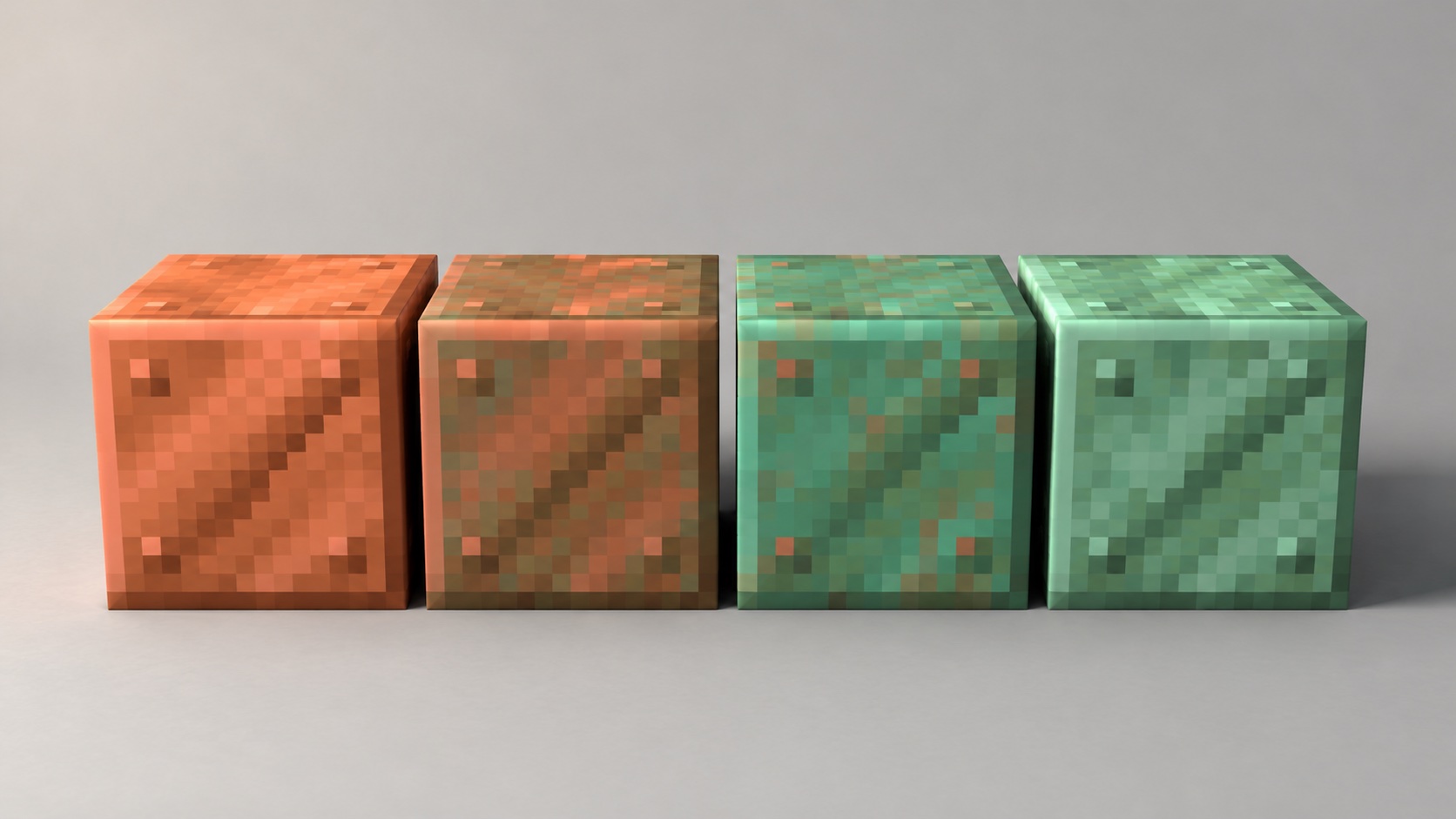
What is cut copper?
Cut copper is a decorative variant of the regular copper block. It has diagonal lines crossing each face that give it a tile pattern, which makes it the go-to choice for builders who want copper’s color shift without the plain look. Players use it for roofs, trim, accents on stone builds, and anywhere a Mediterranean or steampunk feel suits the structure.
Like every copper block, cut copper oxidizes over time. It cycles through four stages: the fresh orange copper look, exposed (slightly faded), weathered (turquoise-tinted), and oxidized (full Statue-of-Liberty green). You can lock any stage with honeycomb, and you can scrape a stage off with an axe or a lightning strike.
This guide covers how to craft cut copper, how to mine it, how oxidation works, how to wax it, the slab and stair variants, and the small differences worth knowing on Java versus Bedrock.
How to craft cut copper
You craft cut copper from copper blocks, not from raw copper or copper ingots directly. The recipe is a 2×2 grid of copper blocks, which gives you four cut copper blocks. So one copper block in equals one cut copper block out.
If you have a stonecutter, that’s a better deal. Drop a single copper block in the stonecutter and you get four cut copper out. Same one-to-four ratio as the crafting table, but you only need a single source slot, which makes inventory work easier when you’re churning out a roof’s worth of blocks.
The math from raw copper:
- 9 raw copper smelted into ingots = 9 copper ingots.
- 9 copper ingots = 1 copper block.
- 1 copper block in the stonecutter = 4 cut copper.
So 9 raw copper turns into 4 cut copper, or roughly two raw copper per cut copper block. Compared to the dye math for terracotta and concrete, copper actually comes out cheaper for big roofs in the long run, especially once you’ve set up a drowned farm to keep raw copper flowing.
How to mine cut copper
Cut copper takes a stone pickaxe or better. A wooden pickaxe will break the block but drop nothing, which is the same rule that applies to most stone-tier blocks. The valid tools are stone, iron, diamond, netherite, or gold. (Gold mines fast but breaks fast, so most players skip it for copper.)
If you’re mining cut copper from a build you placed yourself, any of those pickaxes drops the block as itself. You don’t need silk touch, and there’s no fortune bonus. What you placed is what you get back, at whatever oxidation stage it had reached when you mined it.
Cut copper also spawns naturally in trial chambers, which were added in the 1.21 update. You’ll see it in the floors and walls of the chambers, especially in the more decorated rooms. Mining it there with the right pickaxe drops the block, so trial-chamber raids are a quiet way to stockpile cut copper before you’ve even set up a farm.
How oxidation works
Every copper block in Minecraft, including cut copper, slowly changes color over time. The four stages, in order, are:
- Copper: orange-pink, freshly placed.
- Exposed copper: a little duller, with patches of green starting to show.
- Weathered copper: a green-blue patina taking over the orange.
- Oxidized copper: full pale green, like an aged statue.
The stages don’t happen on a strict timer. Each block makes a random check every so often, and whether it advances depends on how many other un-oxidized copper blocks are nearby. The fewer copper blocks within a small radius, the faster a single block oxidizes. Tightly packed copper roofs oxidize slowly because each block sees too many neighbors. A lone copper block oxidizes much faster.
This matters for builds. If you want a roof to age uniformly, build the whole thing at once. If you want a streaky, mottled look, build it piece by piece across several play sessions. A mix of stages on the same wall is one of the cleanest aesthetic tricks you can pull off with copper, and there’s no other block in the game that gives you that effect for free.
How to wax cut copper
To stop oxidation, apply honeycomb. The recipe is one cut copper plus one honeycomb in any crafting grid. The result is waxed cut copper at the same oxidation stage. Once waxed, the block won’t change color again unless you remove the wax.
You can also wax in place. If a copper roof has reached the exact green you want, right-click each block with a honeycomb and it converts to the waxed version, particle effect and all. You don’t have to mine and re-place anything. This is the easiest way to lock a custom color pattern on a roof you’ve been letting age for weeks.
To remove the wax, hit the block with an axe. That gives you the un-waxed version of the same stage. Hit it again with the axe and you can scrape one oxidation stage off, going from oxidized back to weathered, weathered back to exposed, and so on, all the way down to fresh copper.
Lightning does the same scrape, but harder. A lightning strike on any cut copper block resets it to the freshest copper stage instantly, no matter what stage it was at. If you’re running a lightning rod build over a copper roof, expect that roof to lose its patina the first time a thunderstorm hits.
Cut copper slabs and stairs
Cut copper has two shape variants: slabs and stairs. Each one comes in all four oxidation stages and a waxed form for each stage, which means there are 16 cut copper slab variants and 16 cut copper stair variants in total.
Recipes:
- Cut copper stairs: 6 cut copper in a stair shape on the crafting grid (yields 4 stairs), or 1 cut copper in a stonecutter (yields 1 stair).
- Cut copper slabs: 3 cut copper in a row on the crafting grid (yields 6 slabs), or 1 cut copper in a stonecutter (yields 2 slabs).
The crafting table is more efficient for stairs in raw block terms. The stonecutter wins on convenience because you don’t need to fill the grid. For slabs, both routes give the same one-to-two ratio per source block, so the choice is just about which one you have set up where you’re working.
Each variant oxidizes independently, so a slab placed next to a full block won’t drag the full block forward in stage, and a full block won’t drag a slab forward either. They each look up their own neighbors when deciding whether to age.
Tips and common mistakes
A few things worth knowing before you build:
- Don’t skip the stonecutter. Crafting cut copper at the table works, but the stonecutter saves a lot of inventory shuffling, especially when you’re making slabs and stairs.
- Wax at the right moment. If you wax fresh copper, you’re stuck with bright orange forever. If you want green, place the blocks, wait, and only wax when the color is where you want it.
- Build big roofs all at once. Mixed-age roofs look striking on purpose, but if you want even color, place every block in one session and walk away.
- Beware lightning on copper builds. A roof that took a real-world week to age can reset in one storm. Keep lightning rods at a safe distance from copper structures you want to keep aged.
- Test colors with a small block first. Before committing to a copper roof on your main base, place one block somewhere out of the way, let it sit, and confirm you actually want that final green.
Java vs. Bedrock differences
Cut copper exists in both editions and works the same way at the surface. The recipes, oxidation stages, waxing, axe scrape, lightning scrape, and shape variants all match. Two small things to know:
- Oxidation rate uses the same neighbor logic in both editions, but the random ticks aren’t perfectly aligned, so two identical copper builds in Java and Bedrock won’t always age in lockstep.
- Trial chambers were rolled out in 1.21 in both editions, so you can find naturally generated cut copper in either, though the loot pools and exact generation patterns differ slightly between the two.
Frequently asked questions
Can you craft cut copper from raw copper directly?
No. You have to smelt raw copper into ingots, craft those into copper blocks, then turn the blocks into cut copper. The stonecutter doesn’t accept ingots or raw copper as input.
Does cut copper give you ingots when you mine it?
No. Mining cut copper drops the cut copper block itself. There’s no recipe in the game that converts cut copper back into copper blocks or ingots, so once you commit to cut copper, the copper inside it is locked in that form.
Will cut copper oxidize if I wax it?
No. Waxed cut copper holds its current stage forever, until you remove the wax with an axe. Lightning still affects waxed blocks, though, so a strike will pop the wax off and reset the stage in one event.
Can mobs spawn on cut copper?
Yes. Cut copper is a full solid block with a normal top surface, so hostile mobs spawn on it at low light just like any stone block. If you’re using cut copper as a roof or floor on a base, light it up.
Is cut copper renewable?
Yes. Copper is renewable through drowned mob drops, and farms based around drowned spawners or zombie drowning are common. Once you have a copper farm running, cut copper is effectively free.
Do cut copper stairs and slabs oxidize at the same rate as full blocks?
They oxidize on the same logic but as separate blocks. A stair next to a full block doesn’t share its oxidation timer; each block runs its own check independently. In practice, mixed builds tend to age at slightly different rates.
Can you find cut copper in chests?
Cut copper isn’t a typical chest loot item. Trial chambers contain it as part of natural generation, so you can mine the chamber walls and floors directly. There’s no need to search a chest with it inside.
The bottom line
Cut copper is the most flexible decorative block in Minecraft if you want a build that changes over time. The crafting math is generous once you have a stonecutter, the oxidation gives you four color options out of one block, and waxing lets you freeze any stage. Place a few blocks, leave them alone for a real-world day, and you’ll see for yourself why so many builders default to copper roofs now.