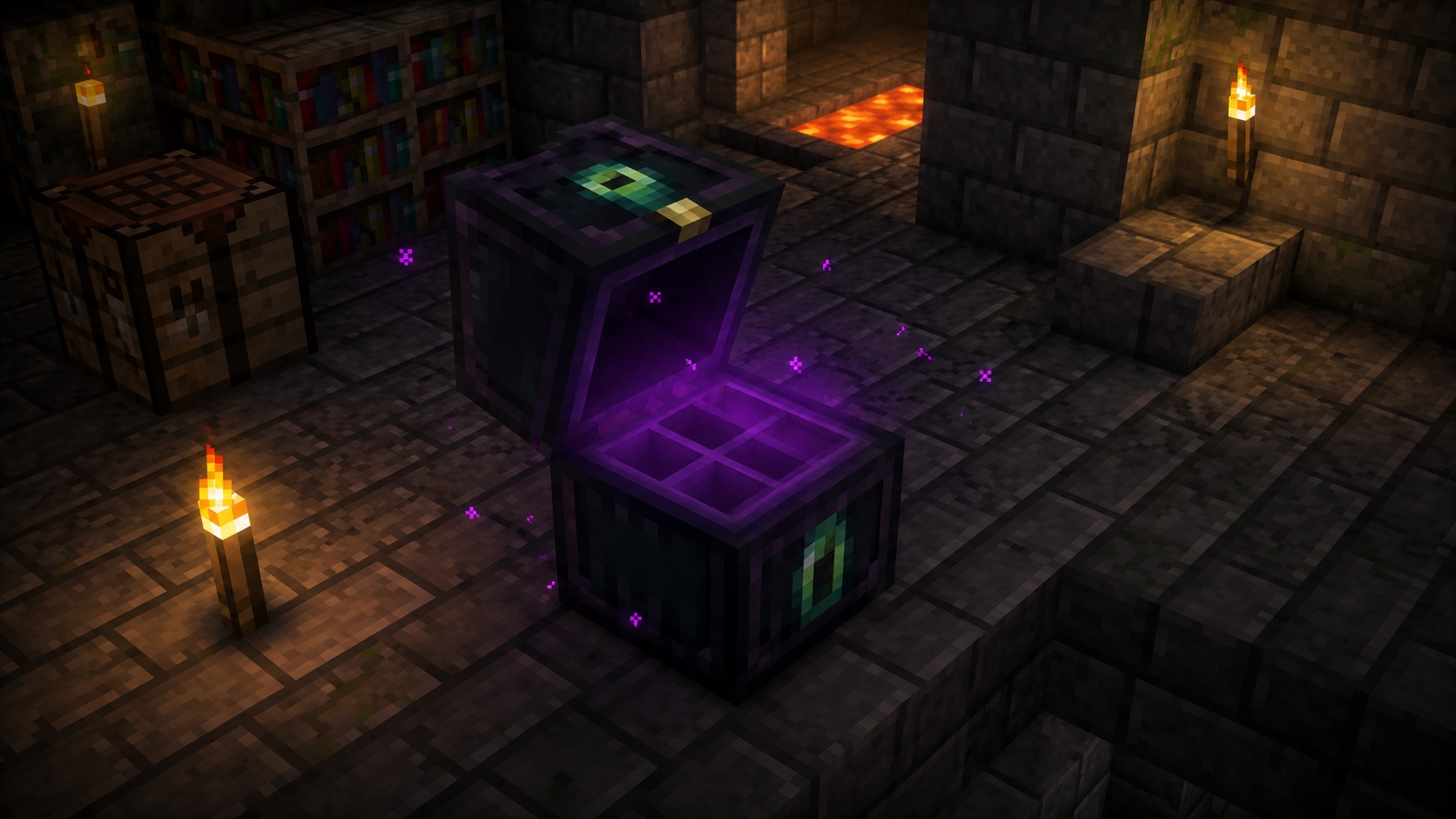
The ender chest is one of the few storage blocks in Minecraft that ignores location. Whatever you put inside one ender chest is accessible from every other ender chest you ever place, anywhere in the same world. The inventory is private to your character, so other players on the same server see their own contents when they open the same block.
For most players, this is the closest thing to personal cloud storage in the game. It’s the standard way to keep your good gear safe before a Nether trip, move loot home from a far-away base, or hide valuables on a multiplayer server. The block itself is expensive (eight obsidian and one eye of ender), and it requires a diamond or netherite pickaxe to mine, so it tends to show up in the mid-to-late game.
Once you have one, the per-player inventory is yours forever in that world. Even after you die, items in the ender chest stay where you left them.
What is an ender chest?
An ender chest is a storage block that gives every player their own 27-slot personal inventory. Open any ender chest in the world, and you see the same contents you saw the last time you opened one. Other players opening the exact same block see their own inventory, not yours.
An ender chest works differently from a regular chest. A regular chest stores items at that physical location. Break it, and the contents drop on the floor. Walk away from it, and you have to walk back to use it again. Ender chests don’t work like that. The chest is a portal into your personal stash, not a box that holds the items.
The ender chest emits a small amount of light (light level 7), which makes it easy to spot in dim spaces. It also has the same blast resistance as obsidian, so creeper explosions, ghast fireballs, and even the ender dragon’s attacks won’t damage it.
How to craft an ender chest
Recipe
The crafting recipe needs eight obsidian and one eye of ender. Place the obsidian in every slot of the crafting table except the center, then put the eye of ender in the middle slot. The recipe produces one ender chest.
Where to get the ingredients
Obsidian is the slow part. You need a diamond or netherite pickaxe to mine it, and each block takes about ten seconds even with a top-tier tool. Most players gather their first batch by pouring water on lava in a cave, or by mining the obsidian generated naturally around lava pools and ruined portals.
Eyes of ender are made by combining one ender pearl (dropped by endermen) with one blaze powder (crafted from blaze rods dropped by blazes in nether fortresses). One eye of ender per chest, plus you’ll need plenty of extras to find and activate the End portal, so it’s worth stockpiling them.
How to break an ender chest
Mining without silk touch
If you mine an ender chest with a regular diamond or netherite pickaxe, the block drops eight obsidian. The eye of ender is destroyed in the process. You can use the obsidian to craft another ender chest later, but you’ll need a fresh eye of ender to do it.
Mining with silk touch
A pickaxe enchanted with Silk Touch drops the ender chest itself as a single block. This is how most players move their ender chest from a starter base to a permanent one without losing the eye of ender every time.
What happens to the contents
This is the most useful thing about ender chests, and the most misunderstood: breaking the chest does nothing to your inventory. The block is just an access point. Mine every ender chest in the world, and your personal 27 slots are still sitting there, waiting for the next ender chest you place.
How the shared inventory works
Every player on a server has their own ender chest inventory. If you and a friend each open an ender chest at the same time, you each see your own 27 slots. The storage is tied to your player UUID, so it survives death, world restarts, and chunk reloads.
Across dimensions
The inventory works across all three dimensions. Place an ender chest at your base in the Overworld, another in your Nether hub, and a third on an End island, and they all open the same stash. This makes the ender chest the easiest way to move loot back from the End without dying on the trip home.
After death
Items stored in an ender chest stay safe when you die. This is the main reason serious players build one before any risky trip. Drop your diamond gear and rare loot in the chest, run the dangerous errand with backup gear, and pick everything back up at home, even if you didn’t survive.
Single-player and multiplayer
In single-player, you only have one inventory, so the shared-storage behavior just means convenient access from anywhere. In multiplayer, every player gets their own independent 27 slots in the same physical block, which makes ender chests great for shared spawn buildings: one block, no fights over storage.
What ender chests can’t do
Ender chests have a few limits that catch new players off guard.
No hoppers
Hoppers do not interact with ender chests. You can’t pull items out of one with a hopper, and you can’t push items into one. This rules out automation: no auto-sorters, no item elevators, no farms feeding directly into ender chests. If you want automation, use a regular chest and move items into the ender chest by hand when you’re done.
No double chests
Two ender chests placed next to each other stay as two separate blocks. They never combine into a 54-slot double chest the way regular chests do. Since the inventory is shared anyway, two adjacent ender chests give you exactly the same access as one.
No piston pushing
Pistons can’t push or pull ender chests, the same as obsidian. This is occasionally useful (you can build a sealed room around one without worrying about pistons cheesing it open), but it also means you can’t build retractable storage rooms with them.
No comparator output
A redstone comparator placed against an ender chest gives a constant output of zero, regardless of what’s inside. The block itself doesn’t track per-player contents at the world level, so there’s nothing for the comparator to read.
Practical uses for an ender chest
The classic use: a safety deposit box before any high-risk trip. Going to the Nether for the first time, raiding a stronghold, fighting the wither, taking on the ender dragon. Stash your good gear in the ender chest, take backup gear, and your stuff is safe if things go wrong.
The second use is logistics. Place one chest at home and one at a remote build site or mining base, and you have a free shortcut for moving small amounts of loot back and forth. You still have to walk both ways for big projects, but the ender chest covers the trickle of valuables (diamonds, ancient debris, rare drops) that would otherwise pile up in scattered chests.
In multiplayer, ender chests are the easiest way to give every player private storage in a shared spawn area. One block, every player gets 27 slots, no admin work required.
Tips and common mistakes
Make a Silk Touch pickaxe before you place your first ender chest. It costs the same eight obsidian to craft a new one, but you lose the eye of ender if you break the original without Silk Touch, and eyes of ender add up if you do this several times.
Don’t try to feed an ender chest with hoppers. New players sometimes spend an hour wiring up a sorter before realizing the items just won’t go in. Save the time and build the sorter into a regular chest system.
If you’re playing on a hardcore world, the ender chest doesn’t help you on death (the world ends), but it does help you keep your best gear together for fast access during a tough fight. Many hardcore players store backup armor and a stack of golden apples in their chest at all times.
Frequently asked questions
Do items in an ender chest stay after I die?
Yes. The contents of your ender chest are saved to your character, not to the block. Death does not affect them.
Can I share my ender chest inventory with another player?
No. Every player has their own private 27 slots accessed through any ender chest. There is no built-in way to give another player access to your stored items.
Why won’t a hopper feed my ender chest?
Hoppers don’t connect to ender chests at all. This is by design, to prevent automation that would defeat the cost of using one. Use a regular chest if you need automated input.
Can I make a double ender chest?
No. Two ender chests placed side by side stay as two separate single chests. Since they share the same inventory anyway, there’s no benefit to placing more than one in the same spot.
What pickaxe do I need to mine an ender chest?
A diamond or netherite pickaxe. Anything weaker breaks the block but drops nothing. Without Silk Touch, the chest drops eight obsidian (and the eye of ender is destroyed). With Silk Touch, the chest itself drops as a single block.
Does an ender chest count as a light source?
Yes, it emits light level 7. That’s enough to keep mobs from spawning on top of the block itself, but not bright enough to fully light a room.
Are ender chests safe from the ender dragon?
Yes. They have the same blast resistance as obsidian, so the dragon’s attacks and explosions won’t break them. Many players place an ender chest on top of an obsidian pillar at the End spawn platform as their first move during a dragon fight, so they can swap gear safely between attempts.
Does the ender chest work the same on Java and Bedrock?
Yes. Both editions use the same recipe, same per-player private inventory, same blast resistance, and the same light level. There are no meaningful differences in current versions.
Worth the obsidian
Of all the storage in the game, the ender chest is the one most worth the obsidian cost. The first one is expensive, but every chest after that is just convenient access. The next time you have a stack of obsidian and a spare eye of ender, put one at your base and one in your Nether hub. You’ll wonder how you ever played without it.