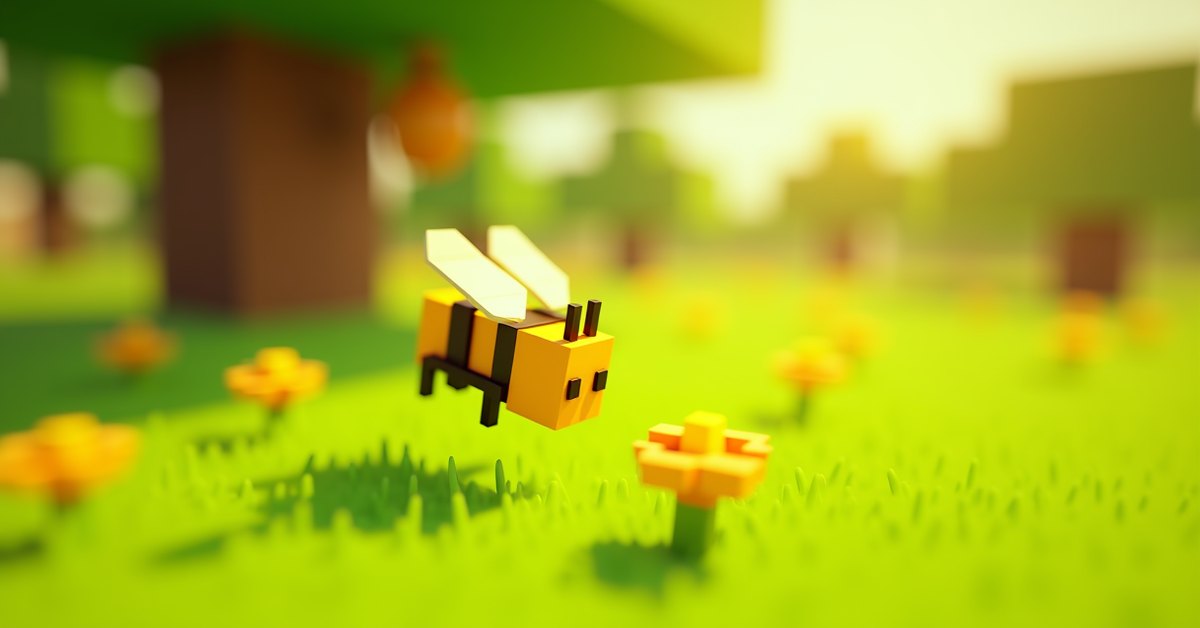
Bees are flying neutral mobs that turn flowers into honey. Leave them alone and they spend the day buzzing between blossoms and their nest. Hit one, or steal honey the wrong way, and the whole nest comes after you with a poison sting.
They arrived in the 1.15 Buzzy Bees update and are the only renewable source of honey and honeycomb in survival. While they work, they also speed up nearby crops for free, which makes a few bees worth keeping next to any farm.
What bees are and where they live
A bee is a small yellow-and-black mob that flies in a slow, looping path. Bees are passive until provoked, so they will never attack you on their own. Each one lives in a home block, either a natural bee nest or a player-made beehive, and returns there at night, during rain, and after collecting pollen.
Bees spawn alongside bee nests when the world generates. Nests appear on oak and birch trees in plains, sunflower plains, and flower forests, on the trees in cherry groves, and around mangrove swamps. A fresh nest usually holds two or three bees inside. If you want bees, the fastest route is to wander a flowery biome and look up at the trees until you spot the honey-colored block hanging under the leaves.
Bees fly over fences and walls and ignore fall damage, but they avoid water and will path around it. They do not despawn once they have a home, so a nest you find on day one will still be buzzing a hundred days later.
Bee nests and beehives
Nests and hives do the same job, but you get them in different ways. A bee nest generates naturally and is made of a soft, papery material. A beehive is the crafted version: place six wooden planks around three honeycombs in the crafting grid and you get a hive you can put anywhere. Both hold up to three bees and fill with honey the same way.
The home block tracks a honey level from 0 to 5. Every time a bee finishes a pollination trip and goes back inside, the level rises by one. At level 5 the block looks full, honey drips from the bottom, and you can harvest it. In Java Edition a full nest or hive also sends out a comparator signal of 5, which lets you wire up automatic harvesting.
If you want to move a wild nest home, mine it with a Silk Touch tool. Silk Touch is the only way to collect the block with its bees still inside. Break it with anything else and the block is destroyed, the honey is lost, and the bees are left homeless and cranky.
How to harvest honey and honeycomb
Once the honey level hits 5, you have two ways to collect, and they give different items. Use a glass bottle on the block to fill it, which gives you one honey bottle and resets the honey level to 0. Use shears on the block instead and you get three honeycomb, also resetting the level to 0.
Honey bottles are food. Drinking one restores hunger and clears poison, which is handy since bees are what poison you in the first place. Four honey bottles craft into a honey block, a sticky block that slows mobs and players and is useful in redstone builds. Honeycomb crafts into honeycomb blocks for decoration, and you can also use a single piece to wax copper and stop it from oxidizing.
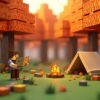
Here is the part most new players miss: harvesting honey or comb normally angers every bee nearby. To collect safely, place a campfire within five blocks below the nest. The smoke rising into the block calms the bees so they ignore the harvest. Set the campfire a few blocks down and drop a carpet or slab on top of it so bees flying low do not catch fire. With smoke in place, you can shear or bottle the nest as often as you like and nobody stings you.
For a hands-off setup, point a dispenser loaded with shears or glass bottles at the block and trigger it with redstone. A dispenser harvest never angers the bees, so you can skip the campfire if every harvest runs through one.
How to breed bees
Bees breed with flowers. Hold a flower near two adult bees and they follow you; feed one flower to each and they enter love mode and produce a baby bee. After breeding, each parent needs about five minutes before it can breed again, and the baby takes around twenty minutes to grow up. Breeding also drops a little experience.
Any flower they can pollinate works for breeding, including dandelions, poppies, the small biome flowers, flowering azalea, and similar plants. Baby bees behave like the adults but cannot pollinate or make honey until they grow up, so a new hive takes a little while to start producing.
Because three bees per home is the cap, a single nest plus a couple of crafted hives nearby gives you room to grow a real colony. Breed a few extras, let them claim the empty hives, and your honey output climbs.
How bees help your farm
Pollination is the reason to keep bees next to crops. A bee leaves home, finds a flower, and picks up pollen, shown by a small cloud of particles trailing behind it. On the way back, a pollen-carrying bee that flies over growing crops has a chance to push each one forward a growth stage. Wheat, carrots, potatoes, beetroot, melon and pumpkin stems, and sweet berry bushes all benefit.
It is not a huge speed boost on its own, but it costs nothing and runs while you do other things. A row of flowers next to a hive and a field gives the bees a reason to fly back and forth across your crops all day. The pollen trip is also what raises the honey level, so the same flight that grows your wheat is filling your hive.
When bees attack
Bees only turn hostile if you provoke them. Attacking a bee angers it and every bee sharing its home. Harvesting honey or comb without a campfire or dispenser does the same thing to the whole nest at once. Angry bees turn red around the eyes and fly straight at you.
An angry bee stings once. The hit deals damage and, on Normal and Hard difficulty, leaves you poisoned for several seconds. Like a real bee, it loses its stinger in the process, cannot sting again, and dies roughly twenty seconds later. That self-destruct is why provoking a whole nest is costly for the bees, but a swarm can still stack up real damage and poison before they drop.
A few things keep you safe. Bees will not sting a player who is in water, and they ignore players in Creative mode entirely. If a nest does turn on you, jumping into a nearby pond or river ends the attack fast. Honey bottles clear the poison afterward.
Tips and common mistakes
Always carry Silk Touch shears if you plan to relocate a nest, and scout the trees before you swing so you do not shatter the block by accident. Keep flowers within range of every hive, since bees that cannot find a flower never pollinate and your honey level sits at zero. If a nest seems stuck, check that there are open flowers nearby and that the bees are not boxed in by water or walls.
When you set up a campfire harvester, test it once before you trust it. A campfire placed too far from the block, or one with no clear smoke path into it, will not calm the bees, and you will find out the hard way. A carpet over the flame protects low-flying bees from burning. Leashes work on bees too, so you can walk one home instead of breaking its nest if you only need a single bee.
Frequently asked questions
How do you get honey without angering bees?
Place a campfire within five blocks below the nest or hive so its smoke reaches the block, then harvest with a glass bottle or shears. The smoke keeps the bees calm. Harvesting through a dispenser also avoids any anger.
Do bees die after they sting you?
Yes. A bee that stings a player loses its stinger, cannot attack again, and dies about twenty seconds later. This matches how real honeybees work.
How many bees can live in one nest or hive?
Three. Both natural nests and crafted hives cap at three bees, so build extra hives if you want a larger colony.
What flowers do bees like?
Any flower they can pollinate works, including dandelions, poppies, the small biome flowers, and flowering azalea. You use these same flowers to breed them.
Can you move a bee nest?
Only with a Silk Touch tool. Mining a nest with Silk Touch collects the block with the bees still inside. Breaking it any other way destroys the block and leaves the bees homeless.
Why won’t my bees make honey?
They need open flowers within flying range. No flowers means no pollination, and the honey level stays at 0. Plant flowers near the hive and make sure the bees can reach them.
The short version
Find a nest in a flowery biome, plant flowers and a campfire next to it, and you have a renewable honey farm that also fertilizes your crops. Breed a few extras into crafted hives and treat the bees well, and the only time you will ever see a stinger is the day you forget the campfire.