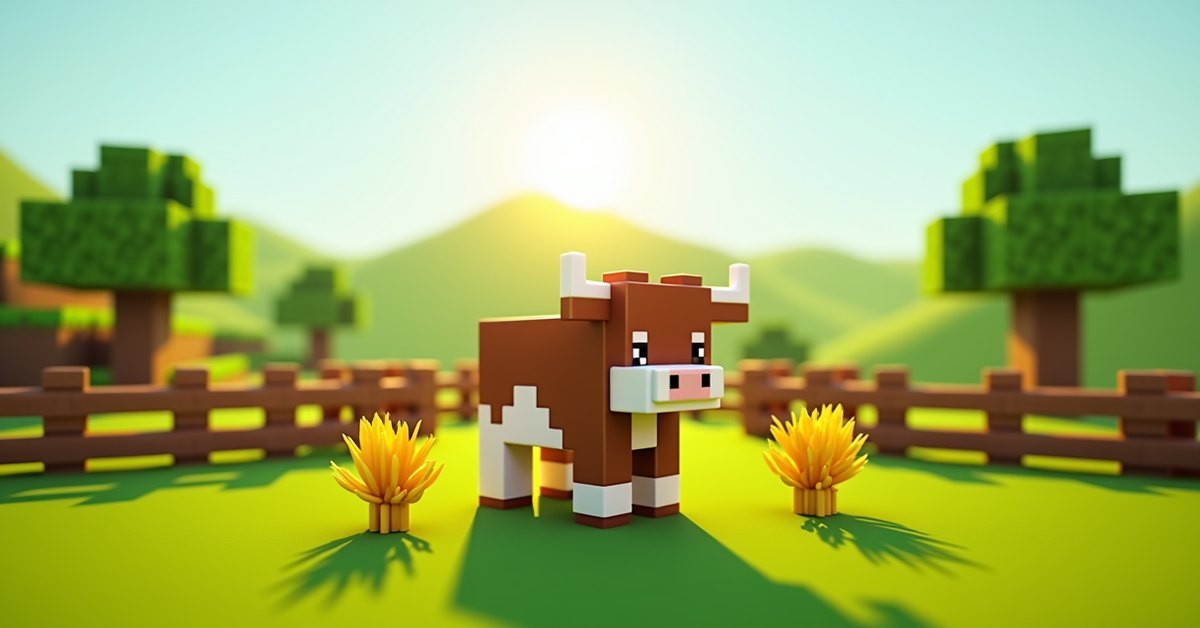
The cow is one of the first animals most players meet in Minecraft, and it stays useful for the whole game. It gives you beef to eat, leather for armor and books, and milk to clear bad status effects. A small pen of cows near your base covers food and a steady leather supply at the same time.
Cows spawn on grass across most overworld biomes, they breed with wheat, and a few of them turn into a reliable farm in a single afternoon. This guide covers where to find them, what they drop, how to milk and breed them, and how to set up a farm that keeps producing.
What is a cow and where does it spawn?
A cow is a passive mob, which means it never attacks you. It wanders, eats nothing, and runs in a panic when you hit it. Each cow has 10 health points, the same as five hearts on your display.
Cows spawn in groups on grass blocks in well-lit areas, usually in herds of two to four. You will find them in plains, forests, and most other grassy biomes. They do not spawn in deserts, snowy wastes, or the Nether. If you have explored near your base at all, you have probably walked past a few already.
Because they are passive, cows do not burn up in daylight and they do not vanish on their own the way hostile mobs do. A cow you fence in will stay there until something kills it, so penning a couple early is a safe investment.
How to get beef and leather
Killing a cow drops two things. The first is raw beef, between one and three pieces per cow. The second is leather, between zero and two pieces. A player kill also gives you a small amount of experience.
Raw beef restores some hunger on its own, but cooking it is worth the trouble. Drop raw beef in a furnace, smoker, or campfire and it becomes steak, one of the best foods in the game for both hunger and saturation. Saturation is the hidden value that decides how long your hunger bar stays full, so steak keeps you fed far longer than the bar alone suggests.
There is a shortcut for cooked beef. If you kill a cow while it is on fire, from lava or a flint and steel, it drops steak directly instead of raw beef. That saves a furnace step, though setting cows on fire also destroys some of the leather, so it is a trade rather than a clean win.
Leather is the other reason to keep cows around. You need it for books, item frames, leather armor, and the leather you turn into book and quill items. Books feed into bookshelves and enchanting, so a leather supply quietly powers your whole enchanting setup.
How to milk a cow
To milk a cow, hold an empty bucket and use it on the cow. You get a milk bucket, and the cow is unchanged, so you can milk the same cow as often as you like. There is no cooldown and no limit.
Milk has one standout use: drinking it removes every status effect you currently have, good and bad. That makes it the cure for poison, the antidote for a witch’s attacks, and the reset button if you drank the wrong potion. The catch is that it strips your buffs too, so do not chug milk in the middle of a fight you set up with strength or regeneration potions.
Milk is also a crafting ingredient. A cake takes three milk buckets along with sugar, wheat, and an egg, and the empty buckets come back to you after crafting. If you plan to bake, a cow nearby saves a lot of walking.
How to breed cows
Cows breed with wheat. Hold wheat near two adult cows and use it on each one. Small red hearts appear above them, they pair up, and a baby calf spawns a moment later. Both parents then enter a cooldown of about five minutes before they can breed again.
Wheat does double duty here. If you hold it while standing near a cow, the cow follows you, which is how you walk wild cows back to a pen without a lead. Lead them in two at a time, breed them, and you have the start of a herd.
A calf takes about 20 real-time minutes to grow into an adult. You can speed that up by feeding it more wheat, and each feeding shaves a little off the remaining time. Calves cannot breed or be milked until they grow up.
Setting up a cow farm
A working cow farm needs three things: a fenced pen, a pair of cows, and a small wheat supply to keep breeding them. Fence in a flat lit area, walk two cows inside using wheat, and breed them whenever the cooldown is up.
Keep the floor lit or fully fenced so hostile mobs cannot wander in and kill your stock at night. A roof or a two-block fence height stops most problems. Leave the pen on solid blocks rather than over a drop, since cows take fall damage like any mob and will hurt themselves on uneven ground.
For steady output, let the herd grow to a comfortable number, then harvest the extras and leave at least two adults to keep breeding. A common setup pushes grown cows into a one-block channel and uses a campfire below to cook the beef as they die, giving you steak and leather without lighting anything by hand. Even a manual pen works fine if you just want food and the odd stack of leather.
One thing worth knowing: you do not need natural spawning once the farm is running. Wild cows only appear on grass in daylight, but a fenced herd reproduces from wheat regardless of the floor underneath. That means you can build the pen out of stone, slabs, or anything else and never lose breeding speed, which makes mob-proofing the farm much easier.
Mooshrooms: the cow variant
The mooshroom is a red or brown cow covered in mushrooms, and it only spawns in the rare mushroom fields biome. It behaves like a normal cow with two extra tricks.
You can milk a mooshroom with a bowl instead of a bucket to get mushroom stew, a free meal with no crafting. A bucket still gives you normal milk. If you shear a mooshroom, it drops its mushrooms and turns into a plain cow, so do that only if you are sure, because the change is permanent.
Tips and common mistakes
Do not kill every cow you find. Two is all you need to start breeding, and a wild herd is easy to wipe out by accident. Pen a pair first, then harvest from the offspring.
Carry a bucket on long trips. A milk bucket is a cheap, light cure for poison from cave spiders or a witch, and it weighs the same as an empty bucket in your inventory.
Cook your beef before stocking up. Raw beef works in a pinch, but steak feeds you for much longer, and the furnace fuel is cheap compared to the food value you get back.
Watch the ground in your pen. Cows path badly around ledges and water, and a pen built over a drop or full of gaps will slowly thin your herd through fall damage.
Frequently asked questions
How many times can you milk a cow?
As many times as you want. Milking does not change or harm the cow and has no cooldown, so a single cow is an endless milk source as long as you have an empty bucket.
What do cows eat in Minecraft?
Cows do not graze or need feeding to survive. The only thing you give them is wheat, and that is used to breed them or to lead them around, not to keep them alive.
Do cows despawn?
Naturally spawned passive cows do not despawn on their own. Once you find or pen a cow, it stays until something kills it, so you do not have to worry about your herd disappearing overnight.
How do you get leather without killing cows?
Leather also comes from horses, llamas, and hoglins, and you can turn rabbit hide into leather by crafting four hides together. Villager trades and fishing can supply small amounts too, but a cow farm is the steadiest source.
Why won’t my cows breed?
The usual reasons are a recent breeding cooldown, feeding only one cow instead of both, or trying to breed a calf. Make sure both animals are adults, hold wheat, and feed each one until the hearts appear.
Can you ride a cow?
No. Cows cannot be saddled or ridden. If you want a mount, look at horses, donkeys, or striders in the Nether instead.
Can you milk a baby cow?
No. Only adult cows can be milked or bred. A calf has to grow up first, which takes about 20 minutes and can be sped along by feeding it wheat.
Bringing it together
If you do one thing with cows early, fence in a pair and keep a few wheat handy. That single step turns a wild animal into renewable food, leather, and milk, and it scales up the moment you want a real farm.