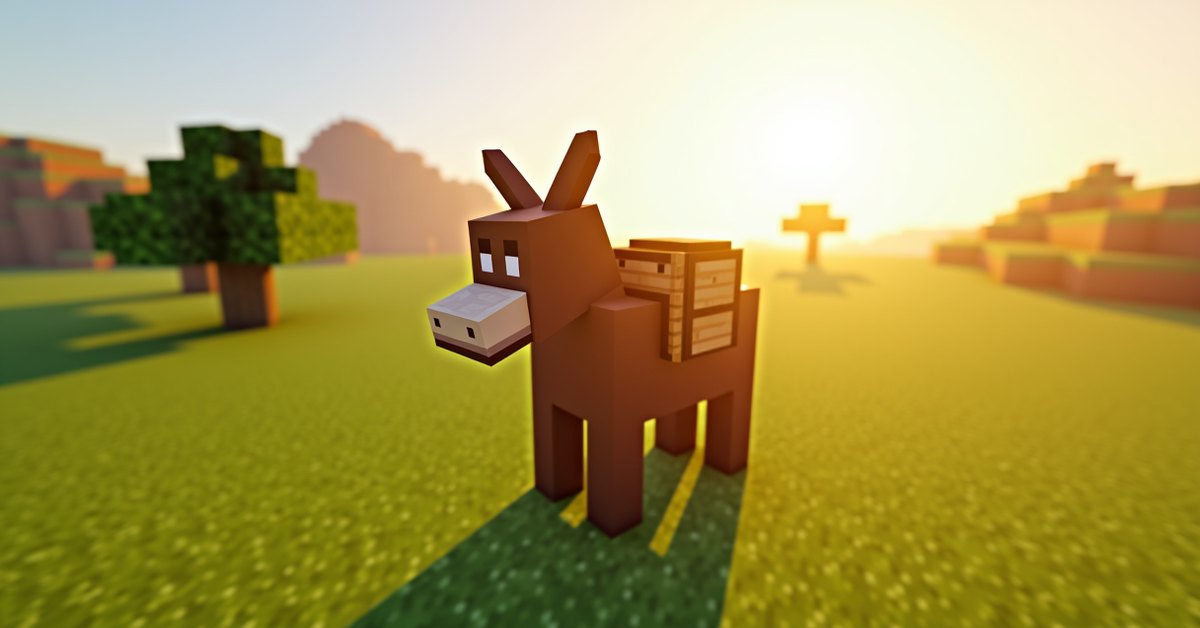
What is a mule in Minecraft?
A mule is a rideable pack animal you get by breeding a horse with a donkey. It looks like a cross between the two: the long ears of a donkey on a slightly leaner, darker body. You can saddle it, ride it, and strap a chest to its side for extra storage on long trips.
The catch is that mules never spawn on their own. You won’t find one wandering a plains biome or standing in a village stable. The only way to get a mule is to breed one yourself, which means you need a tamed horse and a tamed donkey first.
If you want a mount that doubles as a mobile storage box, a mule is one of the best options in the game. Here’s how to make one and what it can do.
How to get a mule
Because mules don’t spawn naturally, breeding is the only path. You’ll need three things: a tamed horse, a tamed donkey, and a breeding food.
Horses spawn in plains, meadows, savannas, and sunflower plains, usually in herds. Donkeys spawn in plains and meadows too, though in smaller numbers. Tame each one by mounting it repeatedly with an empty hand until hearts pop up. The animal will buck you off a few times before it accepts you, and feeding it first makes taming faster.
Once both parents are tamed, feed each of them a golden apple or a golden carrot. Those are the only two foods that trigger love mode in horses, donkeys, and mules. Both animals will show hearts, walk toward each other, and produce a baby mule.
The foal is always a mule. It doesn’t matter which parent you feed first or which way the breeding goes, a horse plus a donkey always equals a mule.
Breeding foods that work
Only golden apples and golden carrots start love mode. A golden apple takes eight gold ingots plus an apple, while a golden carrot takes eight gold nuggets plus a carrot, so the carrot is far cheaper and most players use it for breeding. Regular apples, wheat, and sugar will not trigger breeding, though they do help with taming and healing.
Taming and riding your mule
A baby mule born from breeding is not automatically tamed, and neither is a foal that grows up. You tame it the same way you tamed its parents: hop on with an empty hand, get bucked off, and climb back on until hearts appear.
Feeding the mule before you ride speeds this up. Sugar, wheat, apples, golden carrots, and golden apples all raise its temper, which is the hidden value that decides how quickly it accepts a rider. Golden foods raise temper the most.
Taming alone lets you sit on the mule, but you can’t steer it yet. For that you need a saddle. Mules can’t be crafted a saddle the way some gear is, so you’ll have to find one in dungeon chests, fishing, trading with a leatherworker villager, or looting other structures. Once you have a saddle, open the mule’s inventory and place it in the saddle slot. Now you can control where it walks.
Using a mule for storage
This is the main reason players keep mules around. Like donkeys, a mule can wear a chest, which turns it into a walking storage container.
To add the chest, hold one and use it on the mule, or open the mule’s inventory and place the chest in the equipment slot. The chest gives you 15 extra inventory slots, laid out as a 3 by 5 grid. That’s enough to haul a serious amount of loot back from a mining trip or a far-off structure.
One thing to know before you commit: once a chest is on a mule, you can’t take it back off. The chest stays attached for the rest of the animal’s life. If the mule dies, the chest breaks and drops everything inside, so don’t lead a loaded mule into a creeper or a ravine.
Mule stats: health, speed, and jump
A mule’s stats come from its parents. When a horse and donkey breed, the foal’s health, movement speed, and jump strength are each calculated from the two parents plus a bit of randomness. You can’t fully predict what you’ll get, but breeding two strong parents tends to give a stronger foal.
Health usually lands somewhere between 15 and 30 points, which is 7.5 to 15 hearts. Speed and jump fall in a similar middle range. Mules generally move a touch slower than a fast horse but carry the donkey’s reliability and that all-important chest slot.
One hard limit: a mule cannot wear horse armor. Horses can equip iron, gold, diamond, or leather horse armor for protection, but mules and donkeys can’t use any of it. If you’re heading somewhere dangerous, that’s the trade-off for the storage.
Mule vs donkey vs horse
All three are tamed and ridden the same way, but they fill different roles, and picking the right one saves you trouble.
A horse is the fastest of the three and the only one that can wear armor, which makes it the better choice for combat or quick travel. The downside is that a horse can’t carry a chest, so anything you loot has to fit in your own inventory.
A donkey is slower than most horses but can wear a chest for 15 slots of storage. Donkeys spawn in the world, so they’re the easy starting point for a pack animal. Two donkeys can also breed to make more donkeys, which a mule can’t do.
A mule sits between the two. It carries a chest like a donkey and usually moves a little better, since one parent is a horse. The trade-off is that you have to breed every mule by hand, and you can never make armor work on it. If you already have a tamed horse and donkey, a mule is the natural upgrade over a plain donkey for hauling.
One shared trait worth knowing: all three can be put on a lead and tied to a fence. You can also load a mule or donkey into a boat to ferry it across water, which is the simplest way to move a pack animal over an ocean.
Feeding and healing a mule
Food does more than tame a mule. It also heals injuries and speeds up a foal’s growth. A hay bale restores the most health in one go and is the easiest way to patch up a hurt mule. Sugar, wheat, apples, and the golden foods heal smaller amounts.
If you bred a baby mule and don’t want to wait the full grow-up time, feeding it any of these foods shaves time off. Each feeding nudges the foal closer to adulthood.
Tips and common mistakes
A few things trip up players the first time they raise a mule:
- Don’t expect to find one in the wild. If you want a mule, you have to breed a horse and a donkey. There is no spawn egg path in survival.
- Keep golden carrots on hand. They’re cheaper than golden apples and do the same job for breeding.
- Put a lead on your mule when you’re not riding it. Tie it to a fence so it doesn’t wander off while you explore on foot.
- Tame the foal before you rely on it. A grown mule that was never tamed will still buck you off.
- Never load a chest mule with rare loot and then take a risky shortcut. Losing the mule means losing everything in the chest.
Tamed mules don’t despawn, so once you’ve put in the work, your mule will stay put until something kills it. Name it with a name tag if you want to be sure it never disappears in a chunk-loading mishap.
Frequently asked questions
Can you breed two mules together?
No. Mules are sterile and can’t breed with anything, including other mules, horses, or donkeys. Every mule has to come from a fresh horse-and-donkey pairing. If you want more mules, keep your original horse and donkey parents around.
Can a mule wear horse armor?
No. Only horses can equip horse armor. Mules and donkeys can carry a chest but can’t wear any armor, so they take full damage from mobs and falls.
How many items can a mule carry?
A mule with a chest gives you 15 storage slots, the same as a donkey. The slots are arranged in a 3 by 5 grid in the mule’s inventory screen.
Can you take the chest off a mule?
No. Once you attach a chest, it stays on for good. The only way to get the chest and its contents back is for the mule to die, which drops everything on the ground.
Do mules spawn naturally?
No. Mules are the one common equine you can’t find by exploring. Horses, donkeys, skeleton horses, and zombie horses can all appear in the world, but a mule only exists if a player breeds one.
What do you feed a mule to breed it?
You don’t feed the mule itself, since mules can’t breed. You feed a golden apple or golden carrot to a tamed horse and a tamed donkey, and their baby is the mule.
Is a mule worth making?
If you do a lot of overland travel and want to carry loot without a second trip, a mule earns its keep. It rides like a horse and hauls like a donkey, and the only real cost is a couple of golden carrots and the time to tame the foal. Pick your two best parents, breed once, and you’ll have a pack animal that lasts the rest of the world.