Polished andesite is the smooth, clean-grey version of andesite, one of the most common stone types in Minecraft. If you have ever dug through a cave and pulled out speckled grey blocks, that was andesite. Run four of them through a crafting grid and you get polished andesite, a block with a flat, even surface and no speckles.
Players reach for polished andesite when they want a neutral grey building material that does not look as rough as cobblestone or as busy as raw andesite. It fits modern builds, floors, and trim work without drawing attention to itself.
This guide covers how to make polished andesite, where its raw material comes from, how the block behaves, and the slab and stairs variants you can build with.
What is polished andesite?
Polished andesite is a decorative stone block crafted from raw andesite. Andesite itself is one of three stone variants, alongside diorite and granite, that generate naturally in the Overworld. All three were added in the 1.8 update.
Raw andesite has a mottled grey texture with darker specks scattered across it. Polishing it smooths that texture into a uniform light grey. The polished block reads as cleaner and more deliberate, which is why builders use it for surfaces where raw andesite would look too noisy.
Polished andesite has no effect on gameplay beyond decoration. It is not a redstone component, it cannot be used for tools, and it does not power anything. Its value is visual and structural.
How to make polished andesite
You cannot find polished andesite in the world. It does not generate in caves or structures, so every polished andesite block you own has to be crafted. There are two ways to do it.
Crafting recipe
The standard recipe takes four andesite arranged in a two-by-two square. That square fits in the small crafting grid in your inventory, so you do not even need a crafting table. Four andesite in, four polished andesite out. The ratio is one to one, so you never lose material.
If you need andesite first, it has its own recipe. Place one diorite next to one cobblestone in the crafting grid and you get two andesite. Diorite, in turn, comes from two cobblestone and two nether quartz. In practice most players skip all of this and simply mine andesite, since it is everywhere underground.
Using a stonecutter
The stonecutter is the faster option. Put andesite into a stonecutter and it offers polished andesite as one of the cut results, one block for one block. The stonecutter also lets you cut straight to polished andesite slabs and stairs without crafting the full block first, which saves time and inventory space on big projects.
For anything larger than a small decoration, the stonecutter is the better tool. It is cheap to make, taking one iron ingot over three stone, and it removes the crafting-grid fiddling entirely.
Where to find andesite
Since polished andesite is always crafted, the real question is where to get its raw material. Andesite generates in blobs throughout the Overworld’s stone, from just below the surface down into the deep cave layers. Almost any cave trip or mining run turns up plenty of it, often in large pockets.
Andesite is mined with any pickaxe, and a wooden one works fine. If you break it without a pickaxe the block is destroyed and drops nothing, so keep one on your hotbar before you dig. Andesite drops itself when mined. Unlike stone, which turns into cobblestone, it has no separate cobbled form, so what you mine is what you carry home.
Because andesite is so common, polished andesite ends up being one of the cheapest building blocks in the game. If you are planning a large grey build, a single mining session usually gathers more than enough raw material to work with.
Polished andesite properties and behavior
Polished andesite behaves like ordinary stone in almost every way. It has a hardness of 1.5 and a blast resistance of 6, the same numbers as stone and raw andesite. That makes it reasonably tough but far from blast-proof; a creeper or TNT will still break through it without much trouble.
The block is fully solid and opaque. Hostile mobs can spawn on top of it in the dark, pistons can push and pull it, and redstone dust runs across it like any other full block. It is not flammable, so it is safe to place next to lava, fire, or a working furnace.
Mining polished andesite always returns the block itself, whether or not you use Silk Touch, and Fortune has no effect on it. The only requirement is a pickaxe of any tier. Break it by hand and the block is lost.
Polished andesite slabs and stairs
Polished andesite comes in two shaped variants: a slab and a stairs block. Both were added in the 1.14 Village and Pillage update, which filled in stair and slab versions for many decorative stones.
To craft the slab, place three polished andesite in a horizontal row for six slabs. For stairs, arrange six polished andesite in the usual staircase shape for four stairs. A stonecutter makes both more efficiently, turning a single block into a single slab or stair piece with no wasted material.
Polished andesite slabs can sit in the top or bottom half of a block space, and stacking two of them in the same spot rebuilds a full block. The stairs handle corners and edges the way any other stair block does, which makes them useful for steps, rooflines, and clean trim.
One gap worth knowing: polished andesite has no wall variant. Raw andesite does have an andesite wall, so if your design needs a wall, use the unpolished version or pair it with a different block. This catches a lot of builders off guard partway through a project.
Building with polished andesite
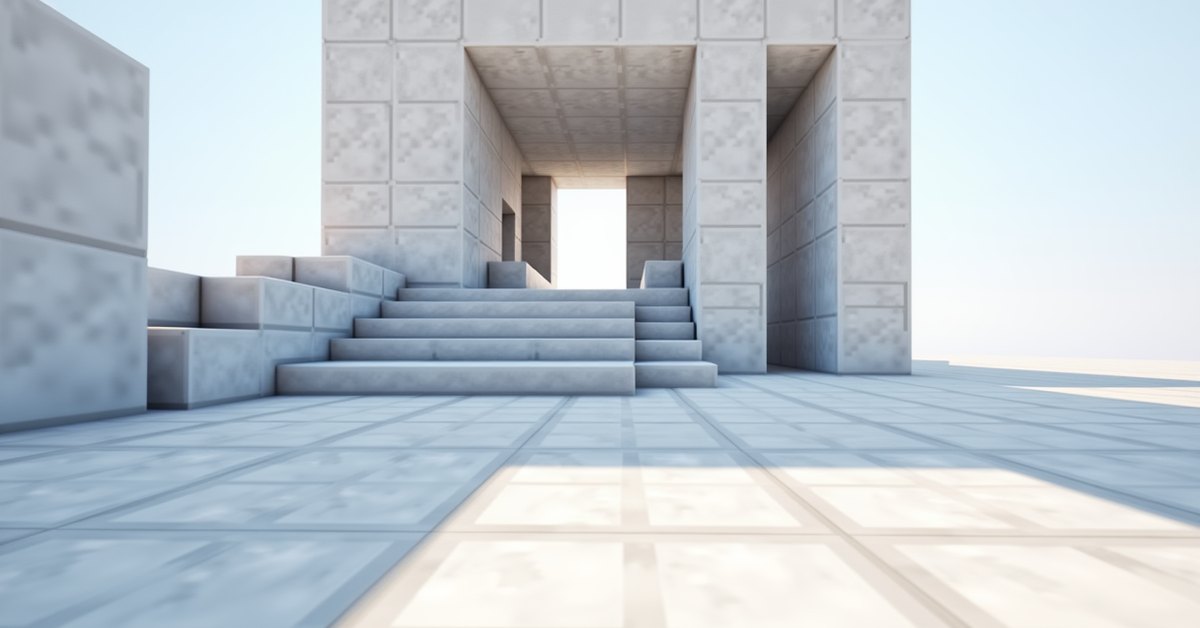
Polished andesite’s main job is decoration. Its flat grey tone sits comfortably next to a wide range of materials, which is what makes it so useful. The polished texture has no grain or direction, so it tiles cleanly across big floors and walls without an obvious repeating pattern.
It pairs well with white and grey concrete for modern builds, with stone bricks for a more traditional look, and with quartz when you want a clean light-and-dark contrast. As a floor it gives a smooth, understated base that does not fight with whatever you place on top. As trim or pillars it adds structure without bright color.
Because the block is so cheap to produce, it works for large surfaces where a fancier material would be a grind to gather. Plazas, roads, foundations, and big interior floors are all good fits for it.
Tips and common mistakes
A few things trip players up with polished andesite:
- You cannot turn polished andesite back into andesite. The recipe only runs one direction, so polish only what you plan to use.
- Breaking andesite or polished andesite without a pickaxe destroys it for nothing. Always carry a pickaxe before you mine.
- If you need a wall, remember polished andesite does not have one. Switch to raw andesite for that piece.
- Use a stonecutter for any sizable build. Crafting works, but the stonecutter is faster and cuts straight to slabs and stairs.
- Do not confuse the three stone variants. Andesite is grey, granite is pink, and diorite is white. Only andesite gives you that neutral grey.
Frequently asked questions
Is polished andesite the same as andesite?
No. Andesite is the raw, speckled stone you mine underground. Polished andesite is the smooth version you get by crafting four andesite together. They are separate blocks with different textures.
Can you make polished andesite without a crafting table?
Yes. The recipe is a two-by-two square, which fits in the crafting grid built into your inventory. You only need a crafting table for recipes that require the full three-by-three grid. A stonecutter also works.
Does polished andesite generate naturally?
No. Only raw andesite generates in the world. Polished andesite does not appear in caves or structures, so it always has to be crafted.
Can you turn polished andesite back into andesite?
No. There is no recipe to reverse it. Once andesite is polished, it stays polished, so only craft as much as you need.
Does polished andesite have a wall variant?
No. Polished andesite has a slab and a stairs block but no wall. Raw andesite is the variant with a wall, so use that if your build calls for one.
What is the fastest way to make a lot of polished andesite?
A stonecutter. Feed it andesite and take out polished andesite one for one, or cut directly to slabs and stairs. For large builds it beats the crafting grid easily.
What pickaxe do you need to mine polished andesite?
Any pickaxe, including a wooden one. There is no minimum tier. The only rule is that it has to be a pickaxe; mining it by hand drops nothing.
Should you use polished andesite?
If you want a grey building block that is cheap and easy to gather in bulk, polished andesite is one of the best options in the game. Keep a stonecutter near your storage, mine andesite whenever you are underground anyway, and you will rarely run short of it for floors, trim, and large neutral surfaces.