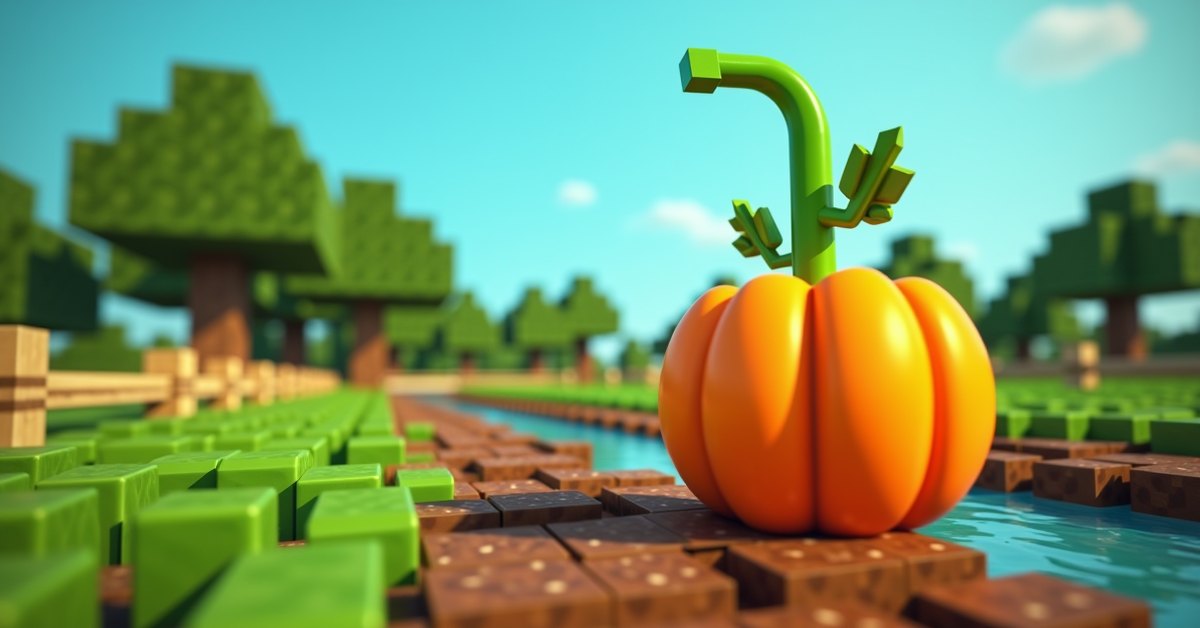
A pumpkin stem is the plant that produces pumpkins in Minecraft. You never place one directly. It grows from a pumpkin seed, climbs through several stages, and then sprouts a pumpkin on a block next to it.
If you have ever planted pumpkin seeds, watched the stem turn fully grown, and still ended up with no pumpkin, the stem itself is rarely the problem. The space around it almost always is.
This guide covers how the stem grows, the one rule that decides whether it fruits, what it drops, and how to lay out a farm that actually produces.
What is a pumpkin stem?
The pumpkin stem is a crop block. Plant a pumpkin seed on farmland and it becomes a short green stem. Over time the stem grows taller and lighter in color until it reaches full height.
A fully grown stem does not turn into a pumpkin. Instead, it grows a pumpkin on one of the four blocks directly beside it. When that happens, the straight stem bends over and connects to the pumpkin. This bent version is called an attached pumpkin stem.
Once you harvest the pumpkin, the attached stem straightens back out and starts working on another one. A single stem can keep producing pumpkins for as long as it stays planted and has room.
Melon stems work the same way. If you understand one, you understand both.
How to get pumpkin seeds
You plant seeds, not stems, so the stem starts with getting pumpkin seeds. There are two reliable sources.
The most common is crafting. Place a single pumpkin anywhere in the crafting grid and it returns four pumpkin seeds. One pumpkin is plenty to start a farm, since every stem you grow makes more pumpkins, and each of those pumpkins crafts into four more seeds.
You can also find pumpkin seeds in generated chests, including those in mineshafts, dungeons, and villages. Early in a world, before you have come across a wild pumpkin, a lucky chest is often how players get their first seeds.
To plant, hold the seeds and use them on a farmland block. Farmland is made by working dirt or grass with a hoe. The seed shows up as a tiny stem right away.
How a pumpkin stem grows
Growth stages
A pumpkin stem passes through eight growth stages. It starts short and dark green and ends tall and pale. The stem only advances when the light level on it is 9 or higher, so a farm needs sky access or torches nearby.
Growth happens at random, a little at a time. Hydrated farmland, meaning farmland within four blocks of water, speeds it up. Bone meal works too: using bone meal on a stem pushes it through its stages fast. There is one thing bone meal does not do, though. It grows the stem, never the pumpkin. No amount of bone meal will make a fruit appear.
Crop spacing also matters. Stems planted in a solid block of the same crop grow slower than stems given a little breathing room, so a checkerboard or single-row layout beats cramming plants together.
When the pumpkin appears
Once the stem is fully grown, it checks the four blocks around it for a place to put a pumpkin. For a pumpkin to spawn, one of those neighboring blocks has to be dirt, grass, podzol, coarse dirt, mycelium, or farmland, and the space above that block has to be air.
If all four neighbors are blocked, occupied, or the wrong material, the stem just sits there fully grown and does nothing. This is the most common reason a stem never fruits. The stem is fine. It has nowhere to put the pumpkin.
When the conditions are met, the pumpkin appears on its own after a random delay. The stem then bends toward it. Break the pumpkin and the cycle repeats. While that pumpkin is still attached, the stem will not start a second one, so harvesting it promptly keeps the farm moving.
What a pumpkin stem drops
Breaking a pumpkin stem, at any stage, drops 0 to 3 pumpkin seeds. You cannot collect the stem as a block and replant it. The only thing it gives back is seeds.
Because the drop is random, breaking a stem sometimes gives nothing at all. If you are reworking a farm and want to keep your seed count high, break the pumpkins and leave the stems in the ground so they keep producing.
The stem breaks instantly with any tool or with your bare hand, and it gives no experience. An attached stem behaves the same way: break it and you still get the same handful of seeds, never the pumpkin it was feeding.
Building a pumpkin farm
A working pumpkin farm is mostly about geometry. The stems need farmland; the pumpkins need bare dirt or grass next to that farmland.
The simplest manual layout is a row of farmland with the stems planted on it and a parallel row of dirt or grass right beside it for the pumpkins. Keep that second row clear. Anything sitting on it, even a torch or a slab, blocks the pumpkin from spawning.
Place a water source every few blocks so the farmland stays hydrated, and light the area so the stems stay above light level 9 and mobs do not spawn on your dirt.
For a hands-off version, players build automatic farms with redstone. An observer watches the block where the pumpkin grows. The moment a pumpkin appears, the observer fires a piston that breaks it. The pumpkin pops off as an item, lands on hoppers, and flows into a chest. The stem straightens and immediately starts the next one.
What to do with the pumpkins
Growing pumpkins is worth the farmland because the fruit pulls real weight. Use shears on a plain pumpkin and it becomes a carved pumpkin, which is the block you need to build an iron golem or a snow golem. Wear a carved pumpkin on your head and endermen will not turn hostile when you look at them.
Put a torch inside a carved pumpkin and you get a jack o’lantern, a bright light source that even works underwater. Pumpkins also craft into pumpkin pie with sugar and an egg, one of the easier filling foods to mass produce once a farm is running.
The seeds have a use of their own. Chickens follow and breed with pumpkin seeds, so a pumpkin farm doubles as a way to stock a chicken coop.
Common mistakes
The mistake behind almost every “my stem won’t grow pumpkins” question is a missing empty block beside the stem. Plant your stems with bare dirt or grass next to them and leave that space alone.
Another is expecting bone meal to finish the job. It matures the stem and stops there. After that, you wait.
Watch your step, too. Jumping on farmland turns it back into dirt, and a stem on reverted farmland pops off as seeds. Walk around your crops, fence the farm off, or cover the path with slabs or carpet.
Last, do not crowd the stems. If two stems share the same patch of dirt, they compete for the same pumpkin spots, and tightly packed crops grow slower anyway. A little room between plants pays off twice.
Frequently asked questions
Why won’t my pumpkin stem grow a pumpkin?
The stem needs an empty block of dirt, grass, podzol, coarse dirt, mycelium, or farmland directly beside it, with air above that block. If every neighbor is blocked, a fully grown stem produces nothing. Clear a space and a pumpkin will appear.
Can you use bone meal on a pumpkin stem?
Yes. Bone meal speeds the stem through its growth stages. It will not create the pumpkin itself, though. Once the stem is mature, the fruit grows on its own timer.
What does a pumpkin stem drop?
It drops 0 to 3 pumpkin seeds when broken, at any growth stage. You cannot collect the stem block itself.
Can one pumpkin stem make more than one pumpkin?
Yes. A stem grows one pumpkin at a time. Once you harvest that pumpkin, the stem starts another. Leave the stem planted and it produces over and over.
Do pumpkin stems need water?
Not strictly. A stem on dry farmland still grows. Water keeps the farmland hydrated, which makes the stem grow faster, so a water source nearby is worth the effort.
Are pumpkin stems and melon stems the same?
Mechanically, yes. They grow through the same stages, follow the same light and space rules, and drop their own seeds. The only difference is the fruit at the end.
Why did my pumpkin stem disappear?
The likely cause is trampled farmland. Jumping on farmland reverts it to dirt, and the stem cannot stay on plain dirt, so it breaks off. Protect the farmland and the stem stays put.
The pumpkin stem rewards planning over patience. Get the empty dirt block right the first time and the stem handles the rest. It quietly turns out pumpkins every time you clear the last one, so one good row set up early means you will not run short of carved pumpkins, jack o’lanterns, or pumpkin pie again.