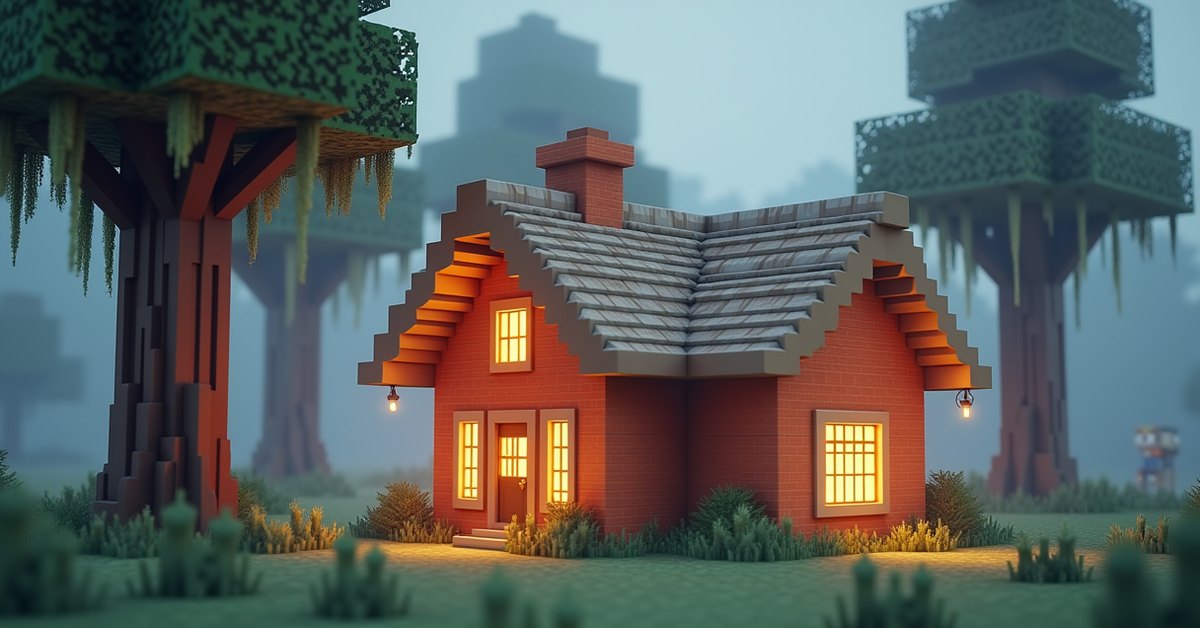
What are resin bricks?
Resin bricks are an orange building block in Minecraft, made from resin you gather in the Pale Garden. They give builders a warm amber color in block form without any dye, which fills a real gap, since orange has always been one of the harder colors to get as plain blocks.
The block arrived with the 1.21.4 update at the end of 2024, the same release that added the Pale Garden biome, the Creaking, and pale oak wood. Bedrock players got the matching content in the same winter update.
Resin bricks are not something you stumble on in the world. You build them from a raw material that has exactly one source, so the bulk of this guide covers how to find that source and turn it into blocks.
Finding the Pale Garden
Resin only exists in the Pale Garden, so that biome is the first thing to track down. The Pale Garden is a gray, washed out woodland full of pale oak trees, pale moss, and hanging moss that drips from the branches. It tends to generate near or inside dark forest regions, and it is easy to recognize because the color drains out of everything once you step in.
The biome is quiet on purpose. Passive animals do not spawn there, and the lighting stays dim even at midday. The one flower you will see is the eyeblossom, which opens at night and closes during the day. That stillness is the cue that you are in the right place and that a Creaking is somewhere nearby.
Where resin comes from
Resin starts as resin clumps, a crusty amber growth that forms on pale oak logs. You will not find clumps sitting around on their own. They show up because of the Creaking, the hostile mob built into this biome.
Every Creaking is linked to a creaking heart block hidden inside a pale oak tree. The creaking heart turns active at night and spawns the Creaking. The mob only moves when no player is looking at it, and it freezes the moment you turn to face it. Hitting the Creaking with a weapon does not kill it. What your attacks do is make resin clumps sprout on the pale oak logs around the creaking heart.
So the gather loop looks like this. Find a Creaking after dark, hit it a few times, and watch resin clumps build up on the logs near its heart. The more you strike it, the more clumps grow. Then mine those clumps off the wood. You can also break the creaking heart itself, which ends the Creaking and releases resin. And if you simply wait, any active Creaking crumbles when morning comes and leaves a resin clump behind.
Because the creaking heart keeps producing Creakings night after night, a single tree with a heart works as a renewable resin source. Farming it does not use the biome up.
Harvesting resin clumps
Resin clumps break fast and you can collect them by hand, so you do not need a special tool. Each clump you mine drops resin clump items to carry home. A clump that has been hit and grown several times yields more than a small fresh one, so it pays to strike the Creaking a few extra times before you start mining.
Using resin clumps as decoration
You do not have to smelt every clump. Resin clumps can be placed straight onto the side, top, or bottom of almost any block, much like glow lichen, and they keep their rough amber look. They make a good detail for grime, rust, or a worn surface on a build, and they cost nothing extra to use since you skip the furnace. Keep a few stacks raw if your build wants texture rather than clean brick.
How to craft resin bricks
Turning raw resin into the finished block takes two steps. This is the part that trips people up, because it is tempting to assume you can craft the block straight from clumps.
First, smelt resin clumps in a furnace. Each resin clump becomes one resin brick item. The resin brick item is an ingredient, not the block you build with, the same way a clay ball has to be smelted into a brick before it is useful.
Second, place four resin brick items in a 2×2 square on the crafting grid. That produces one resin bricks block. Repeat the smelt and craft cycle until you have a stack large enough for your project.
How much resin you actually need
It helps to think in clumps before you set out. Four resin brick items make one block, and each brick item is one smelted clump, so every resin bricks block costs four resin clumps. A full stack of 64 blocks works out to 256 clumps.
That sounds steep, but the variants stretch the material. One block becomes six slabs on a stonecutter, so a roof or a floor in slab form covers far more area per clump than full blocks would. If resin is tight, lean on slabs and stairs and save full blocks for the parts that need the bulk. It also means fuel matters: a long building session can call for dozens of blocks, and every clump in the furnace burns coal or charcoal, so stock up before you start.
Resin brick variants
Once you have resin bricks blocks, you can shape them into the standard building family. Each variant works on an ordinary crafting table, and a stonecutter does the same job with less waste.
- Resin brick stairs, arranged from resin bricks in the usual stair pattern.
- Resin brick slabs, from a row of three resin bricks.
- Resin brick walls, from resin bricks laid in two rows.
- Chiseled resin bricks, made by stacking two resin brick slabs.
Keep a stonecutter handy for this. Drop a resin bricks block into it and you can cut stairs, slabs, walls, or the chiseled version directly. The stonecutter is especially worth it for stairs, since the crafting table recipe gives back fewer stairs than the blocks you put in, while the stonecutter trades one for one.
Chiseled resin bricks are the most interesting piece of the set. The block face carries a carved design that looks like the Creaking peering back at you, which makes it a strong pick for a centerpiece or an eerie accent on a wall.
Building with resin bricks
Orange is genuinely awkward to get as a plain block. The usual options are orange terracotta, orange concrete, and orange wool, and all of them need orange dye, which means farming the right flowers or trading for it. Resin bricks skip that whole chore.
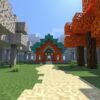
The color lands in a warm orange range that reads well as roofing, as a brick accent against gray stone, or as a full facade on an autumn or desert themed build. With the stair and slab variants in the same color, you can carry that orange through trim and rooflines without a single mismatch.
The chiseled version earns its place as a decorative panel. Set into a flat wall of plain resin bricks, it breaks up the surface and gives the eye a focal detail. A line of chiseled blocks above a doorway or under a roof edge is a quick way to make a plain build look deliberate.
Tips and common mistakes
A few habits make a resin run go smoother:
- Do not burn through a sword trying to kill the Creaking. It will not die from your hits. Striking it only grows resin clumps, and breaking its heart is what actually ends it.
- Do not forget the two step craft. Clumps have to be smelted into resin brick items before the 2×2 block recipe will work.
- Pack extra fuel. Smelting a big haul of clumps eats coal quickly, and running dry mid batch means a trip back.
- Note down where the creaking heart sits. Since it keeps regrowing resin, a marked heart is a farm you return to rather than a one time trip.
- Work after the heart is gone or after sunrise if you want quiet. Creakings stop being a problem once daylight hits or once their heart is broken.
Frequently asked questions
What update added resin bricks?
Resin bricks came in the 1.21.4 update, released in December 2024, together with the Pale Garden biome and the Creaking. Bedrock players got the same content in the matching winter update.
How do you get resin in Minecraft?
Resin comes from resin clumps that grow on pale oak logs in the Pale Garden. Attacking a Creaking makes clumps form on the logs around its creaking heart, and you mine them from there.
Can you craft resin bricks without a furnace?
No. Resin clumps have to be smelted into resin brick items first, and smelting needs a furnace. There is no recipe that skips the smelting step.
Are resin bricks renewable?
Yes. A creaking heart keeps spawning Creakings night after night, and each one is another chance to grow resin clumps, so resin bricks count as a renewable building block.
What color are resin bricks?
Resin bricks are a warm orange close to amber. They are one of the few orange building blocks you can get without crafting any dye.
Can resin bricks be made into stairs and slabs?
Yes. Resin bricks support the full set of stairs, slabs, and walls, plus a chiseled variant. A stonecutter can cut all of them quickly.
Is the Creaking dangerous?
The Creaking can hurt you, and it closes distance only when you are not looking at it, which makes it tense to deal with. It cannot be killed by normal attacks, so the safe play is to break its creaking heart or wait for daylight rather than trading blows.
Is resin worth farming?
The Pale Garden is built to make you uneasy, and the Creaking does its job of keeping you on edge. The payoff is an orange block you can produce for as long as your world exists. Find a creaking heart, mark it on your map, and you have a steady orange supply line that no other block hands you for free.