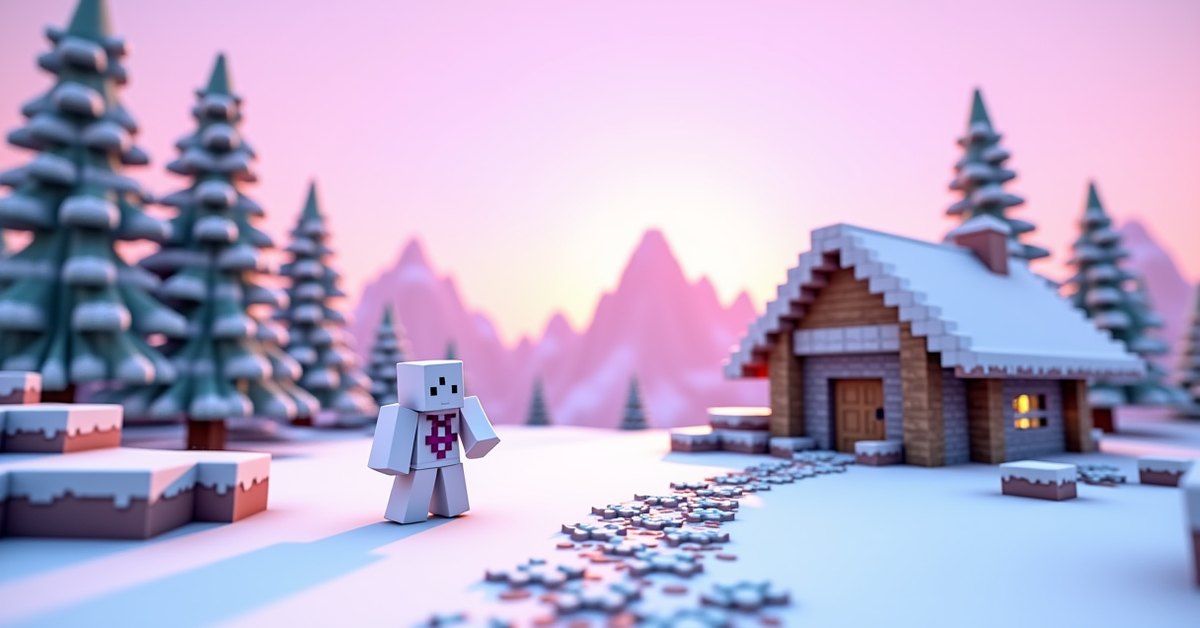
What snow is in Minecraft
Snow is the thin white layer that piles up on top of blocks during snowfall. It’s the sheet you see covering roofs, trees, and ground in cold biomes, and it comes in eight stacking heights. A single layer barely slows you down. Eight layers reach the same height as a full block.
This page is about the snow layer block. The full snow block (the solid cube you craft from snowballs) is a separate item with different behavior. Both are useful, and you’ll often want a mix of the two in your inventory.
Where snow comes from
Snow accumulates naturally during snowfall in any biome cold enough to drop snow instead of rain. Snowy plains, snowy taiga, snowy slopes, ice spikes, frozen peaks, and the upper sections of jagged peaks all qualify. Warm biomes drop rain, not snow, so a snowy roof on a plains house won’t survive a storm.
In Java Edition (version 1.17 and later), snow can stack up to eight layers during a single snowstorm if “weather snow accumulation” is enabled in your world settings. On Bedrock Edition, the first layer forms reliably but additional layers from weather alone are inconsistent. If you want a deep pile on Bedrock, plan to place it yourself.
You can also collect snow by mining it (with or without Silk Touch) or by tailing a snow golem. The golem leaves one snow layer behind it every few ticks while walking through a cold biome.
How to mine snow
Any tool breaks a snow layer, but a shovel does it fastest. A wooden shovel takes about a tenth of a second per layer, and a netherite shovel breaks it instantly. Without Silk Touch, snow drops snowballs: one per layer, so a full eight-layer pile drops eight snowballs. With Silk Touch on the shovel, the block drops as a snow layer item that stacks in your inventory and places back exactly the way it was.
Bare hands work too, just slowly. Other tools (axes, pickaxes, swords) will break snow but burn extra durability for no benefit. A cheap iron or stone shovel handles the job fine.
How snow layers accumulate
Three things need to be true for snow to land on a block. First, the biome has to be cold enough. Second, the block on top has to be solid with a full top face. Third, the sky above the spot has to be clear (no roof). Glass, upside-down slabs, fences, and most non-full blocks won’t catch snow. Leaves are an exception in Java and switch to a snowy texture during snowfall, but they don’t pile up snow layers you can mine.
Snow forms one layer at a time during a snowstorm. Each layer is two pixels tall in-game. When the pile reaches the eighth layer, it visually matches a full block but still behaves as snow, so mining it gives snowballs (or a snow layer with Silk Touch), not a snow block.
Crafting and recipes with snow
The snow layer itself isn’t a crafting ingredient, but snowballs and snow blocks are. Three recipes matter:
- Four snowballs in a 2×2 square give one snow block.
- Three snow blocks placed in a horizontal row in a crafting grid give six snow layers in the output slot.
- Two snow blocks stacked vertically in the world, with a carved pumpkin, jack o’lantern, or regular pumpkin on top, spawn one snow golem. In Java the pumpkin has to be placed last; Bedrock is more forgiving about build order.
The second recipe is the easiest way to get a stack of snow layers for decorating. Snowballs themselves stack to 16, deal 3 damage to blazes, and do no damage to other mobs.
What snow does in the world
Snow layers change the block underneath into its snowy variant when applicable. Grass blocks become snowy grass, podzol becomes snowy podzol, mycelium becomes snowy mycelium. The variant flips back to normal if you remove the snow. The change is cosmetic but makes a big difference for builds in cold biomes.
Walking on snow doesn’t slow you down at one or two layers. Three to seven layers feel a little draggy. An eight-layer pile acts like a full block, so you have to jump to step onto it. Mobs handle it the same way you do.
Snow extinguishes fire on entities. If you’re burning and land on snow, the fire goes out. It doesn’t stop zombies or skeletons from burning in sunlight, though, so a daytime mob grinder built on snow won’t save you any work.
How snow melts
Snow melts when the block-light value at its position reaches 12 or higher. Block-light comes from torches, glowstone, sea lanterns, lava, and similar artificial sources. Skylight does not melt snow, which is why snow survives daytime in cold biomes.
A torch (light level 14) melts snow up to two blocks away. Glowstone and sea lanterns (light level 15) melt up to three blocks. Soul torches (light level 10) and soul lanterns (light level 10) don’t melt snow at any range, which makes them the right pick for lighting up a snowy build. Candles cap at light level 12 and melt only the block they sit on.
Snow also melts almost immediately if you place it in a warm biome (plains, desert, savanna), regardless of light level. Temperature, not just light, is in play.
Best uses for snow
A handful of practical uses outside of decoration:
- Snowball stockpiling. A snow farm with a snow golem inside a small enclosure gives infinite snowballs. Useful against blazes and the ender dragon.
- Roof and accent texture. The white-on-white look fits igloos, mountain bases, and snowy village rebuilds without needing any dye.
- Disguised pressure plates. A single snow layer over a pressure plate or tripwire in a snowy biome blends in well enough that visitors walk right onto it.
- Subtle landscaping. Patchy snow on a snowy slopes build looks more natural than a flat layer everywhere. Place layers by hand for a broken pattern.
Common mistakes
The most common mistake: trying to place snow on a non-solid block (a slab, fence, carpet, or glass) and wondering why it won’t stick. The block underneath needs a full solid top face.
The second most common: melting it by accident. A single torch on a snowy roof clears the snow in a two-block radius within a few seconds. Soul torches or candles solve this when you still need light.
The third: confusing snow with snow blocks. The two items don’t stack together in your inventory, and only the block makes snowballs back when you mine it. Mining a snow layer roof gives you snowballs, not the layers you placed.
Java vs Bedrock differences
The biggest difference is weather accumulation. In Java (1.17 and later), snow can pile up to eight layers naturally during a long snowstorm. In Bedrock, only the first layer forms reliably from weather. If you’re on Bedrock and want a deep snowfield, plan to place layers by hand or use a snow golem farm.
Snow golem behavior is otherwise the same on both editions, and both versions follow the same melt rules (block-light 12 or higher melts snow; warm biomes melt it on contact).
Frequently asked questions
Can I place snow on glass?
No. Snow needs a solid block with a full top face underneath. Glass, slabs, stairs, fences, and most non-full blocks won’t hold a snow layer.
Does snow melt in warm biomes?
Yes. A snow layer placed in plains, desert, savanna, or any warm-temperature biome disappears within seconds. Snow only stays put in biomes with a low enough temperature value.
What’s the difference between snow and a snow block?
Snow is the thin layer (one to eight stacks). A snow block is a solid cube crafted from four snowballs. They have different inventory items, different mining behavior, and only the snow block can be used to build a snow golem.
Can you walk on a full eight-layer pile of snow?
Not without jumping. Eight layers act as a full-block obstacle. One or two layers are fine to walk straight through; three to seven slow you down a little.
Do I need Silk Touch to get a snow layer item?
Yes, if you want the layer back as a placeable item. Without Silk Touch, mining a snow layer gives you snowballs instead. Silk Touch on a shovel is the cheapest way to collect snow for builds.
Why do my torches melt snow?
Block-light values above 11 melt snow. A regular torch gives off light level 14, so any snow within two blocks of a torch disappears. Use soul torches (light level 10) for lighting that won’t melt snow.
How do I farm snowballs?
Build a snow golem inside a one-block-wide trench in a snowy biome. The golem leaves a snow layer on the block under it every few seconds. A piston, a hopper-minecart, or even your own shovel breaks the layer into a snowball that hoppers can collect.
A practical note
If you’re choosing between building with snow layers and snow blocks, layers give you more visual control (eight heights instead of one) and the snowy-variant effect on the ground beneath them. Snow blocks pack more snowballs per inventory slot and won’t melt at lower light levels. For a snowy roof, layers look better. For an army of snowballs, blocks are the right call.