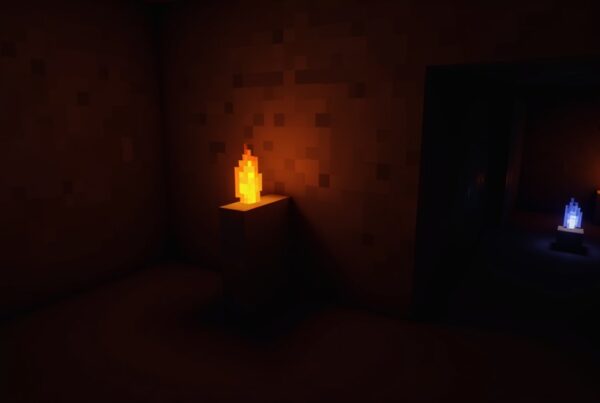
A soul campfire is a darker, colder version of the regular campfire. The flames burn blue instead of orange, the smoke is teal, and it does more damage if you step on it. It also has one extra trick that the regular version doesn’t: piglins are afraid of it.
Most players run into a soul campfire for the first time in the Nether, after picking up some soul soil. Once you know the recipe and the rules, it’s a useful block for both lighting and crowd control.
This guide covers the crafting recipe, how the block behaves, the damage numbers, and the reasons to use one over a normal campfire.
What is a soul campfire?
The soul campfire is a Nether-themed variant of the regular campfire, added in the Nether Update (version 1.16). It works as a light source, a cooker, and a signal block. It differs from the standard campfire in three ways:
- It uses soul soil or soul sand in the recipe instead of coal.
- It emits a lower light level (10 instead of 15).
- It deals twice as much damage if a mob or player stands on top of it.
That last point is what makes it useful in piglin-related builds. Piglins treat soul fire as a threat. A lit soul campfire within 8 blocks will make any nearby piglin flee, which is one of the easier ways to keep a Nether base safe without walls everywhere.
How to craft a soul campfire
Soul campfires use the same recipe shape as regular campfires, with one ingredient swap. In a crafting table, place:
- A stick in the top-middle slot
- Sticks in the left-middle and right-middle slots
- One soul soil or one soul sand in the center slot
- Three logs (or stripped logs, or wood) across the bottom row
Any log type works for the bottom row, and you can mix them. Soul soil and soul sand are interchangeable for the recipe.
You’ll need to visit the Nether to gather soul soil or soul sand. Both spawn in the Soul Sand Valley biome, and soul sand also generates in patches near nether fortresses and at the base of nether wart farms inside those fortresses.
The recipe gives you one soul campfire per craft.
How to place, light, and put it out
Place a soul campfire like any other block. It snaps to the top of the block underneath, and it can sit on most solid surfaces. It lights up by default when you place it.
To put it out, do one of the following:
- Use a water bucket or place water on top of it
- Wait for rain to fall on it (if it’s exposed to sky)
- Right-click it with a shovel (the cleanest way)
An extinguished soul campfire still exists as a block, just with the flames off. You can relight it with flint and steel, a fire charge, or any other ignition source.
A lit soul campfire doesn’t set nearby blocks on fire, even flammable ones. That’s a practical difference from regular fire and one reason campfires are popular as decorative light sources in wooden builds.
Soul campfires can be waterlogged. Placing water in the same block keeps the campfire there but turns the flames off.
Damage and how it works
A soul campfire deals 2 damage per damage tick when something stands on it. That’s one full heart per tick, double what a regular campfire does (which deals 1 damage, half a heart).
A few things to know about the damage:
- Mobs walking onto a lit soul campfire take damage every half-second.
- Sneaking (crouching) prevents damage. You can stand on a lit campfire safely if you’re sneaking.
- Damage only applies when the campfire is lit. An extinguished one is harmless.
- Fire resistance potions block the damage entirely.
This makes soul campfires useful as the damage block in mob traps. Drop the mob from a fall, land it on a soul campfire, and the campfire finishes it off without burning the surrounding floor.
Light level
A lit soul campfire emits light level 10. For comparison, a regular campfire emits 15, the same as a torch.
Light 10 is enough to prevent most hostile mob spawns nearby, but it falls off faster than torch light, so you may need to space soul campfires more tightly than torches if you’re using them as your only light source.
Cooking food
A soul campfire cooks food the same way a regular campfire does. Drop a raw food item onto the lit block, or right-click it with food in hand, to start cooking. You can hold up to four food items on one campfire at the same time, and they cook in parallel.
Each food item takes 30 seconds to finish. When it’s done, the cooked food pops off the campfire and drops as a regular item entity, so put a hopper underneath if you want to collect cooked food automatically.
Soul campfires accept the same foods as regular campfires: raw meat, raw fish, and potatoes.
A soul campfire does not cook food faster than a regular campfire, despite the higher damage. The cook time is identical.
Scaring piglins
This is the soul campfire’s signature use. Piglins are afraid of soul fire, and a lit soul campfire counts as soul fire for that purpose. Any piglin within 8 blocks of a lit soul campfire will run away from it.
Common ways to use this:
- Place soul campfires around a Nether base or trading floor to keep piglins from wandering inside.
- Surround a portal landing zone in the Nether with a few soul campfires to give yourself a safe spot to spawn back into.
- Use a ring of soul campfires to herd piglins toward a barter farm without doors.
Piglin brutes are not afraid of soul fire. The fear behavior only applies to regular piglins.
Zombified piglins also ignore soul campfires. They’re already burned, so the fire mechanic doesn’t faze them.
Smoke and signal fires
A lit soul campfire produces blue-teal smoke that rises about 10 blocks straight up. That’s the same height as a regular campfire’s smoke column.
If you place a soul campfire directly on top of a hay bale, the smoke column rises 24 blocks instead. This is called a signal fire, and it’s how the block was originally designed to be visible from a long distance. It’s good for marking your base location or a meeting point on a multiplayer server.
Soul campfire smoke passes through blocks above it, so even if there’s a ceiling, the smoke will still travel up through whatever’s overhead. That’s a small detail that can confuse new players who expect the smoke to stop at a solid block.
Tips and common mistakes
A few things that trip players up:
- Don’t confuse soul campfires with regular campfires when setting up a piglin defense. Only the soul version scares piglins. A normal campfire does nothing to them.
- Don’t expect a soul campfire to light up a room the same way a torch does. The light radius is smaller, so plan accordingly.
- Use silk touch if you want to recover the campfire block itself when mining it. Without silk touch, breaking a soul campfire drops 2 soul soil instead of the block.
- Mobs can path over an unlit soul campfire. If you’re using one as a damage block in a trap, make sure it stays lit.
- Sneaking through a lit soul campfire is the only way to cross it safely. Any movement other than sneaking triggers damage.
Java vs. Bedrock differences
The block works the same way in both editions for most purposes: same recipe, same damage, same light level, same piglin behavior.
One small Bedrock-specific note: the signal fire smoke column on top of a hay bale is the same 24-block height in both editions, but the smoke effect renders slightly differently in Bedrock because of the rendering engine. It’s a visual difference only.
Frequently asked questions
Does a soul campfire stop mobs from spawning?
Yes, within its light radius. Light level 10 is enough to block most hostile spawns. Some mobs (like blazes or magma cubes) have their own spawn rules that don’t depend on light, so the campfire won’t stop everything.
Can you sleep next to a soul campfire?
Yes. A soul campfire isn’t a hostile mob and doesn’t block sleep in the Overworld. In the Nether, you can’t sleep at all (beds explode), so the question doesn’t come up there.
Do soul campfires work in the End?
Yes. They work in any dimension, the same as a regular campfire.
What’s the difference between soul fire and soul campfire?
Soul fire is the flame block that appears when you light soul soil or soul sand on fire directly. A soul campfire is a crafted block that uses soul fire as its visual effect. Both scare piglins, but the campfire is a permanent block, while soul fire only lasts as long as the soul soil underneath it stays lit.
Can I put out a soul campfire without breaking it?
Yes. Right-click it with a shovel. The flames go out, the block stays, and you can relight it later.
Does silk touch matter when mining a soul campfire?
Yes. With silk touch, you get the campfire back as a block. Without silk touch, you get 2 soul soil.
When to build one
If you spend any real time in the Nether, build at least one soul campfire near your base. A few of them around a piglin trading floor or a portal landing pad will save you from a lot of close calls. The recipe is cheap once you’ve got soul soil, and the damage and light behavior are predictable enough to plan traps around.