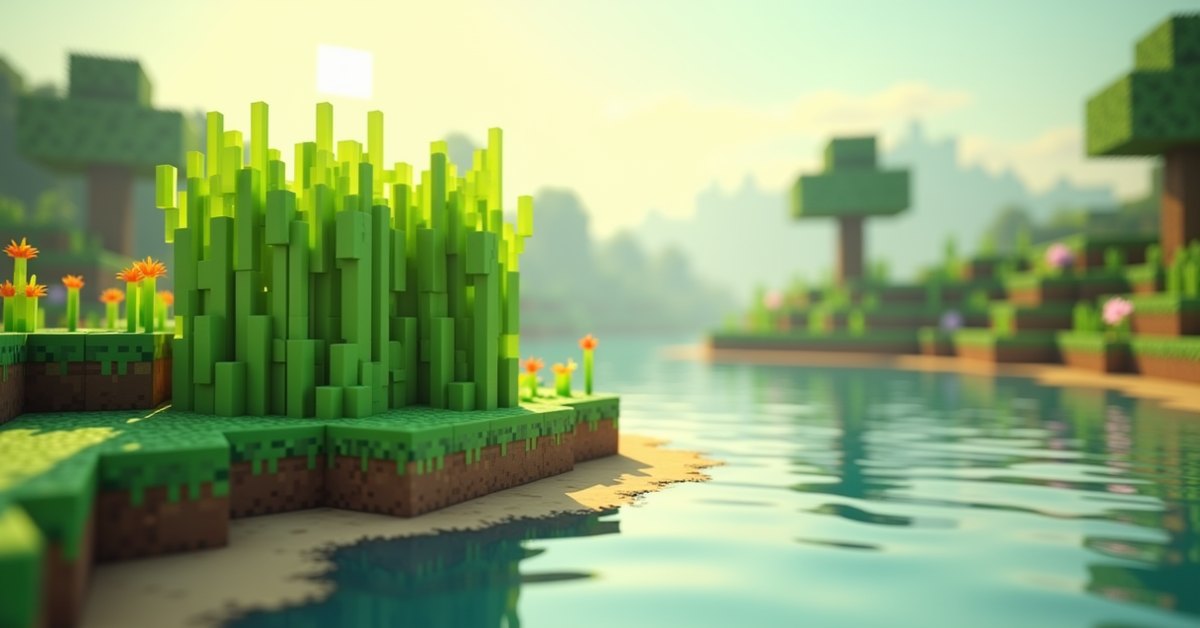
What is sugar cane?
Sugar cane is the tall green plant you see growing in clumps along rivers, lakes, and ocean shores. It looks a bit like bamboo, but it’s a different plant with different uses. You break it with your bare hands, plant it next to water, and turn it into the two things every base eventually needs: sugar for food recipes and paper for books, maps, and enchanting setups.
If you’ve never set up a sugar cane farm, you’re spending way more time hunting for paper than you need to. The plant grows on its own, doesn’t need light, and doesn’t need bone meal. Once you have a small farm running, you’ll have more paper than you know what to do with.
Sugar cane grows in stacks up to three blocks tall. The bottom block is the part you plant; the upper blocks grow on their own as long as there’s space above and water within one block of the base. It drops itself when broken, so you don’t need silk touch or any special tool.
Where to find sugar cane
You’ll find sugar cane growing naturally near water in plains, swamps, savannas, jungles, deserts, and beaches. It’s especially common along river edges and ocean shores. The green stalks are easy to spot from a distance, even at night, because they stand a block taller than the grass around them.
The fastest way to get your first sugar cane is to walk the edge of any river or coastline and harvest what’s already growing wild. You don’t need any tool, you don’t lose anything by breaking the bottom block, and the drops stack to 64 in your inventory.
A few notes on where to look:
- Rivers are the most reliable source. Almost every river biome has sugar cane growing along the banks somewhere within a minute of walking.
- Swamps are usually thick with it. The shallow water and abundant grass blocks make swamps one of the densest spots for wild cane.
- Beaches and ocean shores also have clumps, including desert beaches where everything else is sand.
Three or four stalks are enough to start a farm. You don’t need more than that to bootstrap a steady paper supply.
How to plant and grow sugar cane
Sugar cane has three planting requirements:
- A valid block underneath: dirt, grass block, coarse dirt, rooted dirt, podzol, mycelium, sand, red sand, mud, or moss block.
- Water within one block of the base, on the same horizontal level (directly next to the planting block, not below it).
- No solid block above the spot where the next stage will grow.
That’s it. No light requirement. Sugar cane grows fine in pitch dark caves as long as there’s a water source next to it.
Place the cane on the planting block and it’ll start growing on the next random tick. The stalk grows upward one block at a time until it reaches three blocks tall. After that, growth stops until you break the top.
If you remove the water source next to the base, the entire stack pops off as drops. The same thing happens if you break the block underneath, or if the block above gets blocked by a piston or another placed block.
Bone meal does not work on sugar cane in either Java or Bedrock. Don’t waste it. The only way to get more output is to plant more stalks.
Sugar cane farms
The simplest sugar cane farm is a row of dirt blocks next to a 1-block-deep water trench. Plant cane on each dirt block, then break the top two stalks of each stack when they’re ready and leave the bottom block in place so it keeps regrowing.
For a basic 10-stalk manual farm you need:
- 10 dirt or sand blocks in a row
- A 1-block-deep water trench running parallel to that row
- 10 sugar cane to plant
- A walkable path so you can harvest the whole line in one pass
Wait 10 to 20 minutes for the cane to grow back, then walk through and harvest. That’s enough sugar cane for casual paper and sugar needs.
If you want automation, the standard build is an observer farm. An observer block watches the top of each sugar cane stack. When the third block grows in, the observer fires a piston that breaks the top two stalks. The drops fall into flowing water that pushes them to a hopper and a chest. Once it’s built, the farm runs on its own and you come back to a chest full of cane.
An observer farm fits in a 3-wide footprint per row and scales as wide as you want. Two rows back to back share the water and double your output without doubling your footprint.
What to do with sugar cane
Sugar cane has two main crafting outputs.
Sugar
One sugar cane in any crafting grid produces one sugar. Sugar shows up in a handful of recipes:
- Cake, with milk, eggs, and wheat
- Pumpkin pie, with pumpkin and egg
- Fermented spider eye, for weakness and invisibility potions
- Horse breeding (sugar is one of the foods horses accept)
You don’t burn through sugar fast. A single stack covers a long stretch of normal play unless you’re baking a lot of cake.
Paper
Three sugar cane in a horizontal row makes three paper. Paper is the bigger reason most players farm sugar cane, because it goes into a lot of useful items:
- Books (3 paper plus 1 leather) for bookshelves, enchanting, and writing
- Maps (8 paper plus 1 compass on Java, 9 paper on Bedrock) for exploring
- Banner patterns (paper plus an item like a creeper head, wither skull, or enchanted apple) for custom banners
- Empty firework rockets (paper plus gunpowder) for elytra flight and fireworks shows
- Cartography tables, which need paper as part of the recipe
If you’ve built an enchanting setup, you’ve burned through paper making 45 books for 15 bookshelves. A sugar cane farm pays for itself the first time you stock up an enchanting room.
Tips and common mistakes
- Don’t break the bottom stalk. Leave it planted and the cane keeps regrowing. Break only the top two blocks of each three-tall stack.
- Don’t try to bone meal it. It doesn’t work on either edition of the game.
- Light doesn’t matter. Dark farms work fine, which is useful if you’re building underground.
- Water can be flowing or still. As long as a water block is directly next to the base on the same level, the cane is happy.
- One water source can feed up to four stalks. Center a water block with cane on all four sides for the densest small farm.
- Plant the cane and walk away. Standing nearby doesn’t speed up growth; random ticks happen on chunks that are loaded, and standing still doesn’t help.
The most common mistake new players make is putting the water below the dirt block instead of beside it. The water has to be on the same horizontal level as the planting block, not underneath. If your cane isn’t growing, that’s almost always the reason.
The second most common mistake is breaking the bottom stalk every harvest, then having to replant the whole farm. Aim at the second block from the bottom and only break upward from there.
Java vs. Bedrock differences
Sugar cane works the same way in both editions for the basics: same planting rules, same three-block max height, same drops. The two differences worth knowing:
- Map recipe: Java needs 8 paper and 1 compass; Bedrock needs 9 paper (no compass) for an empty locator map. Compass and paper together make a different map type in Bedrock.
- Random tick speed defaults differ slightly between editions in some seed-specific cases, but in normal play you won’t notice a difference in how fast cane grows.
Frequently asked questions
How tall does sugar cane grow?
Three blocks tall is the natural maximum. You can stack taller by manually placing more cane on top, but the plant will only grow itself up to three blocks.
Does sugar cane need light to grow?
No. Sugar cane grows in any light level, including total darkness. It’s one of the few plants in the game that doesn’t care about light at all.
Can you grow sugar cane on sand?
Yes. Sand, red sand, dirt, grass, coarse dirt, rooted dirt, podzol, mycelium, mud, and moss all work as planting blocks. The block has to be directly next to a water source on the same level.
How fast does sugar cane grow?
A stalk grows roughly one block every 18 minutes of real time on average, depending on random tick luck. With a row of 10 stalks, you’ll see new growth every couple of minutes once the farm is established.
Can you bone meal sugar cane?
No. Bone meal does nothing to sugar cane. Plant more stalks if you want more output.
Do you need a tool to break sugar cane?
No. Your bare hand breaks it instantly. Any tool also works, but none are faster than your fist.
Why is my sugar cane breaking on its own?
Almost always because the water next to it got removed or blocked, the block underneath got broken, or something got placed in the space above the top stalk. Check all four sides of the base and the block below it.
The short version
If you only build one early-game farm, make it sugar cane. The setup is two rows of blocks and a bucket of water, the maintenance is zero, and the payoff is enough paper to cover your enchanting, cartography, and firework needs for the rest of the world.