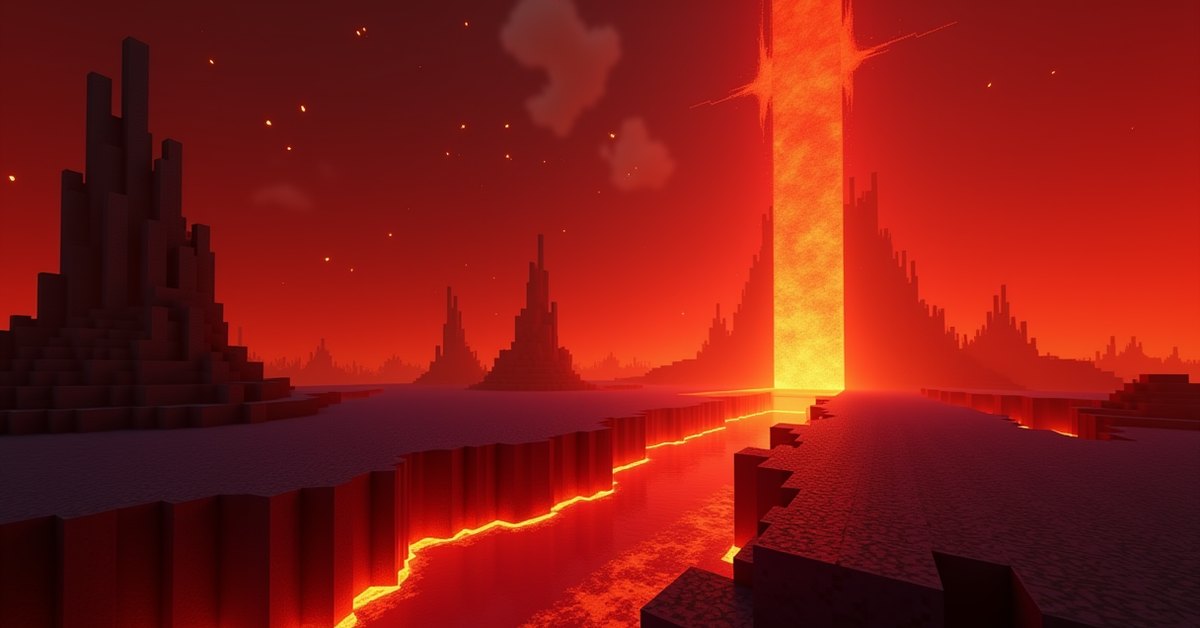
The Nether is Minecraft’s second dimension, a hot underground world of lava seas, fire, and hostile mobs that sits parallel to the Overworld. You reach it through a portal, and once you step through, the rules change. Water evaporates, beds explode, your compass spins uselessly, and the clock stops telling time.
Players go to the Nether because almost everything worth having in the late game lives there. Netherite gear, blaze rods for potions, nether wart, and the fastest long-distance travel in the game all come from this dimension. It is dangerous, but learning it is the single biggest jump in power you can make in survival Minecraft.
This guide covers how to get there, what you will find, how to survive each biome, and the mistakes that get new players killed.
How to get to the Nether
You travel to the Nether through a nether portal. To build one you need obsidian and a way to light it.
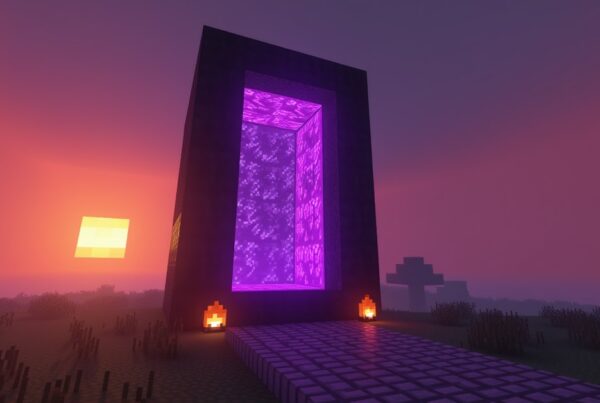
The smallest portal is a frame of 10 obsidian blocks: a rectangle 4 blocks wide and 5 blocks tall, with the four corners left out. You can corner the obsidian if you want, but you don’t have to. Once the frame is up, light the inside with flint and steel and the empty space fills with a purple, swirling field.
Getting obsidian is the usual hurdle. Obsidian forms when water touches a lava source block, and you mine it with a diamond or netherite pickaxe. If you don’t have a diamond pickaxe yet, you can build the frame without mining obsidian at all: pour water over lava by hand to shape the 10 blocks in place, or use a bucket of lava poured into a mold. Many players make their first portal this way before they ever find diamonds.
Step into the lit portal and stand still for a few seconds. The screen warps and you load into the Nether at a matching location. A portal also appears on the Nether side, so you can step back the way you came.
The coordinate trick that makes the Nether worth it
Distance in the Nether is compressed. One block traveled in the Nether equals eight blocks in the Overworld. If you walk 100 blocks in the Nether and build a return portal, you come out roughly 800 blocks from where you started on the surface.
This is the backbone of every nether highway. Players build tunnels through the Nether to connect far-apart bases, because the eight-to-one ratio turns a long Overworld trek into a short Nether walk. To link two specific points, divide your Overworld X and Z coordinates by 8 and build a portal at those Nether coordinates. Press F3 on Java or turn on coordinates in the world settings to read your position.
The five Nether biomes
The Nether is not one flat wasteland. It has five biomes, and each one changes what spawns and what you can collect.
Nether Wastes
The classic red-rock biome and the most common. You’ll see netherrack, lava falls, and the occasional glowstone cluster on the ceiling. Zombified piglins, ghasts, and magma cubes spawn here. Nether quartz ore and nether gold ore are mixed into the netherrack.
Soul Sand Valley
A bleak, blue-lit canyon floored with soul sand and soul soil, scattered with giant fossils made of bone blocks. Skeletons and ghasts spawn in heavy numbers, so the open sightlines make this one of the more dangerous biomes to cross. Soul sand and soul soil are useful at home for soul campfires, soul torches, and wither summoning.
Crimson Forest
A red mushroom forest of crimson stems and giant fungus, lit by glowing weeping vines. This is where you find hoglins, the Nether’s huntable food source, along with piglins. Crimson stems can be cut into planks and used like wood, and the forest floor is covered in nylium that you can spread with bone meal.
Warped Forest
The blue-green cousin of the crimson forest, and the safest biome in the dimension. Almost nothing hostile spawns here except the occasional enderman. If you want a calm spot to set up a base inside the Nether, a warped forest is the place. Warped fungus is also what you put on a stick to steer a strider across lava.
Basalt Deltas
A broken field of basalt columns, blackstone, and lava streams under a constant drizzle of falling ash. Magma cubes are everywhere and the terrain is brutal to walk across. It looks incredible and it is full of blackstone, but it is slow and easy to die in.
What you can mine and harvest
The Nether holds resources you can’t get anywhere else, plus a few cheaper versions of Overworld materials.
The headline material is ancient debris, which you smelt into netherite scrap and combine with gold to make netherite ingots. Netherite upgrades diamond gear into the strongest equipment in the game. Ancient debris is rare and hidden inside solid rock, so most players strip-mine or blast for it around y=15, where it spawns most often. It never appears exposed to open air, so anything you find by tunneling is hidden behind at least one block.
Other Nether materials worth grabbing: nether quartz for redstone and decoration, glowstone for light and potions of strength, nether gold ore that drops gold nuggets, and the building blocks blackstone and basalt. Crimson and warped stems give you a wood substitute that won’t burn.
One material you can only farm here is nether wart, the base ingredient for almost every useful potion. It grows on soul sand and shows up in nether fortresses and bastion remnants. Grab a few and you can farm an endless supply back home on soul sand.
The two structures you want to find
Two generated structures hold the best loot in the dimension.
A nether fortress is a dark brick complex of bridges and corridors. It is the only place blazes spawn, and blaze rods are required for brewing and for reaching the End. Fortresses also contain nether wart growing in their stairwells and wither skeletons that drop the skulls you need to summon the wither. If you need to progress the game, a fortress is the priority.
A bastion remnant is a huge blackstone ruin guarded by piglins and piglin brutes. The loot is excellent, including gold, enchanted gear, ancient debris, and the music disc Pigstep, but the brutes hit hard and ignore your gold armor. Bastions reward careful, sneaky looting over a head-on fight.
Surviving the Nether
The Nether punishes habits that keep you alive in the Overworld. A few rules matter more than anything else.
First, never sleep in the Nether. Beds explode when you try to use them, and the blast is strong enough to kill you and blow a hole in the floor over a lava sea. The same trick is used on purpose to mine ancient debris, but lying down to skip the night will simply kill you.
Second, wear gold. Piglins turn hostile the moment they see a player without at least one piece of gold armor. A single gold boot is enough to keep regular piglins calm, though piglin brutes attack no matter what you wear.
Third, bring fire resistance. Potions of fire resistance let you survive a fall in lava long enough to climb out, and a single dunk in lava without one is almost always fatal. Carry a few, plus a water bucket for the Overworld habit it breaks: water does nothing in the Nether, so don’t count on it to put out fires or break your fall.
Ghasts are the other constant threat. These floating white mobs shoot explosive fireballs from a distance. You can deflect a fireball by hitting it back at the ghast, which is the cheapest way to kill one, but it takes practice. A bow or crossbow is more reliable.
Finally, mark your portal. It is easy to wander off and never find your way back, and a lost portal in the Nether can mean a lost world if your spawn point is gone. Build a tall tower of a bright block next to it, write down the coordinates, or wall it off so mobs can’t spawn inside.
Getting around on a strider
Striders are passive mobs that walk on top of lava, and they are your ride across the dimension’s lava seas. Put a saddle on one and steer it with a warped fungus on a stick, the same way a carrot on a stick steers a pig. A strider lets you cross a lava ocean that would otherwise stop you cold. Off the lava they move slowly and start to shiver, so they are a lava-only mount.
Frequently asked questions
How big does a nether portal have to be?
The minimum is a 4-by-5 frame using 10 obsidian, with the corners optional. You can build larger portals up to 23 by 23, which is handy if you want a wide gateway, but the small frame works exactly the same.
Why does my bed explode in the Nether?
Beds only function in the Overworld. In the Nether (and the End) trying to sleep triggers an explosion instead. Use a respawn anchor if you want to set your spawn point inside the Nether.
What is the fastest way to find netherite?
Mine or blast around y=15. Ancient debris is blast-resistant, so bed explosions and TNT clear the cheaper rock around it while leaving the debris behind. Fortune does not increase ancient debris drops, so any pickaxe works for collecting it.
Can you place water in the Nether?
No. Water evaporates the instant you pour it. This is why you can’t use water for fall damage or fire control down there, and why obsidian generators that rely on water don’t work in the Nether.
Do piglins always attack me?
Only if you wear no gold. Equip at least one piece of gold armor and regular piglins leave you alone, and you can even barter with them by dropping or trading gold ingots. Piglin brutes are the exception and stay hostile regardless.
Does the Nether have day and night?
No. The Nether has no sky, no sun, and no weather, so the light level stays constant and mobs can spawn at any time. Clocks spin randomly and compasses point nowhere useful, so you navigate by coordinates instead.
A practical first trip
If this is your first real expedition, keep it simple: bring a full set of armor with at least one gold piece, a stack of blocks to bridge gaps, a pickaxe, food, and a bow. Head straight for a fortress, grab blaze rods and nether wart, and mark your portal before you go anywhere. Everything else, including netherite and bastion loot, is easier once you can brew potions and you know the way home.