What wheat is in Minecraft
Wheat is a crop you grow from seeds. It is one of the first food sources most players plant after their first night. The seeds come from breaking grass, growth is fast on watered farmland, and one small farm covers you and your animals for the rest of the world’s life.
You get wheat by harvesting a mature plant on farmland. The plant goes through eight growth stages and only drops wheat at the final stage. Anything earlier just gives the seed back.
Wheat itself does not heal hunger. You have to bake it into bread, craft it into a hay bale, or feed it to animals. Eating raw wheat does nothing.
How to get wheat seeds
The fastest way to get seeds is to break grass. Tall grass and short grass on the surface have a chance to drop wheat seeds when you walk through them, hit them, or run a sword across them. Sweeping Edge on a sword clears a whole field of grass into a pile of seeds in a few seconds.
Seeds also drop from harvesting mature wheat plants. Each mature plant drops one wheat plus 0 to 3 seeds, so you can start with a single seed, plant it, and within a few cycles have enough to fill a 9×9 farm.
Villages are a shortcut. Most plains, savanna, and taiga villages have wheat farms with crops already at random growth stages. Harvest the ripe ones and replant the rest with the seeds they drop.
How to plant and grow wheat
Wheat grows on farmland, which you make by using a hoe on a dirt, grass, dirt path, coarse dirt, rooted dirt, or mud block. The block becomes a brown tilled square with vertical grooves. Right-clicking with seeds in hand plants a wheat seedling on top.
Hydration and farmland
Dry farmland (the lighter brown) works, but wet farmland (the darker brown) grows crops far faster. To hydrate farmland, place water within 4 blocks horizontally of the tilled block. A single source water block in the middle of a 9×9 plot hydrates every square.
Dry farmland slowly reverts back to dirt if you walk over it or leave it without crops. Wet farmland stays wet as long as the water source is in range.
Light
Wheat needs a light level of at least 9 to grow. Daylight is fine, and so are torches, lanterns, glowstone, sea lanterns, or any other light source you place around the farm. Wheat will not grow in the dark, but it also will not die in the dark, so a covered farm with torches works year-round.
Growth speed
Wheat takes around 60 to 80 in-game minutes to fully grow on wet, well-lit farmland with no neighbors. Growth happens in random ticks, so it is not a fixed timer. Two things speed it up a lot: planting in rows with every other row left empty (or using a diagonal pattern), and using bone meal. Bone meal on a wheat plant has a 75% chance to advance it one stage, so a stack of bone meal will finish a small farm in seconds.
Harvesting wheat
Wheat is ready to harvest when the stalks turn brown at the tip and the texture looks bushy instead of green and thin. Break it with any tool, or with your fist, and it drops 1 wheat plus 0 to 3 seeds.
Use the seeds to replant immediately. A “harvest the mature ones, leave the green ones” pass through a 9×9 farm is the standard rhythm. There is no advantage to ripping out unripe wheat, so leave it.
Fortune does not affect wheat drops on the crop itself. The randomized 0 to 3 seed drop is just chance, but repeated harvesting will still give you a net positive supply of seeds over time.
What you can do with wheat
Bread
Three wheat in a horizontal row on a crafting table makes one loaf of bread. Bread restores 5 hunger points and 6 saturation. It is one of the most efficient foods in the game for the effort involved: no cooking, no fuel, just plant, wait, harvest, craft.
Bread does not stack into anything else. You eat it straight.
Hay bale
Nine wheat in a 3×3 crafting grid makes a hay bale, which is both compact storage and a working item in its own right. A hay bale crafts back into 9 wheat, so it is a clean way to store large amounts of wheat without filling a chest. One stack of hay bales equals nine stacks of wheat.
Hay bales also reduce fall damage by 80% when you land on one, feed horses (each bale heals a horse for 20 hearts and helps speed up baby horse growth), and feed llamas and donkeys. They burn in furnaces and smokers for a short time, though better fuels exist.
Breeding and taming
Wheat is the food item for cows, sheep, and mooshrooms. Hold wheat in your hand near two adult animals and they will follow you. Right-click each one to enter love mode. Two animals in love mode produce a baby, and there is a 5-minute cooldown before each can breed again.
Wheat also heals adult cows and sheep when fed, and speeds up the growth of their babies. You can feed up to about 10 wheat to a baby to cut its growth time down significantly.
Horses, donkeys, mules, and llamas accept wheat too, but they prefer hay bales, golden apples, or golden carrots for taming and healing.
Other uses
Wheat feeds villager farmers in the same way you would feed yourself: a farmer picks up wheat from a composter or shared inventory and turns it into bread, then shares that bread with hungry villagers nearby. This is the loop that powers iron farms and any villager-based food chain.
You can also trade wheat to a novice-level farmer villager for emeralds. The exact rate changes by version, but 20 wheat for 1 emerald is the common Java rate, and Bedrock sits in the same range.
Common mistakes that ruin wheat farms
The most common one is jumping on the farmland. Jumping turns farmland back into dirt and destroys any crop on top. Either build a fence around the farm or use slabs along the walking path. The dirt-path block is also a clean walkway because it does not revert to dirt.
The second is planting without water. Dry farmland still grows wheat, but so slowly that most players assume the farm is broken. Always set up one or more water sources before tilling.
The third is forgetting light. Underground or covered farms need a torch every few blocks, otherwise growth stops dead at night and never picks up.
The fourth is harvesting too early. A wheat plant at growth stage 7 looks almost ready but only drops seeds, not wheat. Wait for the brown tips.
Java vs. Bedrock differences
Wheat is almost identical on both editions. A couple of small notes:
- On Bedrock, hostile mobs can spawn on farmland if the light level drops too low at night. On Java, the farmland block counts as transparent, which changes some spawn behavior around it.
- Bedrock villagers will sometimes path onto farmland and trample it. Fence them off if you want to keep the crops alive.
- Bone meal growth chance is the same (75% per use), but Bedrock applies the visual update one tick later. That is a cosmetic detail, not a mechanical one.
Frequently asked questions
Can you eat wheat in Minecraft?
No. Raw wheat is not edible. Craft 3 wheat into bread before you eat it.
How long does wheat take to grow?
Around 60 to 80 in-game minutes on hydrated farmland with a light level of 9 or higher. Bone meal can finish a single plant in seconds.
What is the best layout for a wheat farm?
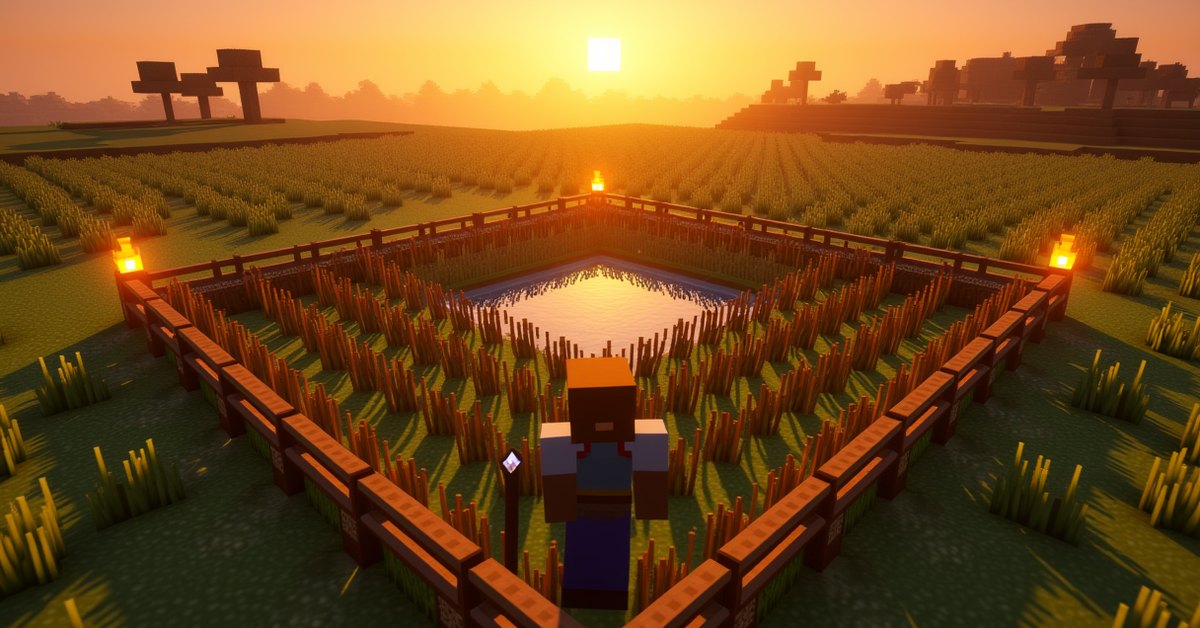
A 9×9 plot with one central water source and torches at the corners is the standard. It gives you 80 farmable squares per water block, which is the maximum hydration radius. For larger farms, repeat the 9×9 tile.
Can you bone meal wheat to harvest faster?
Yes. Each use has a 75% chance to advance the plant one growth stage, so a few bone meal applications will take a fresh seed to ready-to-harvest. The trade-off is that bone meal is a finite resource (from skeletons or composters), so most players let nature do the growing and save bone meal for trees or saplings.
Do cows and sheep eat wheat off the ground?
No. They only respond to wheat you hold in your hand. You can drop wheat on the ground without losing it to passing animals.
Can villagers farm wheat for you?
Yes. A farmer villager will plant, grow, and harvest wheat if you give them access to farmland and they have the farmer profession assigned through a composter. The wheat goes into their inventory and then into a connected composter or shared storage. This is the foundation of most automatic food farms in Java.
Does wheat grow in the Nether?
Yes, if you bring farmland and water. You cannot place water source blocks directly in the Nether, but farmland made before you went through the portal will work if you can keep it hydrated with a clever workaround like ice in a different dimension. The Nether’s normal farmable plant is nether wart, not wheat.
If wheat is your first big farm, the upgrade path is usually carrots and potatoes (better hunger per item) and then beetroot for variety. The same 9×9 layout works for all of them, and the same farmer villager will handle the mix.