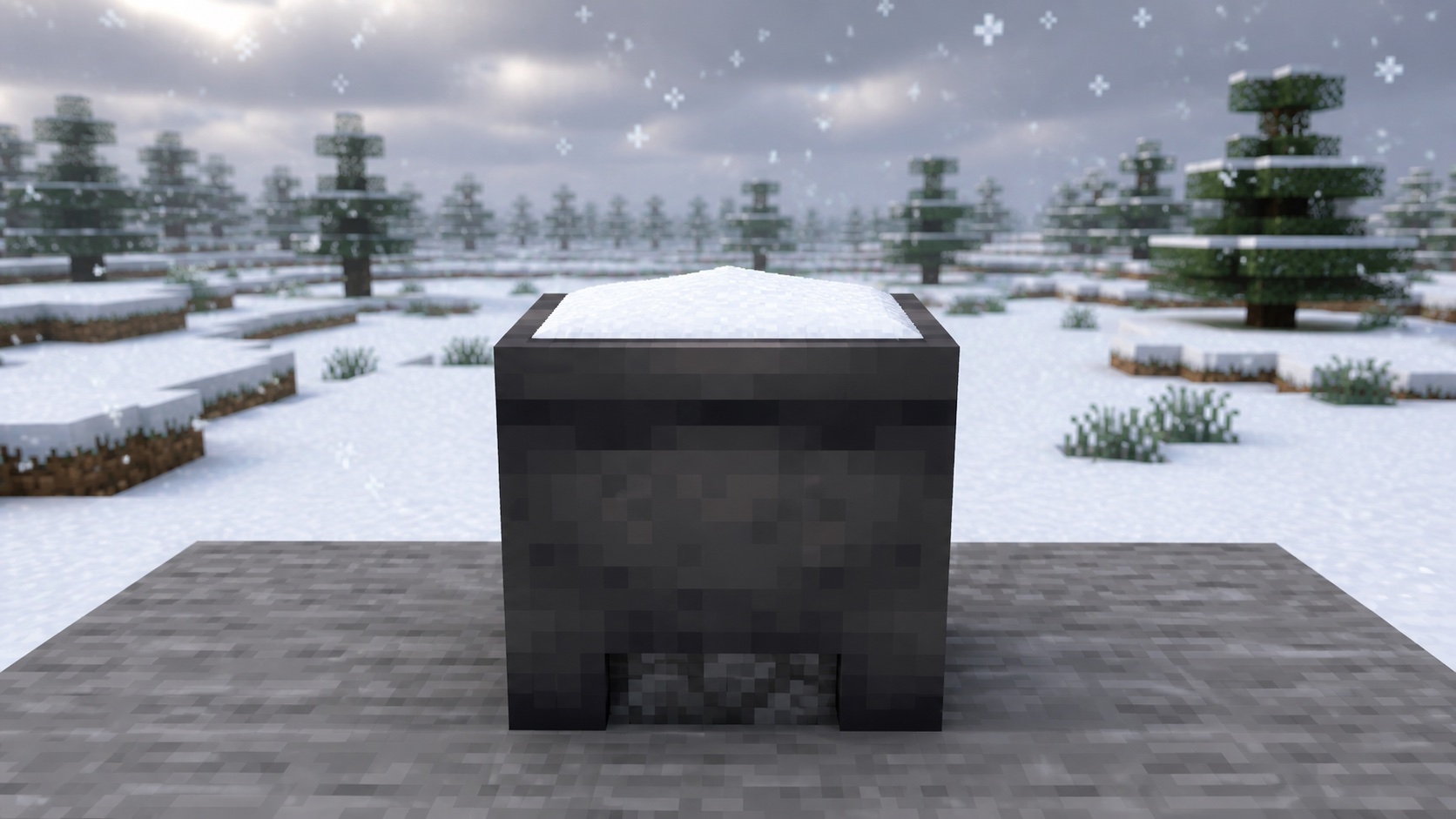
What a powder snow cauldron is
A cauldron filled with powder snow is the same iron pot you already use for water or lava, only this time it stores powder snow instead. The fill state shows a small white pile inside the cauldron, and you can scoop it back out into a bucket whenever you need it.
This block exists for one practical reason: powder snow is annoying to gather and easy to lose. A cauldron lets you keep some on hand in a fixed spot, refill your buckets when you need them, and build traps that always have powder snow ready to go.
How to fill a cauldron with powder snow
There are two ways to get powder snow into a cauldron. The fastest is to use a powder snow bucket. You collect a powder snow bucket by right-clicking a powder snow block with an empty bucket. Then right-click an empty cauldron with the full bucket. The cauldron fills to its maximum level instantly, and you keep the now-empty bucket.
The slower way is to let the snow fall in. Place a cauldron under open sky in a biome where it snows (snowy plains, snowy slopes, frozen peaks, snowy taiga, ice spikes, grove, frozen ocean, and so on) and wait through a snowstorm. Each snow tick fills the cauldron a bit further until it reaches the top. This only works in Java Edition. Bedrock cauldrons do not collect powder snow from snowfall.
If you want to fill several cauldrons in a hurry, the bucket method wins. The snowfall method matters when you do not have a powder snow source nearby, but you do have a snowy biome, and you are willing to wait.
How to empty a powder snow cauldron
Hold an empty bucket and right-click the cauldron. The cauldron empties in one click, and you walk away with a powder snow bucket. The bucket can then be poured anywhere as a fresh powder snow block.
You cannot collect powder snow out of a cauldron with glass bottles the way you can with water. Powder snow only moves between cauldrons and buckets.
Breaking the cauldron with a pickaxe also removes the powder snow, but the snow is destroyed in the process. If you want to save the snow, scoop it into a bucket first, then mine the cauldron.
What powder snow does to mobs and players
Powder snow inside a cauldron behaves like a small powder snow block. If a mob or player drops onto the cauldron, they sink into the snow instead of standing on top, and they start freezing. Freezing builds up a frost effect over about seven seconds in survival, then it begins dealing one heart of damage every two seconds.
Wearing leather armor of any kind protects against the freezing damage, and leather boots specifically let you walk on top of powder snow without sinking in. Iron, gold, diamond, and netherite boots do not have this effect; only leather boots are light enough to sit on the surface.
Cold-adapted mobs like polar bears, snow golems, and strays do not take freezing damage at all. Most hostile mobs do, which is what makes a powder snow cauldron useful as a tiny, contained hazard.
Crafting and placement
The cauldron itself is crafted from seven iron ingots in a U-shape on a crafting table. The recipe does not change for the powder snow variant. There is no separate “powder snow cauldron” item in your inventory; it is just a normal cauldron once you put powder snow in it.
Place the cauldron on any solid block and fill it after placement. You can break the cauldron with a wooden pickaxe or higher, and it drops as a regular cauldron item. The powder snow inside is lost when the block breaks, so save it with a bucket first if you care about the contents.
Trap and farm uses
The most popular use for a powder snow cauldron is a small, fixed-position trap. Drop a cauldron into a one-block hole, fill it with powder snow, and put a carpet or trapdoor on top so a mob cannot see the hazard. When the mob walks across, it falls in, gets stuck in the snow, and starts freezing. Cauldrons keep the snow contained, so it cannot get knocked out or replaced by other block physics the way a free-standing powder snow block sometimes does.
Cauldrons also work as a stash for adventure maps and Skyblock-style worlds where you want a guaranteed powder snow source. On Java, a single cauldron under open sky in a snowy biome can refill itself from weather, which means it can keep generating powder snow buckets indefinitely as long as the snow keeps falling.
For PvP arenas and custom maps, lining up cauldrons in a row is a clean way to make a “freezing strip” without any of the visual oddness of free-standing powder snow blocks. Each cauldron looks like a normal cauldron from a distance, but stepping over the row gets the player frozen fast if they are not in leather boots.
Renewable powder snow on Java
If you live in a snowy biome on Java, a powder snow cauldron is the easiest renewable source of powder snow buckets you can build. Place one or more empty cauldrons under open sky, wait for snow weather, and keep checking back. Each filled cauldron gives you one bucket of powder snow.
This is more reliable than carving powder snow out of natural deposits, because the natural deposits do not regrow. Once you scoop up a powder snow block in the wild, that spot stays empty. Cauldrons replenish.
Java vs. Bedrock differences
The bucket fill method works the same in both editions. The snowfall method is Java-only. In Bedrock, cauldrons gather water from rain in some biomes, but they do not gather powder snow from snowfall. On Bedrock, the only way to fill a powder snow cauldron is with a powder snow bucket.
Freezing damage and the leather-boots interaction work in both editions, so a powder snow cauldron behaves the same once it is filled.
Common mistakes
The most common slip is treating a powder snow cauldron like a water cauldron. You cannot dye leather armor in it, you cannot wash banners in it, and you cannot put out fires by jumping into it the same way water does. The snow behaves like ice, not water.
The second mistake is breaking the block when you meant to refill it. A pickaxe destroys the cauldron and dumps the snow as a free-standing block, which then often despawns or gets messy. If you only want to remove the snow, use an empty bucket on the cauldron, not a pickaxe.
The third mistake is forgetting that any mob without leather boots will sink in. If you build a walkway over a row of powder snow cauldrons for a trap, your villagers, tamed wolves, and pet cats can fall in too. Carpet or trapdoors on top help control which entities walk over and which fall through.
Frequently asked questions
Can a cauldron fill with powder snow from snowfall on Bedrock?
No. Bedrock cauldrons only collect rainwater in certain biomes. They do not collect powder snow from snowfall. Use a powder snow bucket on the cauldron instead.
Does a powder snow cauldron freeze mobs that walk past it?
Only mobs that actually step into the snow itself take freezing damage. Standing next to a filled cauldron is safe.
Can you walk on top of a filled cauldron without falling in?
Yes, if you are wearing leather boots. Without leather boots, you sink into the snow and start freezing, even from the cauldron’s small fill volume.
How many buckets does a powder snow cauldron hold?
One bucket’s worth. Filling with a powder snow bucket fills the cauldron completely. Scooping with an empty bucket gives you one full powder snow bucket back.
Will the powder snow inside a cauldron melt over time?
No. The cauldron’s powder snow fill stays as long as the cauldron itself is intact, regardless of light level or biome temperature.
Can you stack powder snow cauldrons for a wider trap?
Yes. Lining up cauldrons in a row or a 2×2 cluster creates a freezing zone the player or mob falls between. Each cauldron has to be filled separately, since they do not share a fill state.
Can a snow golem stand in a powder snow cauldron?
Yes. Snow golems are cold-immune and will not take freezing damage from the cauldron’s snow.
One last tip
If you build a powder snow trap, put a sign or a block of color near the entrance so you remember where the cauldrons are. Powder snow is one of the few hazards in Minecraft that looks identical to a safe block from above, and stepping into your own trap by accident is a slow, cold way to lose your gear.