What a water cauldron does
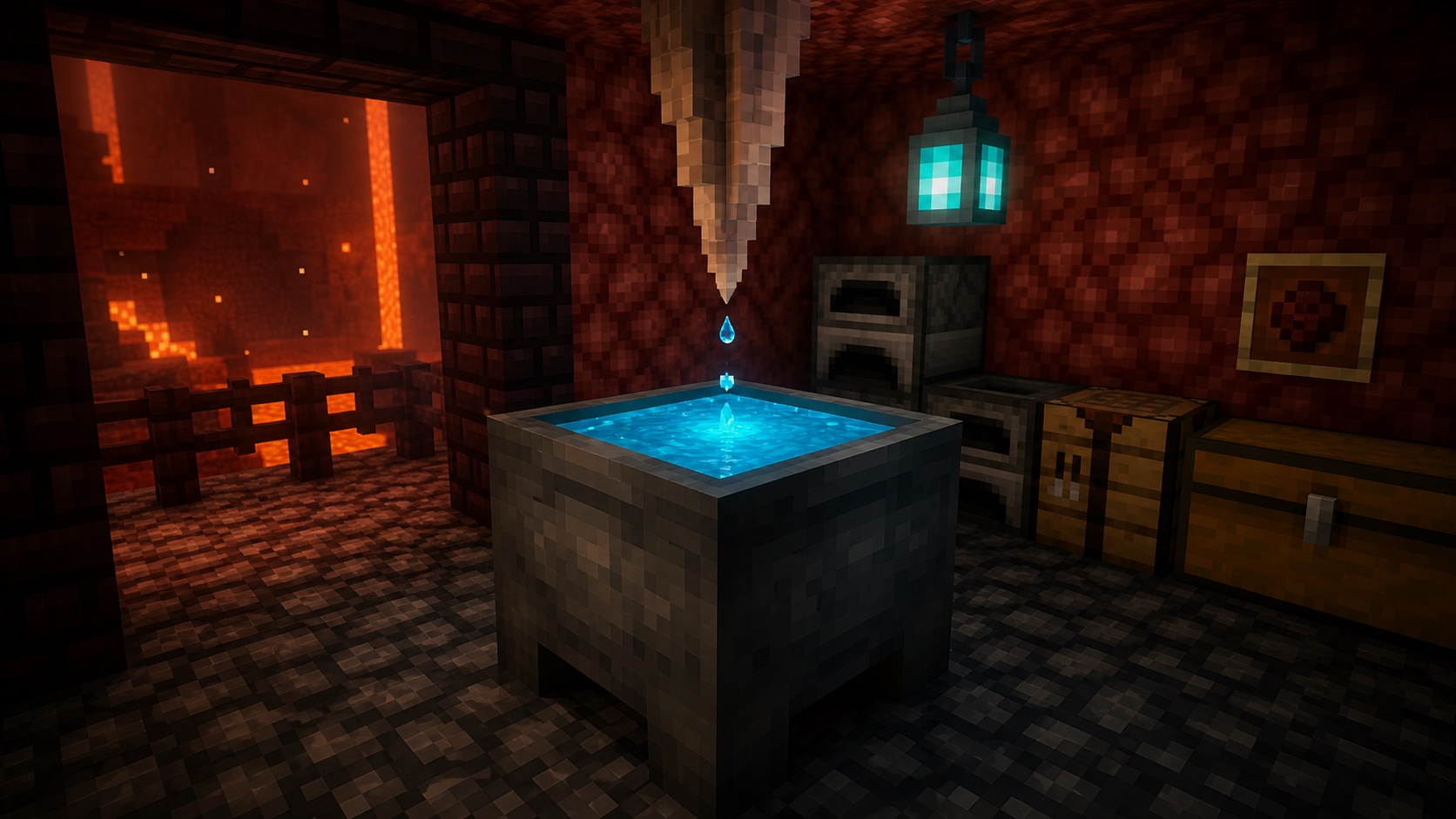
A cauldron in Minecraft is a small iron pot that holds one of three liquids: water, lava, or powder snow. When you fill it with water, the cauldron becomes one of the few utility blocks that lets you keep water in places where a full source block would soak the floor or wash items away.
A water cauldron has three fill levels. Each level is one third of the pot. You can pour water in, dip bottles to grab some, dunk a piece of dyed leather to clean it off, or stand in it to put out a fire on yourself. When the cauldron is empty, the next bucket of water resets it straight to full.
This guide covers everything water-specific about cauldrons: how to get water into one, what you can do with that water, and how to empty it when you need the cauldron for something else.
How to fill a cauldron with water
There are four ways to put water in a cauldron. Two are direct, two are passive.
Use a water bucket
Hold a water bucket and right-click (or use the interact button) on a cauldron. The bucket empties completely and the cauldron jumps to level 3, regardless of the level it was at before. You will not get any water back; the entire bucket is consumed.
This is the fastest way to fill a cauldron and the one most players use. Carry one full bucket to the spot where you want a cauldron, place the cauldron, then pour the bucket in. Done.
Use a glass bottle
You can also fill a cauldron one level at a time using a water bottle. Right-click the cauldron with a water bottle in hand. The bottle becomes empty and the cauldron level rises by one. Three water bottles fills it from empty to full.
Bottles are slower than buckets. They are useful early game when you have glass but haven’t smelted iron for a bucket yet, or when you need to top off a partly used cauldron without a fresh water source nearby.
Let rain fill it
If a cauldron sits with open sky directly above it during rain or snow, the cauldron fills on its own. The block above the cauldron has to be open air. A clear roof, a half slab, or stained glass over the cauldron all block the fill. While it’s raining, the level rises gradually until the cauldron hits level 3, then it stops.
This is useful for outdoor builds where you want a self-refilling water supply for leather washing or bottle filling without running a separate water tank.
Drip from pointed dripstone
Place a pointed dripstone tip pointing downward, with a water source block one or more blocks above the dripstone, and put a cauldron under the dripstone tip. Water slowly drips into the cauldron, raising the level over time. The original water source is not consumed, so this gives you slow but unlimited water generation.
The drip is slow. Plan on roughly an hour or more of real time to fill an empty cauldron from a single dripstone, depending on chunk loading. People use this in long-running farms tied to fountains, auto-brewers, or in-base bottle refills that work while they’re nearby.
What you can use a water cauldron for
Wash dye off leather armor
Right-click a cauldron of water with a piece of dyed leather armor or dyed leather horse armor in hand. The dye comes off, the armor returns to its default brown, and the water level drops by one. This is the easy way to undo a color you don’t want without crafting a fresh leather piece from scratch.
This is the main long-term use of water cauldrons in survival worlds. If you redye armor often, keep a water cauldron in your wardrobe room next to the dyes.
Wash a banner pattern off
Banners gain patterns when you combine them with dyes at a loom. If you decide a layer wasn’t right, you can right-click the banner on a water cauldron to remove the most recent pattern. Each wash takes one water level and strips one pattern. Keep washing to back out further.
The base color of the banner doesn’t change. You only lose the patterns you added on top.
Fill glass bottles
Hold an empty glass bottle and right-click a water cauldron. You get a water bottle, and the cauldron level drops by one. Three bottles fully drains a level-3 cauldron.
Outside the Nether this isn’t usually worth doing, since you can fill bottles directly from any water source block. But in the Nether, where loose water evaporates the moment it leaves a bucket, a water cauldron is the only way to fill bottles. That makes a water cauldron the foundation of any Nether brewing setup.
Put out fire on yourself
If you catch fire from lava, a fire block, or a flame arrow, stepping into a cauldron of water extinguishes the fire and lowers the water level by one. The cauldron works as a one-shot fire extinguisher you can place exactly where you need it.
This is most useful in the Nether. Place a water cauldron right next to the inside of your portal so you can step in if a piglin sets you alight the moment you arrive.
Job site for leatherworker villagers
An unclaimed cauldron near an unemployed villager turns that villager into a leatherworker. The cauldron does not have to be full or even contain water for it to count as a job site. Still, if you’re already placing the cauldron, you might as well fill it; the villager animates as if working with the water.
How to empty a water cauldron
Pick the water up with a bucket
Right-click a level-3 cauldron with an empty bucket. You get a full water bucket and the cauldron empties completely. Important caveat: this only works if the cauldron is at level 3. A partly full cauldron will not let you scoop a bucket of water out.
Drink it down with bottles
Right-click the cauldron with an empty glass bottle. Each pull drops the level by one and gives you a water bottle. This works at any fill level, so it’s how you drain a partly full cauldron when you need it for something else.
Use the contents
Washing dye, washing banner patterns, and putting out a fire on yourself all consume one level each. If you’d rather not waste a bucket on emptying, just use the cauldron until it runs dry.
Tips and common mistakes
Bottles preserve water; buckets pull all of it out
A common rookie mistake: emptying a water cauldron by scooping it with a bucket, then dumping the bucket somewhere useless. If you only need to free the cauldron for another job, drink it into bottles. Three water bottles store the same volume the bucket would, but you can keep them around as drinkable bottles for brewing.
Cauldrons are not infinite water
Another common misconception: that a cauldron acts as a compact water source you can pull from forever. It doesn’t. Each interaction consumes a level. If you want unlimited water in a base, place an actual 1×1 water tile or build a 2-block infinite source. Cauldrons store water; they don’t generate it.
Boats and fish won’t fit
Cauldrons are too small to spawn boats inside or to hold fish in a tropical fish bucket. Treat them as utility blocks, not aquariums. If you want a tiny indoor water feature, the right tool is a single source block in a sealed 1×1 hole, not a cauldron.
Use the cauldron’s reach in the Nether
Water buckets evaporate the moment you pour them in the Nether, but a cauldron carried through a portal keeps its water. Fill the cauldron in the Overworld, build or step through a portal, and the cauldron arrives full. This makes water cauldrons the standard way to keep drinkable water and fire-extinguishing water in any Nether base.
Java and Bedrock differences
Washing dyed shulker boxes
On Bedrock, you can dye a shulker box and then wash the dye off in a water cauldron, the same way you wash leather armor. On Java, dyed shulker boxes can’t be undyed in a cauldron; you have to break the box and craft a fresh one with a regular shulker if you want to reset the color.
Dripstone fill timing
Both editions support filling cauldrons from pointed dripstone with water above, but the exact tick timing isn’t identical, and Bedrock can feel slightly more reliable in long sessions. If a fast fill matters for a build, test it in your own world rather than relying on a number from a video, since changes to chunk-tick behavior shift the rate over time.
Frequently asked questions
Can you use a water cauldron in the Nether?
Yes. A cauldron filled with water in the Overworld keeps its water when you bring it through a Nether portal. This is the only practical way to keep water on hand in the Nether for filling bottles or putting out fire on yourself.
Does a partial water cauldron let me scoop out a bucket?
No. The empty bucket only fills off a level-3 cauldron. If the cauldron is at level 1 or 2, you have to top it back up to level 3 first or use bottles instead.
How long does rain take to fill a cauldron?
Roughly one full rainstorm if you start from empty. Levels rise gradually while it rains and stop the moment the rain stops. If a single storm doesn’t finish the job, the next rainstorm picks up from the level you left it.
Can I swim in a water cauldron?
No. The cauldron is too small to enter as a swim volume. Standing in one will put out a fire on you, but you can’t dive, breathe underwater, or hold your breath the way you would in a real water source block.
What happens if I right-click a full cauldron with another water bucket?
Nothing useful. The cauldron is already at level 3, so the bucket isn’t consumed and the level doesn’t change. You walk away with the same full bucket you came in with.
Can I fill a cauldron from another cauldron directly?
No. There’s no cauldron-to-cauldron transfer. You’d have to bottle the water from the first cauldron, then pour those bottles into the second one a level at a time.
Why does my cauldron look full but read as empty when I try to use it?
This is almost always a render glitch from a chunk that didn’t update, not an actual bug with the cauldron. Walk away a few chunks and come back. If the visual mismatch persists, break the cauldron and place it again. The block won’t drop water if it was already empty in the game’s logic.
Putting it together
A water cauldron is the cleanest answer to “I need a small, contained water supply.” It earns its block in the Nether and in storage rooms where a full water tile would soak the floor. Build one near your loom and your dye chest, fill it with a single bucket, and you’ll save dozens of crafts the next time you change a leather chestplate or back out of a bad banner layer.