Cherry leaves are the pink leaf blocks that grow on cherry trees in the cherry grove biome. Mojang added them to Minecraft in the 1.20 Trails and Tales update, and they’ve quickly become one of the most popular building blocks added in years.
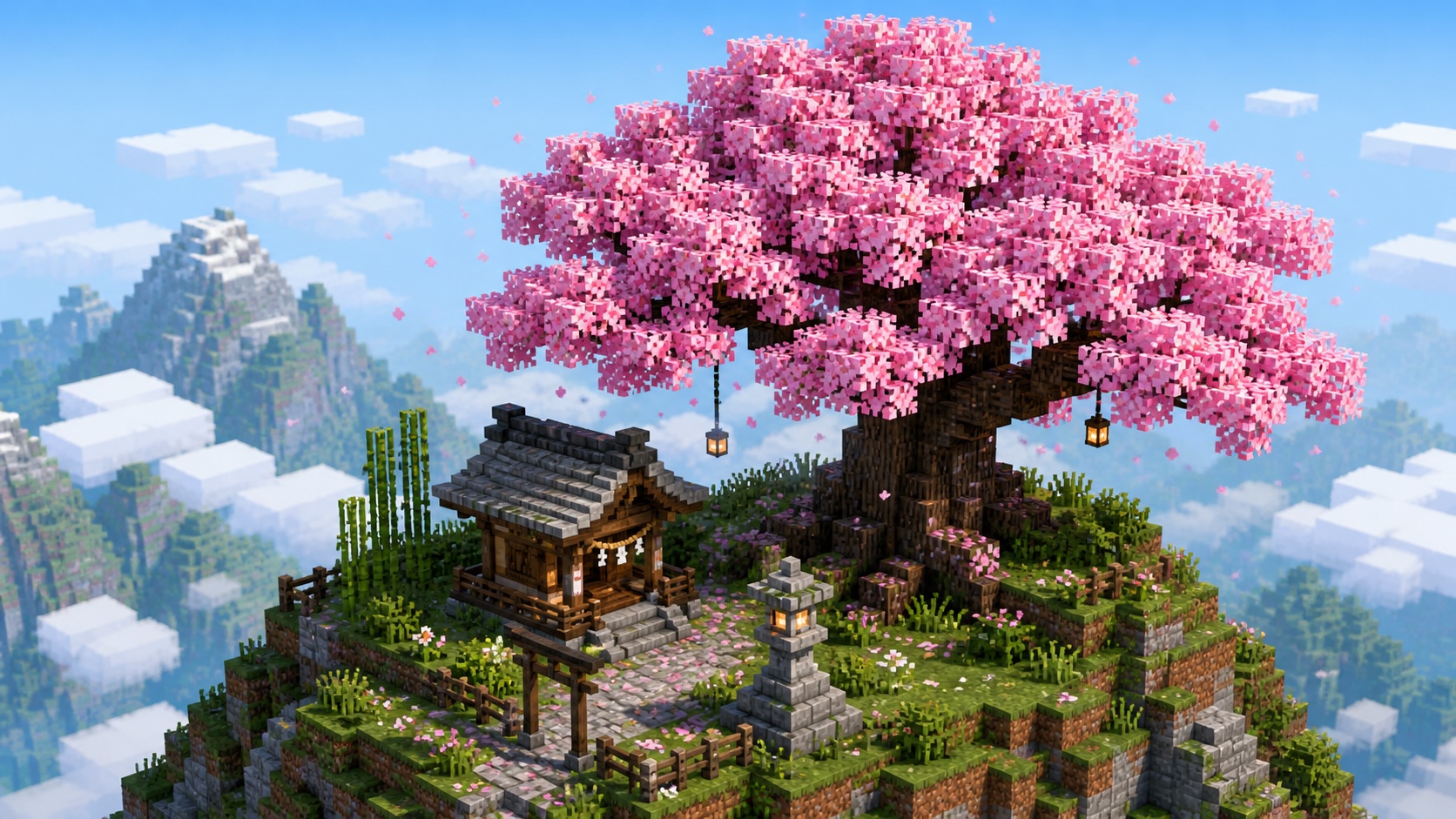
This guide covers how to find cherry leaves, the best tool to harvest them, what they drop, how decay works, and how to use them in builds. If you’ve ever wanted to build a cherry blossom shrine or a pink-roofed cottage, this is the block you’ll be working with.
What are cherry leaves?
Cherry leaves are a leaf block that generates as the canopy of cherry trees. They share most of the behavior of other leaf blocks: they decay when disconnected from a log, they’re flammable, they’re non-solid (mobs can’t stand on them like a normal floor), and they let some light through.
What sets cherry leaves apart is their look. The texture is bright pink, the particles falling from the bottom of each block look like petals, and the block has a slight transparency that makes a thick canopy look soft instead of flat.
How to get cherry leaves
Cherry leaves can be broken with any tool, but the tool you choose decides what you actually walk away with.
Use shears to keep the block
To collect the cherry leaf block itself for building, break it with shears. You can also use any tool with the Silk Touch enchantment. Shears are the easier path because they’re cheap to craft and don’t take up an enchantment slot you might want for something else.
One pair of iron shears can collect a few hundred cherry leaf blocks before breaking, so a single grove can supply enough leaves for a large build in one trip.
Use a hoe for speed
If you only want saplings and sticks, use a hoe. Hoes are the fastest tool against leaves in both Java and Bedrock editions. A diamond or netherite hoe will tear through a cherry tree’s canopy in seconds.
What you drop without shears
Breaking cherry leaves with bare hands, a sword, an axe, or a hoe gives you a chance at the standard leaf drops:
- Cherry sapling: roughly a 5% chance per leaf block.
- Stick: roughly a 2% chance per leaf block, doubled or better with the Fortune enchantment.
Cherry leaves do not drop apples. Apples are tied to oak and dark oak leaves only. They also do not drop pink petals; that block is a separate ground plant.
How cherry leaf decay works
Cherry leaves follow the same decay logic as every other leaf in vanilla Minecraft. Each leaf block tracks its distance to the nearest log block of the same tree type. If that distance is greater than six, the leaf is considered orphaned and will randomly decay over the next minute or two.
Two important details:
- Leaves placed by a player are flagged as persistent and never decay, no matter how far from a log they are.
- Leaves generated as part of a tree are not persistent, so cutting the trunk starts the decay clock.
A common technique is to chop the cherry trunk, walk back to base, then return ten minutes later. The decayed leaves will have left a small pile of saplings and sticks on the ground for you. This is faster than breaking every leaf by hand.
Where to find cherry leaves in the world
Cherry leaves only generate in the cherry grove biome. Cherry groves are mountain-side biomes that tend to spawn between meadows and snowy slopes, often along the lower flanks of larger mountain ranges.
The trees themselves stand out from a long distance because of the bright pink canopy. From the ground, they’re often the tallest and widest things on the slope, with branches that fork out and curve upward like cherry trees in real life.
If you can’t find a cherry grove within a reasonable walk, here are a few options:
- In a singleplayer world with cheats on, run
/locate biome minecraft:cherry_grove. The game will return coordinates to the nearest cherry grove. - Climb to the top of any nearby mountain and scan the horizon. Cherry groves are visible from much farther than most biomes.
- If you’re starting a new world and the biome is too far, try a different seed. Cherry grove placement can be uneven.
Bring shears, a stack of food, and a way home. Cherry groves are scenic but they often sit far from spawn.
Building with cherry leaves
Cherry leaves are one of the most-used decorative blocks in modern Minecraft builds. The pink color, falling petals, and soft texture work well in dozens of styles. Common uses include:
- Japanese-inspired shrines, gardens, and torii gate entrances.
- Spring-themed houses with cherry plank walls and pink roofs.
- Wedding venues and town squares on multiplayer servers.
- Stylized hedges and bushes when stacked one or two blocks high.
- Roof canopies over patios or paths, to filter light and add color.
Practical tips that show up a lot in build tutorials:
- Pair cherry leaves with cherry planks, white concrete, and pink petals for a clean palette.
- Bone meal a patch of grass under a cherry tree to fill it with pink petals and small flowers automatically.
- Leaves are non-solid, so no hostile mobs can spawn on top of a cherry canopy. This is useful for above-ground bases.
- Cherry leaves let some light through. A row of them above a window will dim the room slightly without blocking it entirely.
- Beacon beams pass through leaves, so a cherry-leaf canopy over a beacon does not interrupt the beam.
Petal particles and atmosphere
Cherry leaves are currently the only leaf block in vanilla Minecraft that throws off particles on its own. Tiny pink petals drift downward from the underside of every cherry leaf block at random intervals. The effect is visual only; it does not damage entities, place blocks, or interact with the world in any way.
The particles are tied to the block, not the biome. A cherry leaf block placed in the Nether, in a desert, or inside a stone bunker will still emit petals. This is useful when you want a pop of cherry blossom indoors, or in a biome that wouldn’t normally support the tree.
If you want a thicker petal effect, place several cherry leaf blocks close together overhead. Each block emits its own particles, so a 5×5 patch produces a heavier shower than a single block.
Java versus Bedrock differences
Cherry leaves behave almost identically across the two editions, but a few small notes are worth knowing:
- The petal particle effect is present on both Java and Bedrock. Some Bedrock players on lower-end devices report fewer particles per second, which is performance-related rather than a different rule.
- Hoes break leaves faster than other tools on both editions.
- The drop chances for saplings and sticks are roughly equivalent. Small implementation details vary, but a tree farm in either edition produces saplings at a usable rate.
- Cherry grove biome generation is the same on both, so the trees and surrounding terrain look like the same biome on either edition.
Builds with cherry leaves transfer cleanly between versions through structure blocks or world conversion. Color and texture render the same way.
Frequently asked questions
Do cherry leaves drop apples?
No. Apples only drop from oak and dark oak leaves. Cherry leaves drop cherry saplings and sticks based on the normal leaf decay table, plus the cherry leaf block itself when broken with shears.
Can you get pink petals from cherry leaves?
No. Pink petals are a separate plant block that grows on the ground inside cherry grove biomes. You collect pink petals with any tool, and they place down like a sea pickle, with up to four petals per block. The pink particles you see falling from cherry leaves are visual only and never become petals on the ground.
Are cherry leaves flammable?
Yes. Cherry leaves catch fire like every other leaf in Minecraft. A nearby fire block, a careless flint and steel, or a creeper blast can set a whole canopy ablaze. Keep a water bucket close when you’re working with lava or fire near cherry trees, and consider lining flammable builds with non-leaf blocks where the fire risk is highest.
Can mobs spawn on cherry leaves?
Hostile mobs cannot spawn on top of cherry leaves because leaves are not a full solid block. Bees do spawn in cherry groves and treat cherry trees as a valid hive location, but they don’t spawn on the leaves themselves. Passive mobs need solid grass blocks to spawn, so a leaf canopy over your base is a clean way to keep the roof mob-free.
Can you put cherry leaves in a composter?
Yes. Cherry leaves have a 30% chance per block to raise the level of a composter, the same chance as other leaf blocks. If you have a small cherry tree farm running, this is a slow but steady source of bone meal.
How long do cherry leaves take to decay?
Decay starts about a minute after the leaves lose their connection to a log and finishes within a few minutes for most of the canopy. The exact rate depends on random ticks, so a small portion of leaves will sometimes hang on for a while longer. If you want to clean up the rest, break them by hand.
Can you bone meal cherry leaves?
No. Bone meal does not affect cherry leaves directly. It does work on cherry saplings to grow them into a full cherry tree, and on grass blocks under a cherry tree to spawn pink petals and small flowers in the surrounding area.
Are cherry leaves worth farming?
If you want a steady supply of cherry saplings for trees, builds, or villager trades, a small cherry farm pays off quickly. Three or four trees on a replant rotation give you enough leaves for most projects, and the petal particles around the tree make the farm itself look good. For pure decoration, a single trip to a wild cherry grove with a pair of iron shears will fill several stacks in under an hour.