What chain blocks are in Minecraft
A chain is a decorative iron block that connects two points with a metal link. It looks like a straight length of chain, which makes it useful for hanging lanterns, dressing up Nether builds, and adding a bit of detail to medieval or industrial designs.
Chains were added in the Nether Update (1.16). You can craft them, mine them with a pickaxe, and find them already placed in a few Nether structures.
How to craft a chain
Open a crafting table and use the middle column. Put one iron nugget in the top slot, one iron ingot in the middle slot, and another iron nugget in the bottom slot. That gives you one chain per craft.
Iron nuggets come from iron ingots (one ingot turns into nine nuggets in the crafting grid) or from smelting iron tools and weapons. Three iron ingots’ worth of material feeds one chain, since the two nuggets together cost less than a full ingot.
The chain recipe is unlocked from the start in Java and Bedrock. You do not need to find a chain first to learn the recipe.
Where to find chains naturally
You can also collect chains by mining ones the game generates for you. Look in:
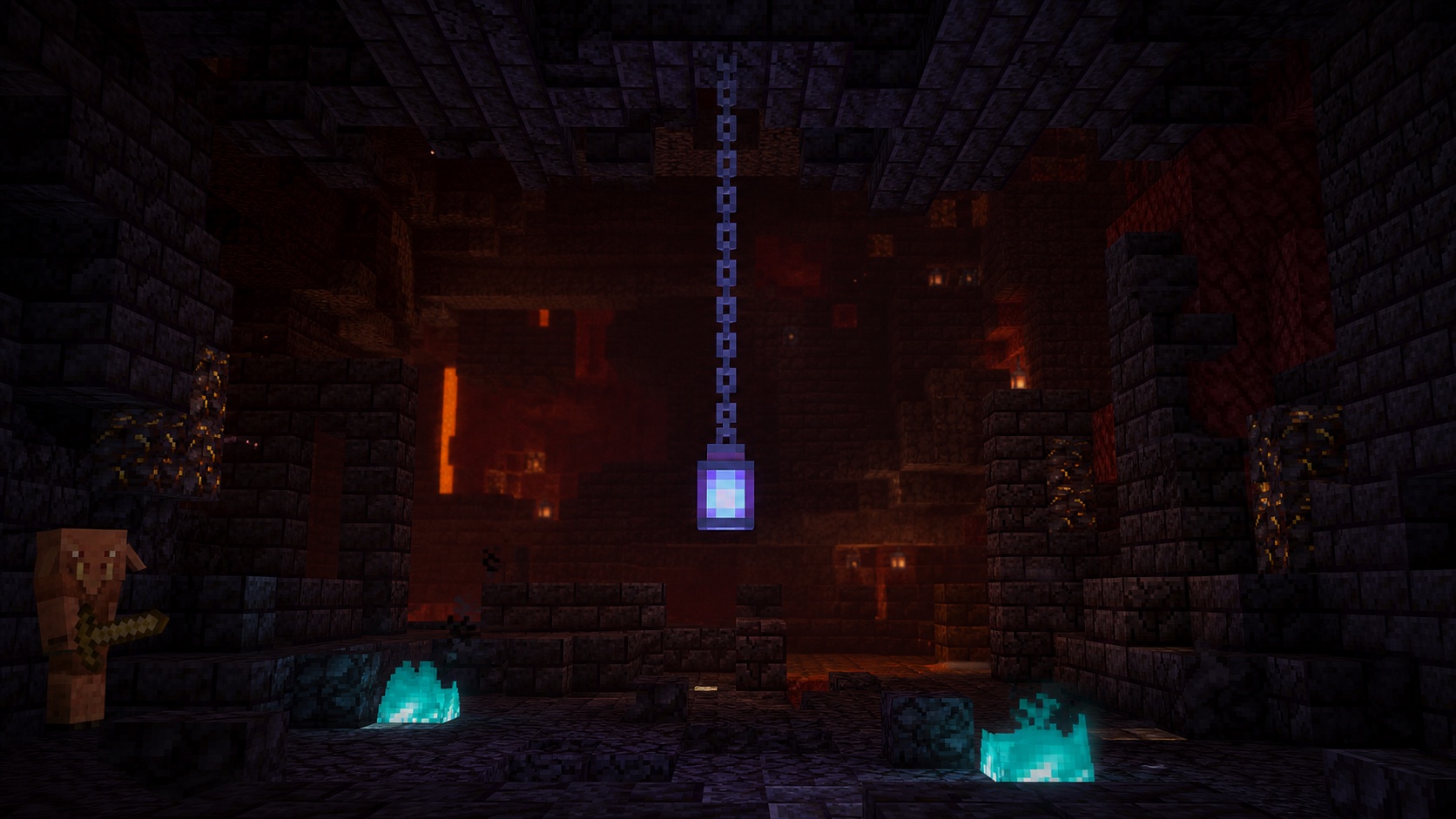
- Bastion remnants. These Nether structures use chains as part of the architecture, often suspended from ceilings or wrapped around pillars. A single bastion can have dozens of chains, especially in the housing units and bridge variant.
- Ruined portals. Some ruined portal variants spawn with chain blocks lying nearby, usually in the rubble pile or near broken obsidian frames. Both Overworld and Nether ruined portals can include them.
Mining a chain with a pickaxe drops the chain itself. Breaking a chain with anything else (your hand, a sword, an axe, or a shovel) gives you nothing, so always switch to a pickaxe before swinging.
If you want to farm chains in bulk, scout a bastion early and run a clear path through it with cobblestone or netherrack. Bastions hold a lot of gold and netherite scrap on top of the chains, so the trip pays off in more than one way.
How chains behave when you place them
A chain can be placed in three orientations:
- Vertical (top to bottom).
- Horizontal along the north-south axis.
- Horizontal along the east-west axis.
The orientation depends on the face you click. Click the top or bottom of a block to get a vertical chain. Click the side to get a horizontal chain running along that side.
Chains are non-solid, so mobs and players can walk through them, and light passes through without dimming. They will not block redstone signals, support hoppers, or trigger pressure plates.
Chains also support waterlogging. Place a chain underwater or use a water bucket on one above water, and the block will hold water inside it. The chain still looks the same, but water flows through the same space, which is handy for underwater Nether-style decoration.
Common uses for chains
Chains are mostly aesthetic. The most common uses are decorative builds, but a few of them have real gameplay value.
Hanging lanterns and soul lanterns
Place a chain hanging from a solid block, then place a lantern on the bottom of the chain. The lantern hangs from the chain visually, which gives you a tall hanging light fixture. You can stack multiple chains for a longer drop.
Lanterns themselves do not need a chain to hang; they will hang from any block face that supports them. The chain is purely visual, but it pushes the light source farther down so it can light up a bigger room from above.
Hanging bells
You can mount a bell on the bottom of a chain to recreate the look of a bell tower. The bell still rings when hit, and the chain provides the structural look without taking up the full height of a fence or post.
Decorating Nether builds
Bastion remnants use chains heavily, so chains fit naturally in Nether-themed builds. Wrap them around netherite columns, run them across blackstone arches, or stretch a row of chains across a ceiling for a prison or dungeon vibe.
Medieval and industrial builds
Outside the Nether, chains work for drawbridge mock-ups, hanging signs, factory or workshop scenes, and any build that needs a metallic accent. Combining chains with iron bars, anvils, and the smithing table gives a clean blacksmith aesthetic.
Hanging signs (visual only)
Hanging signs were added in 1.20. They have their own chain texture built in and do not need a chain block to hang. If you want a longer hanging sign, place a chain above the sign for a taller hanging look.
Fence and post detailing
Chains pair well with fences, fence gates, and walls. A chain wrapped around a fence post reads like a barrier rope. A chain stretched across two end posts reads like a closed-off entrance. Both work well at the front of a base or shop build, and both are cheap enough to do on every corner.
Chandeliers and ceiling fixtures
For a centerpiece chandelier, run a vertical chain down from the ceiling, then attach lanterns or sea lanterns to the bottom and to nearby trapdoors or fence stubs. The chain hides the support block, the lanterns provide the light, and the whole fixture sits a block or two below the ceiling so it actually feels like a hanging light.
Mining and breaking chains
Chains have a hardness of 5 and a blast resistance of 6, similar to iron bars. Any pickaxe will mine a chain quickly enough; better tiers go faster.
| Tool | Result |
|---|---|
| Wooden, stone, iron, gold, diamond, or netherite pickaxe | Drops one chain |
| Hand or any non-pickaxe tool | Drops nothing |
| Explosion (TNT, creeper, end crystal) | Usually destroyed; sometimes drops |
Silk Touch and Fortune do not affect chain drops. You always get exactly one chain when mined with a pickaxe.
Tips, tricks, and common mistakes
A few small things that come up often:
- If a chain looks like it is floating with no support, that is fine. Chains do not need a block above or below them to stay in place.
- Chains will not connect to each other automatically. If you place two stacked chains, the textures line up because the model is designed that way, not because the game is doing anything special.
- Pistons can push and pull chains. Sticky pistons retain them, so you can build retracting chain doors or moving chandeliers.
- Endermen cannot pick up chains, so a chain wall is safe from enderman griefing (though it does not block their teleport).
- Chains do not catch fire and will not melt if placed near lava, which makes them safer than wood for Nether decoration.
- Chains are listed under the Decorations tab in the creative inventory, not the Building Blocks tab. If you cannot find one in creative, look there.
- The most common mistake on multiplayer servers is placing chains as fall protection, which does not work. Chains do not break a fall and you will pass right through them. Use scaffolding or slime blocks instead.
Java vs. Bedrock differences
Chains work the same on both editions for crafting, mining, and placement. Both versions support vertical and horizontal placement, both support waterlogging, and both generate chains in bastion remnants and ruined portals.
The textures and animation are identical. There is no Bedrock-only or Java-only behavior for the chain block as of version 1.21.
Frequently asked questions
How do you make a chain in Minecraft?
Put one iron ingot in the middle slot of a crafting grid, and one iron nugget above and one below it. That gives you one chain per craft. Total cost: three iron ingots’ worth of material.
Can you place a chain horizontally?
Yes. Click the side of a block while holding a chain, and the chain will lay flat along that axis. The orientation follows the face you target.
Can chains be waterlogged?
Yes. Use a water bucket on a chain, or place a chain inside a water source, and water will fill the same block. The chain still looks the same, but mobs can swim through it like normal water.
Can you hang a lantern from a chain?
You can place a lantern on the bottom of a chain so it visually hangs from the chain. The lantern works the same way it would attached directly to a ceiling block. Chains let you drop the light source lower into the room.
Where do chains spawn naturally?
Bastion remnants and ruined portals. Bastions have the most chains by far. Ruined portals occasionally have a chain or two in the rubble around the frame.
Do chains conduct redstone?
No. Chains are non-solid and do not transmit, power, or block redstone signals. If you need a transparent block that carries signals, use glass with redstone dust on top, or a slab.
Can chains be smelted?
No. Chains cannot be put into a furnace or blast furnace. If you want to recycle them, your only option is to break them and use them as building blocks somewhere else.
Quick reference
Hardness: 5. Blast resistance: 6. Mining tool: any pickaxe. Stack size: 64. Renewable: yes. Transparent: yes. Waterloggable: yes. Recipe output: 1 chain per craft.
Chains are a small block with a lot of decorative range. If you have spare iron and a build that needs a metal touch, a few chains in the right spot can lift the whole scene without costing you much.