Minecraft walls are one of the most useful building blocks in the game, but many players still underuse them. At first glance, they look like simple barriers. In reality, they are one of the easiest ways to make builds look sharper, more detailed, and more finished.
Walls help castles look stronger, gardens look cleaner, bridges look better, and starter bases look more intentional. They also serve a practical purpose because players and most mobs cannot normally jump over them.
If your builds often feel flat or unfinished, walls are frequently the fix.
What Are Walls in Minecraft?
Walls are decorative barrier blocks that automatically connect to nearby compatible blocks. Their shape changes depending on placement, which gives them much more design flexibility than standard full blocks.
A wall can act as:
- a short divider
- a support post
- a railing
- a castle battlement
- a garden border
- a ruin accent
- a slim pillar
That automatic connection behavior is what makes walls so strong for builders.
Walls vs Fences
Fences are lighter and better for farms, wooden builds, and rustic themes.
Walls feel heavier and sturdier, making them ideal for:
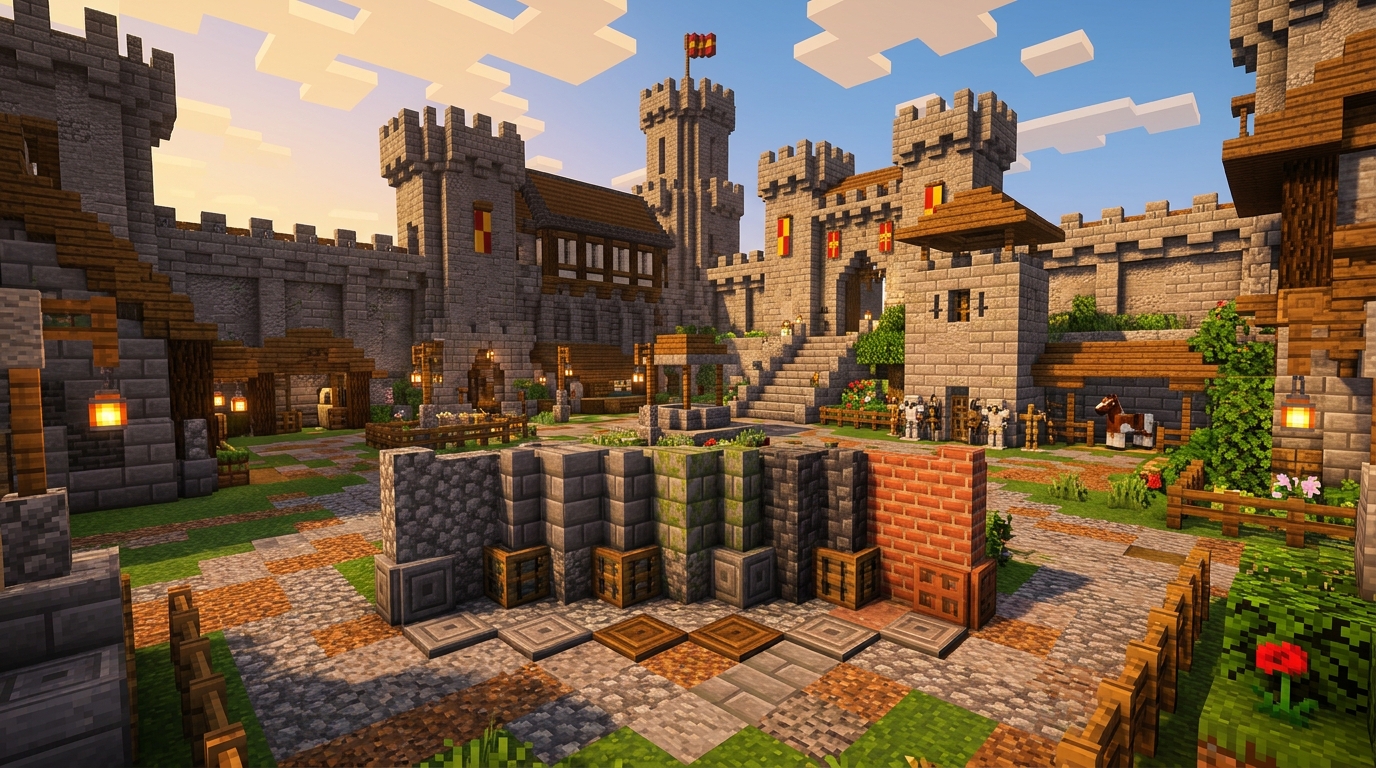
- castles
- stone houses
- bridges
- forts
- ruins
- dark fantasy builds
Walls vs Full Blocks
Full blocks add bulk.
Walls add shape.
If a build looks too boxy, walls can break up the flatness instantly.
How to Make Walls in Minecraft
Most wall variants are crafted from their matching parent block.
Standard Crafting Recipe
For many wall types:
- Place 6 matching blocks in the crafting grid
- Receive 6 walls
This applies to many stone, brick, and decorative families.
Why the Stonecutter Is Better
The stonecutter is usually the smartest way to make walls.
It offers:
- cleaner conversions
- exact block selection
- less waste
- faster production for large projects
One practical example:
- 64 cobblestone in crafting = 60 walls
- 64 cobblestone in stonecutter = 64 walls
If you build often in survival mode, always keep a stonecutter nearby.
Every Wall Type in Minecraft
Minecraft has far more wall options than many players realize.
Classic Survival Walls
- Cobblestone Wall
- Mossy Cobblestone Wall
- Stone Brick Wall
- Mossy Stone Brick Wall
- Brick Wall
- Andesite Wall
- Granite Wall
- Diorite Wall
Best for villages, starter bases, castles, towers, and roads.
Warm / Desert Walls
- Sandstone Wall
- Red Sandstone Wall
- Resin Brick Wall
Great for desert towns, temples, and warmer palettes.
Dark / Nether Walls
- Nether Brick Wall
- Red Nether Brick Wall
- Polished Blackstone Brick Wall
- Deepslate Wall
- Deepslate Tile Wall
Best for fortresses, underground bases, and gothic builds.
Specialty / Decorative Walls
- Prismarine Wall
- End Stone Brick Wall
- Mud Brick Wall
- Tuff Brick Wall
Excellent for temples, ruins, swamps, archaeology builds, and custom palettes.
Best Wall Types by Build Goal
| Goal | Best Wall Choice | Why |
|---|---|---|
| Starter base | Cobblestone Wall | Cheap and common |
| Early mob barrier | Cobblestone Wall | Fast to mass produce |
| Castle | Stone Brick Wall | Classic fortress style |
| Old ruins | Mossy Stone Brick Wall | Aged texture |
| Dark fantasy base | Deepslate Tile Wall | Heavy dramatic look |
| Nether build | Nether Brick Wall | Strong dark-red palette |
| Desert town | Sandstone Wall | Matches biome colors |
| Premium modern build | Resin Brick Wall | Bold newer look |
Where to Get Wall Materials
Early Game
Easy to gather immediately:
- Cobblestone
- Andesite
- Granite
- Diorite
- Sandstone
Best move: use cobblestone walls right away for borders and safety.
Mid Game
As your world grows:
- Stone Bricks
- Mossy Stone Bricks
- Bricks
- Nether Bricks
- Prismarine
- End Stone Bricks
This is where builds begin to look polished instead of temporary.
Late Game / Premium Materials
- Deepslate
- Polished Blackstone
- Mud Bricks
- Tuff Bricks
- Resin Bricks
These materials usually create the best-looking advanced builds.
Best Uses for Walls in Minecraft
Walls are both practical and decorative.
Quick Practical Uses
- mob barriers
- cliff rails
- animal pens
- rooftop edges
- lava walkway safety
- path borders
- courtyard boundaries
Fast Decorative Uses
- window framing
- chimney detailing
- staircase trim
- garden borders
- bridge rails
- small columns
- castle battlements
- ruined towers
- gate entrances
These small touches often improve builds more than adding another room.
How Wall Connection Behavior Helps Builds
Most players ignore this advantage.
Walls automatically reshape based on surrounding blocks. That means placement matters.
Smart Tips
Use Repeating Posts
Instead of one long flat line, break walls into sections with posts.
Looks stronger and more intentional.
Test Corners First
Corners often change the wall shape. Build a small sample before outlining your whole base.
Use Depth Changes
Place walls slightly in front of full blocks to create shadows and texture.
This is one of the easiest “pro builder” tricks.
Best Material Pairings
Walls usually look best as part of a palette.
Great Combinations
- Cobblestone Wall + Stone Bricks
- Mossy Cobblestone Wall + Mossy Stone Bricks
- Stone Brick Wall + Cracked Stone Bricks
- Deepslate Tile Wall + Polished Blackstone
- Sandstone Wall + Smooth Sandstone
- Mud Brick Wall + Spruce Wood
- Nether Brick Wall + Basalt
Mixing related textures creates depth without chaos.
Common Mistakes Players Make
Using the Wrong Wall Theme
Dark deepslate walls may look strange in a bright desert village.
Match wall tone to biome and build style.
Overusing Walls Everywhere
Walls are accent blocks. Too many can make builds cluttered.
Ignoring Stonecutter Efficiency
Large projects become slower and more expensive if you craft everything manually.
Forgetting Spiders Can Climb
Walls help against most mobs, but spiders are different.
Fast Build Upgrades Using Walls
If your build feels plain, add one of these tonight:
- walls beside front door
- wall corners on house exterior
- wall supports under roof edges
- wall rails on bridges
- wall trim around farms
- mossy walls near ponds
- stone brick battlements on towers
- deepslate walls in mines
These take minutes and often transform a build.
FAQ
Can mobs jump over walls in Minecraft?
Players and most mobs cannot normally jump over walls.
Are walls better than fences?
Depends on style. Walls are better for stone or defensive builds. Fences are better for wood and farms.
Can different wall types connect?
Yes. Different wall variants can connect to each other.
Is the stonecutter better for walls?
Usually yes. It is more efficient and gives precise outputs.
What is the best wall for castles?
Stone Brick Wall is the safest overall choice.
What is the best cheap wall?
Cobblestone Wall remains the best budget option.