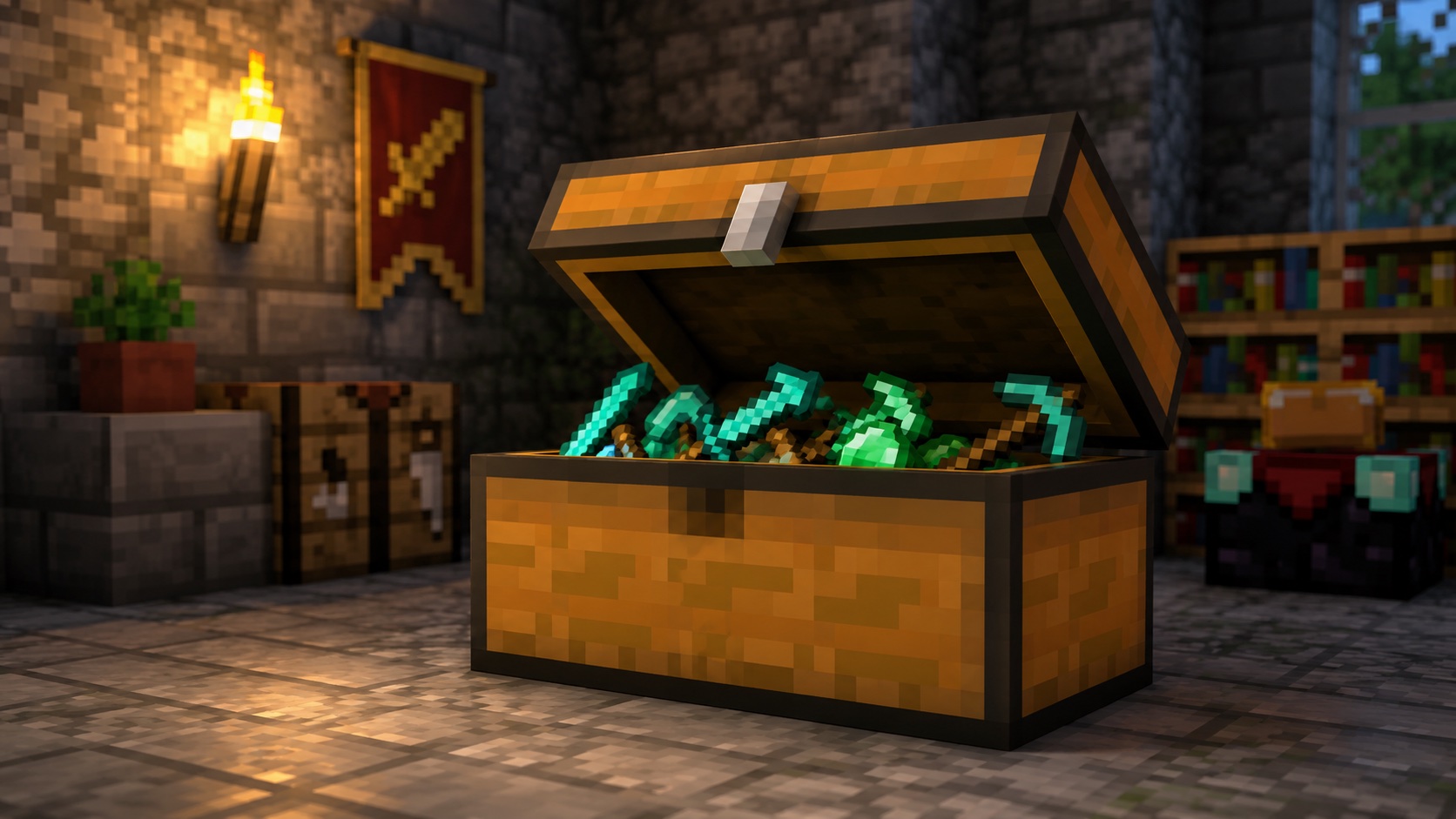
What is a chest in Minecraft?
A chest is a wooden block with an inventory. Open it and you get 27 storage slots arranged in three rows of nine, plus your own hotbar and inventory below. Items inside a chest stack the same way they do in your inventory, so a stack of 64 cobblestone fills exactly one slot.
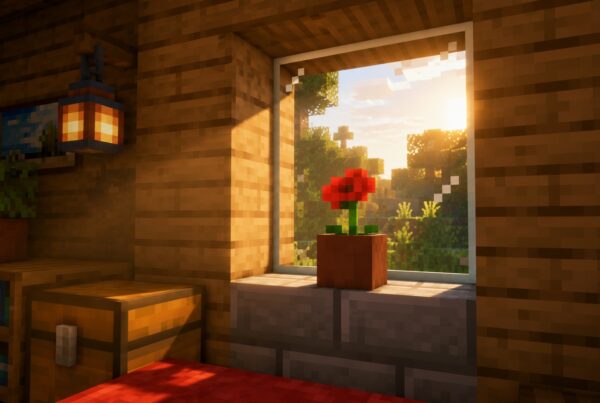
Chests render as a brown wooden box with a metal latch on the front. They use a directional orientation, so the latch always faces away from the player who placed it. That detail matters more than you’d expect when you’re trying to make a double chest or hide one against a wall.
The block itself is flammable like other wood, but the items inside don’t burn even if a chest catches fire. The contents live in the chest’s inventory data, not as floor entities. Still, don’t park your gear next to lava without a buffer block.
How to craft a chest
The recipe is eight wooden planks arranged around the empty center slot of a 3×3 crafting grid. The output is one chest.
Any plank type works. You can mix plank types in the same recipe (oak plus spruce, for example), and the chest looks the same either way. Don’t waste oak if you have stacks of birch sitting in your inventory; they all build the same chest.
Crafting a chest is the second priority recipe in most early-game runs, right after the crafting table itself. Most players make two or three chests in their first night so they have somewhere to dump dirt and cobblestone before bed.
How to place and orient a chest
Right-click (or use the interact button on console and mobile) on a block face to place a chest. The lid sits on top, the latch faces the player, and the chest occupies one full block of space.
Two placement rules to remember:
- The space directly above the chest needs to be air or a non-blocking shape: a slab in the bottom half, stairs, glass, a fence, a sign, and so on. A solid opaque block above will stop the chest from opening, since the lid would clip into it.
- A cat or ocelot sitting on top of the chest will block the opening animation. Push the cat off, light up the area to keep them from spawning nearby, or place the chest where they don’t pile up.
Single chest vs. double chest
Two chests placed next to each other along their facing axis combine into a single 54-slot inventory called a double chest. The two halves work as one container: hoppers pull from any side, items distribute across the whole grid, and opening either half opens the same large UI.
To make a double chest, place the second chest directly beside the first at the same Y level, with both facing the same direction. If you place a chest behind, above, below, or facing the wrong way, the two stay separate.
A chest only combines with one neighbor at a time, so a third chest placed against a pair stays single. The game enforces a max of two per group.
If you break one half of a double chest, the surviving half keeps its share of the items and goes back to being a regular single chest.
How chests interact with hoppers
Hoppers are the standard way to move items in or out of a chest automatically.
- A hopper placed below a chest pulls items from the chest above into whatever the hopper output points at.
- A hopper placed above a chest, with its output facing down, pushes items into the chest. This is the workhorse setup for sorting and storage builds.
- A hopper minecart on a rail under a chest pulls items as it passes, useful for distributing storage across long lines of chests.
Droppers and dispensers can push items into a chest if they face into it and receive a redstone pulse, which is handy for one-time transfers triggered by a button or pressure plate.
Chests don’t emit a redstone signal on their own. A comparator placed against a chest reads how full the chest is on a 0 to 15 scale, which you can use to trigger something when storage hits a threshold.
Why your chest won’t open
Three causes account for almost every stuck chest:
- There’s a solid block on top. Replace it with air, a slab in the bottom half, or a transparent block like glass, fence, or sign, and the chest will open.
- A cat or ocelot is sitting on the lid. Climb on top to shove it off, or break the perch nearby.
- The chest is part of a misaligned double-chest setup. If two chests are touching but face the wrong way, they confuse the game’s pairing logic. Re-place each chest so the latches line up.
Less common: a chest on a multiplayer server might be locked by a plugin, or have an NBT lock tag set with commands. Vanilla survival doesn’t lock chests on its own, so locked behavior is mostly a server-side thing.
Trapped chests, ender chests, and chest boats
Three close cousins of the regular chest are worth knowing.
Trapped chest
A trapped chest looks like a regular chest with a red latch. Crafted from a chest plus a tripwire hook, it outputs a redstone signal when opened, with the strength scaling to the number of players currently looking inside. Useful for trapdoors, alarms, and one-shot redstone triggers. A trapped chest does not combine with a normal chest into a double; it only pairs with another trapped chest.
Ender chest
An ender chest is a one-block portal to your personal storage. Crafted from eight obsidian and one Eye of Ender, the 27 slots inside are tied to your account rather than to the chest itself, so any ender chest in any dimension shows you the same items. Ender chests don’t pair into doubles. Mining one without a Silk Touch pickaxe drops eight obsidian instead of the chest, so bring an enchanted pick if you want to move it.
Chest boat
A chest boat is a boat with a 27-slot chest baked in. Crafted by combining a regular boat with a chest, it’s useful for hauling supplies across oceans or down rivers. The chest’s contents travel with the boat as it moves. Chest boats are available in every wood type and in bamboo.
Where to find chests in the world
Generated structures across every dimension drop chests with loot inside. The most reliable sources:
- Villages: chests in houses, the blacksmith forge, and crop fields.
- Mineshafts: chests in the corridor minecarts and the few floor placements.
- Dungeons (monster rooms): one or two chests per spawner room.
- Strongholds: library, altar, and storage rooms.
- Woodland mansions: scattered through the upper floors and secret rooms.
- Desert pyramids: in the hidden treasure room below the central floor.
- Jungle pyramids: behind the lever puzzle.
- Igloo basements: in the rare laboratory variant.
- Shipwrecks: up to three chests with map, supply, and treasure tables.
- Buried treasure: a single chest at the X spot from a treasure map.
- Bastion remnants: type-dependent loot tables for gold, weapons, and supplies.
- Nether fortresses: corridor chests with rare brewing ingredients.
- End cities: hallway and tower chests, plus the End Ship treasure room.
- Ancient cities: scattered across the city floors with rare loot like Swift Sneak books.
- Ruined portals: a single supply chest near the portal frame.
Loot chests sit unopened until the chunk first loads. After that, the loot table rolls and the items are committed to that chest. Once you open one, the contents are fixed and the chest won’t refill.
Tips, tricks, and common mistakes
A few things experienced players know:
- Pistons can’t move chests. Don’t try to build a sliding-storage door out of chests; the piston will refuse to push them.
- A chest renamed in an anvil shows that name as the GUI title when opened. Useful for labels like “Mining Gear,” “Brewing Stand Stock,” or “Junk.
- Putting a chest at every farm output is the easy way to keep auto-farms running. A double chest with a hopper underneath catches every drop.
- Spread your gear out. A single creeper or stray fire tick won’t destroy chest contents, but one misclick on a TNT cart will.
- Chests inside boats stay with the boat. If you break a chest boat, the boat returns as a regular boat item and the chest contents drop on the ground.
Common mistakes to avoid:
- Placing a chest with an opaque block above and wondering why it won’t open.
- Trying to combine a regular chest with a trapped chest to make a double. They look almost identical, but the game treats them as different blocks.
- Forgetting that an ender chest’s contents are personal, then setting up a “shared” ender chest base and being surprised that nothing’s inside when a friend opens it.
Java vs. Bedrock differences
Most chest behavior is identical across editions. The cat-on-lid blocking, the trapped-chest redstone output, hopper input and output, and ender chests all work the same way on Java and Bedrock. The few small differences are entity-side rather than block-side: cat AI picks chest perches a little differently on Bedrock, and item-frame interactions on chests can vary in edge cases.
If you’re playing on Bedrock and a chest feels off, the cause is usually an adjacent entity (cat, item frame) or a server-pack rule, not the chest block itself.
Frequently asked questions
How many items does a chest hold?
A single chest holds 27 stacks. A double chest holds 54 stacks. Each stack maxes out at 64 for most items, less for things like ender pearls (16) and tools (1).
Why won’t my chest open?
The most common reason is a solid block directly above it. Break that block, swap it for a slab in the bottom half, or move the chest. The other common reason is a cat sitting on top.
Can you push a chest with a piston?
No. Chests are on the no-push list, along with most other tile-entity blocks like furnaces, hoppers, brewing stands, and beacons. Slime and honey blocks won’t drag them either.
How do you make a double chest?
Place a chest, then place a second one directly next to it on the same Y level, both facing the same direction. They merge automatically into a 54-slot inventory.
Do chests burn?
Chests are flammable like other wood blocks, but the items inside don’t burn even if the chest itself is on fire. If a chest is destroyed by fire or an explosion, the items pop out as ground entities and can be picked up before they despawn.
Can mobs open chests?
No. Only players can open chests in vanilla Minecraft. Mobs walk past them.
Will my loot stay if I leave?
Yes. Items in a chest persist in the world save, so you can come back to a base after months of in-game time without losing anything.
A chest is one of the first blocks you’ll place in any world, and one of the last you’ll stop using. Get the placement habits right early. Leave air above each chest, line up the latches when you pair them, and your bases will stay tidy from day one to year ten.