What is concrete powder?
Concrete powder is a gravity block in Minecraft that comes in all 16 dye colors. It looks like colored sand and acts like sand: place it without a block under it, and it falls. Walk under a column of it, and you can suffocate. Mine it with a shovel for the fastest break.
The reason most players make it is water. The instant a concrete powder block touches a water source or flowing water, it hardens into solid concrete of the same color. That gives you a clean way to produce bright, smooth, fire-proof blocks for builds, roads, pixel art, and color-coded interiors.
Concrete powder was added in version 1.12 along with concrete, glazed terracotta, and the rest of the colored building blocks from that update. It is one of the easiest ways in the game to get a saturated, single-color block in bulk.
How to craft concrete powder
Concrete powder is crafted on a crafting table in the 3×3 grid. The recipe is shapeless, so the ingredients can sit anywhere in the grid as long as you have the right amounts. One craft uses:
- 4 sand (regular or red sand, both work)
- 4 gravel
- 1 dye (any of the 16 colors)
The output is 8 concrete powder of the dye’s color. The dye determines the color. The sand and gravel are neutral, so you can mix red sand and regular sand in the same recipe and the output is the same color either way.
To bulk-produce a color, scale up the inputs. White concrete powder is usually the cheapest because bone meal is easy to farm from skeleton mobs and from a composter. Black is next-easiest if you have ink sacs from squid or a wither rose set up. The other 14 colors usually mean a flower farm or a tree-and-cocoa-bean run, depending on the dye.
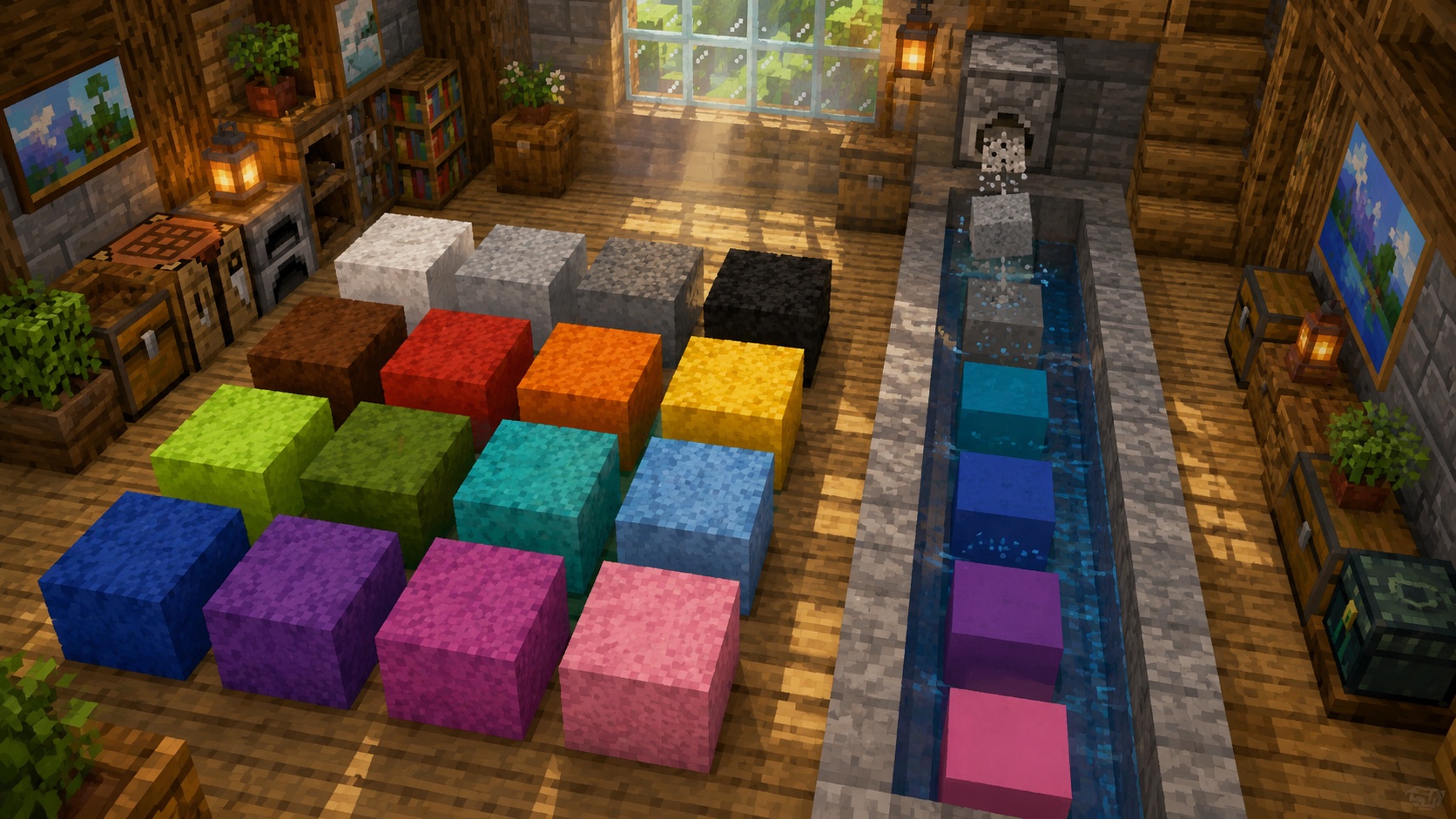
All 16 concrete powder colors
The 16 colors match the standard Minecraft dye palette: white, light gray, gray, black, brown, red, orange, yellow, lime, green, cyan, light blue, blue, purple, magenta, and pink. Each color is its own block ID, so you can store and sort by color in chests or shulker boxes. The colors render the same on maps as the corresponding wool and concrete blocks, which makes concrete powder useful for map art when you don’t want to harden every block.
How to turn concrete powder into concrete
This is the part most players come for. To turn concrete powder into solid concrete, the powder block has to come into contact with water. Two ways to make that happen:
- Place the powder next to a water source block or flowing water. It hardens instantly.
- Drop the powder into water from above. The moment it touches the water, it converts.
Some quick rules to know:
- Water bottles do not work. Only world water (source or flow) triggers the conversion.
- Cauldrons filled with water do not trigger the conversion, even if the powder is right next to the cauldron.
- Rain does not harden concrete powder. The block has to physically touch a water block.
- Once it hardens into concrete, you can’t reverse it back into powder.
The fastest bulk method: dig a small hole, fill it with water, and pour stacks of concrete powder in from above. Every block that touches water becomes hardened concrete. Mine it back out with a pickaxe (a stone or iron pickaxe is fine, since concrete only requires wood-tier or higher).
Why this doesn’t work in the Nether
You cannot make concrete in the Nether by hauling concrete powder over and trying to drop water on it. Water evaporates instantly in the Nether. If you need colored concrete in a Nether build, harden the blocks in the Overworld first, then carry the finished concrete through a portal. The same is true for the End: water doesn’t evaporate there, but you have to bring water in by bucket, since the End has no natural lakes or rivers.
How to mine concrete powder
Concrete powder breaks fastest with a shovel. You can also mine it by hand, since the block has very low hardness, but a shovel is meaningfully faster. Efficiency on the shovel speeds it up further; Silk Touch and Fortune do nothing useful, since the block already drops itself every time.
- Best tool: shovel (any tier)
- Hardness: 0.5
- Drops: itself, every time, no enchantments needed
- Stack size: 64
Powder is much faster to mine than hardened concrete. Concrete itself has a hardness of 1.8 and requires a pickaxe. If you accidentally harden the wrong block, expect to spend more time on cleanup.
Mechanics and behavior
Concrete powder follows the same gravity rules as sand and gravel. If there is no solid block under it, it falls. If a powder block falls onto a non-solid block (like a torch, an open trapdoor, or a hopper), the powder is destroyed and drops as an item. This makes it usable for sand-style traps, where powder is placed above a target and a redstone trigger removes a support block.
Pistons can push and pull concrete powder. Pushing a powder block into a position where it has nothing under it triggers the fall. Pushing it into water triggers the hardening immediately on contact, which is the basis for color-change redstone displays in some technical builds.
Concrete powder is not flammable and will not catch fire from lava or fire blocks. It also doesn’t conduct redstone, doesn’t power anything, and isn’t a valid surface for crops, paths, or villager beds. Mobs can pathfind across it like any other solid block, so monsters will walk on it during night raids.
Common uses for concrete powder
The two main reasons players keep concrete powder around:
The first is smooth color builds. Most players use concrete powder as a step on the way to concrete. The hardened block is the cleanest, most saturated solid color in the game and works well for facades, roofs, signs, and pixel art.
The second is sand-style aesthetics. Powder itself has a matte, grainy look that pairs well with sand and gravel in desert or wasteland builds. Some builders leave it as powder for this reason, especially in red and brown variants.
Other practical uses:
- Color-coded storage. A wall of 16 powder blocks above 16 chests is a fast way to label what’s where without signs.
- Map art. Each color has a stable map color and renders cleanly on Minecraft maps.
- Road markings. Yellow or white powder dropped into a water trough makes lane paint for highways.
- Sand traps. Same mechanic as a sand trap, but with color, so you can blend it into themed builds.
- Quick patch jobs. Powder is the fastest way to fill a hole that you plan to harden into a clean color match for the rest of a wall.
Tips and common mistakes
Things players run into the first time:
- If you build a column of powder upward, the first block falls when you step off. Place from the bottom up on a solid surface, or use scaffolding for vertical work.
- If you accidentally place powder next to flowing water, it hardens before you can pick it back up. Mining the hardened block returns concrete, not powder.
- The recipe needs a 3×3 grid. The 2×2 grid in your inventory will not work.
- Sand and gravel are not interchangeable with each other in the recipe. You need both.
- If you mix dye colors in the same recipe, the craft fails. Each batch needs one dye, one color.
- If you are hardening blocks in bulk and need to undo a mistake, mine fast: the block is already hardened the moment it touches water.
- Don’t store concrete powder above water in a hopper minecart system. If the cart drops a block in the wrong place, you can lose blocks to instant hardening or to gravity destruction on a non-solid surface.
Java vs. Bedrock differences
Concrete powder behaves the same in both editions for crafting, hardening, and mining. The recipe, the colors, the water mechanic, and the gravity behavior all match. There are no edition-specific differences worth planning around. Bedrock players sometimes report tighter piston timing, but this affects all gravity blocks the same way and isn’t specific to concrete powder.
Frequently asked questions
Can you turn concrete back into concrete powder?
No. The conversion only goes one way. Once concrete powder hardens, the only way back is to break the concrete and recraft fresh powder from sand, gravel, and dye.
Does rain turn concrete powder into concrete?
No. Rain visually wets the surface but doesn’t place a water block, so the powder stays as powder. The block has to actually touch a water source or flowing water to harden.
What’s the fastest way to harden a lot of concrete powder at once?
Dig a 1-deep trough, place a water bucket at one end, and drop stacks of powder in from above. Every block that lands in or beside the water hardens on contact. Mine the concrete back out with a pickaxe.
Does concrete powder burn?
No. It is not flammable and won’t catch fire from lava or open flame. The blocks beside it might catch, but the powder itself does not.
Can you craft concrete powder in a stonecutter?
No. The stonecutter does not accept concrete powder, concrete, sand, or gravel as inputs. You craft concrete powder on a crafting table with the standard recipe.
Why does my concrete powder keep disappearing?
Two likely causes: the block fell onto a non-solid block (like a torch, a hopper, or an open trapdoor) and dropped as an item, or it fell into lava and was destroyed. Build on solid surfaces, or use scaffolding to reach the height you need before placing.
Can pistons push concrete powder into water to harden it?
Yes. A piston that pushes a powder block into a water source or flow will trigger the hardening as soon as the powder enters the water block’s space. This is the basis for some technical color-changing builds.
Does concrete powder need to be on the ground to harden, or can it harden in mid-air?
It can harden in mid-air. As soon as a falling powder block enters a water block on the way down, the conversion happens and the block becomes a solid concrete block at that location. This is how most bulk-hardening setups work.
Worth knowing
If you build large with hardened concrete, set up a small water-trough station near your sand and gravel supply. Stack a chest of dye, a crafting table, and a 1-deep water moat. You can craft, harden, and mine in one loop without leaving the spot, and you’ll burn through stacks of color in minutes once the workflow is in place.