What the anvil does when you repair and combine
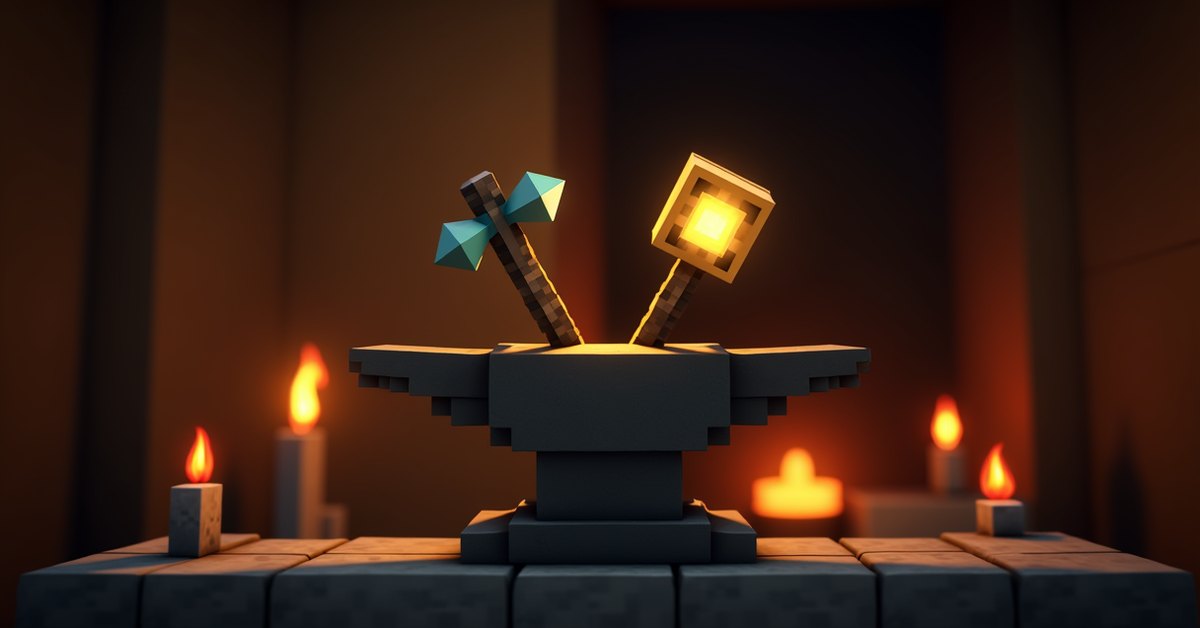
The anvil is the only block that lets you fix a tool while keeping its enchantments. A grindstone repairs gear too, but it strips every enchantment off in the process. The anvil keeps them, and it can also merge enchantments from two items into one. That is why most players keep an anvil near their storage room.
Every repair or combine on an anvil costs experience levels. You feed in a target item on the left slot, a second item or material in the middle slot, and the anvil shows you the result and the level cost before you take it. If you do not have enough levels, the output stays locked.
This guide covers the repair-and-combine side of the anvil: the two ways to repair an item, how enchantments merge, why the cost keeps climbing, and how to avoid the dreaded “Too Expensive!” wall.
The two ways to repair an item
You can restore durability on an anvil in two different ways, and they behave differently.
Combine two of the same item
Place two of the same item in the anvil, for example two damaged diamond pickaxes. The result is a single pickaxe whose durability is the sum of both, plus a bonus equal to 12% of the item’s maximum durability. That bonus is the reason combining two worn tools often gives you back more than you expect.
The big advantage here is enchantments. When you combine two enchanted items, the result keeps the enchantments from both. So two pickaxes with different enchantments can become one pickaxe that carries the lot, as long as those enchantments are compatible.
Repair with raw material
The second method uses the material the item is made from. Put the damaged item on the left and the matching material in the middle: iron ingots for iron tools and armor, diamonds for diamond gear, netherite ingots for netherite, and the matching planks for a wooden tool or shield. Gold tools take gold ingots, and a turtle shell takes scute.
Each unit of material restores 25% of the item’s maximum durability, and you can use up to four units in a single repair. Four diamonds will take a near-broken diamond pickaxe back to full. This method does not add or change enchantments, so it is the cheap way to top off a single enchanted tool you want to keep using.
How combining enchantments works
When both items carry enchantments, the anvil merges them onto the result. The item on the left is the one you keep; the item on the right is the sacrifice, and its enchantments transfer over if they can.
The rules for the merge are worth knowing:
- Same enchantment at the same level moves up one level, up to that enchantment’s maximum. Two Sharpness III swords give you Sharpness IV.
- Same enchantment at different levels keeps the higher of the two. Sharpness IV plus Sharpness II stays Sharpness IV.
- Different enchantments that work together are both kept. A Sharpness sword and a Looting sword combine into one blade with both.
- Enchantments that conflict cannot share an item. Sharpness and Smite, or the different Protection types, will not stack, and trying to merge them wastes the attempt.
An enchanted book is often the smarter way in. Applying an enchantment from a book usually costs fewer levels than merging two fully enchanted tools, and a book lets you build a tool up one enchantment at a time without risking a second good item.
Why the level cost keeps climbing
The number under the output slot is not fixed. It grows based on what you are doing and, more importantly, how many times the item has already been worked.
The prior work penalty
Every time an item goes through an anvil, it gets a hidden “prior work” count, and that count makes the next anvil use more expensive. The penalty roughly doubles with each pass, so the first few operations are cheap and later ones spike fast. An item that has been through the anvil five or six times can cost dozens of levels for a simple repair.
The result item inherits the higher prior work value of the two inputs and then adds one. This is why stacking enchantment after enchantment onto the same tool gets painful near the end. The order you combine things in changes the final bill.
Renaming adds to the cost
The anvil also renames items, and the text box at the top costs one level per use plus the item’s current prior work penalty. Renaming counts as an anvil operation, so doing it on an already heavily worked item can be surprisingly steep. If you plan to name a tool, do it early while the prior work count is still low.
The “Too Expensive!” wall
In Java Edition, any anvil operation that would cost 40 or more levels shows “Too Expensive!” and refuses to give you the item, no matter how much experience you have. This is the hard ceiling that ends a lot of god-tool projects. Once an item’s prior work penalty pushes a normal repair past 40 levels in survival, you cannot work it on an anvil again.
There are a couple of ways around it. In Creative mode the cap is ignored, so you can keep combining freely. And on Bedrock Edition there is no 40-level cap at all, which means a Bedrock player can keep repairing the same enchanted tool long after a Java player would be locked out. This is one of the real, practical differences between the two versions.
Plan the combine order to save levels
Because the prior work penalty grows so fast, the order you merge enchantments in decides how much experience the whole project costs. A few habits keep the bill down.
Build your enchantments onto books first, then combine those books into one master book before touching the tool. Merging two books costs less than merging into a finished tool, and it keeps the tool’s prior work count low until the very end. When you do apply the book, the tool only takes one heavy operation instead of five.
If you are combining several books, pair them evenly instead of adding them one at a time to the same book. Two pairs combined, then those two results combined, ends up cheaper than a single book that absorbs five others in a row, because you avoid driving one item’s prior work penalty sky-high.
Repair with raw material rather than a second tool when you only need durability back. Unit repair adds prior work like any operation, but it avoids the larger cost of an item-to-item combine and it does not risk wasting a second enchanted tool.
The anvil can break
Anvils do not last forever. Each time you use one there is roughly a 12% chance it degrades a stage, going from a normal anvil to a chipped anvil, then a damaged anvil, then finally breaking and disappearing. The damage is cosmetic for function, every stage still works the same, but a damaged anvil is a warning that it is on its last few uses.
Anvils are also affected by gravity, like sand and gravel, so they fall if the block under them is removed. A falling anvil deals damage to anything beneath it, which is the basis for a lot of trap and crusher builds. Keep that in mind when you place one on a shelf above your head.
Frequently asked questions
Does repairing on an anvil remove enchantments?
No. That is the whole point of the anvil over a grindstone. Repairing with raw material or combining two enchanted items keeps the enchantments. The grindstone is the one that strips them.
Why does my anvil say “Too Expensive!”?
In Java Edition the cost has hit 40 levels or more, usually because the item has been worked on the anvil many times and its prior work penalty is high. There is no way to lower an item’s prior work count in survival, so that item is locked out of further anvil use. Bedrock has no such cap.
How many materials do I need to fully repair a tool?
Up to four units, each restoring 25% of maximum durability. Four diamonds fully repair a diamond pickaxe, four iron ingots fully repair an iron one, and so on. If the tool is only lightly worn, you may need fewer.
Is it cheaper to use a book or another tool?
A book is usually cheaper and safer. Applying an enchantment from a book costs fewer levels than merging two finished tools, and you only risk the book rather than a second valuable item.
Can I rename an item and repair it at the same time?
Yes. A single anvil operation can repair, combine enchantments, and rename all at once, and the costs add together. Doing them in one pass is cheaper than three separate operations because each operation adds its own prior work penalty.
Does combining two items always add the 12% durability bonus?
Only when you combine two of the same item type. The 12% bonus does not apply when you repair with raw material; that method gives a flat 25% per unit instead.
Getting the most out of your anvil
The single habit that saves the most experience is doing your enchantment planning on books before the tool ever touches the anvil. Keep the tool’s prior work count low, merge books in balanced pairs, and apply everything in as few operations as you can. Do that and you will rarely hit the 40-level wall on Java, and your anvils will last a good deal longer too.