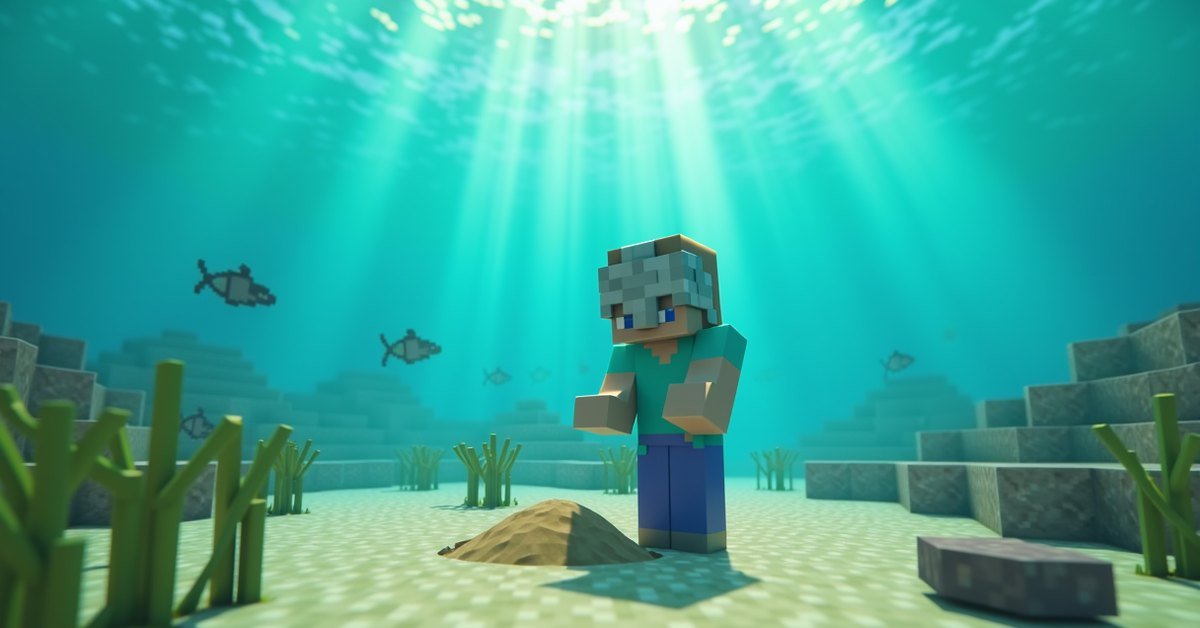
What Aqua Affinity actually does
Aqua Affinity is a helmet enchantment that lets you mine blocks at full speed while your head is underwater. Without it, mining a block underwater takes five times longer than mining the same block on dry land. With Aqua Affinity on your helmet, that penalty goes away and you break things at normal speed.
It only has one level, written as Aqua Affinity I. There is no Aqua Affinity II, no upgrade path, no stacking. One rank handles the whole job. Combining two books at an anvil still leaves you with Aqua Affinity I.
One thing to clear up right away: Aqua Affinity does not help you breathe underwater. That job belongs to Respiration. The two work fine together on the same helmet, but they solve different problems, and people mix them up all the time. If you want longer breath, you want Respiration. If you want faster mining, you want Aqua Affinity. The good news is you can have both.
How the underwater mining penalty works
Two separate things slow you down when you try to break a block underwater. Knowing both is the difference between an enchantment that feels like magic and one that feels broken.
The first penalty is being submerged. If your head is inside a water block while you mine, the game multiplies your mining time by five. A block that normally takes one second on land takes five seconds underwater. This is the penalty Aqua Affinity removes.
The second penalty is being unsupported. If you are floating in water instead of standing on a solid block, the game multiplies your mining time by another five. Combine both penalties and you are mining at one twenty-fifth of your normal speed. A simple stack of sand turns into a slog.
Aqua Affinity removes the submerged penalty. It does nothing for the floating penalty. So even with the enchantment on, your feet need to be on something solid before you start breaking blocks. Pillar a column down to the seabed, sneak onto a coral reef, or place a single block to stand on. Once your feet are planted and your helmet is enchanted, mining underwater feels almost identical to mining on land.
How to get Aqua Affinity
From the enchanting table
Aqua Affinity can roll on any helmet you put through the enchanting table. The chance is modest because the helmet enchantment pool is crowded with Protection variants, Respiration, Mending, and Unbreaking. At lower bookshelf counts you may see it once in a long while. At fifteen bookshelves around the table you will see it often enough to plan for.
You can also enchant a book at the table and apply it through an anvil. This is the cleanest method for putting Aqua Affinity onto a netherite helmet that already has other enchantments you care about, since the anvil combine preserves the existing work.
From a librarian villager
Librarians sell enchanted books once they reach journeyman level. The book pool is randomized per villager and per refresh, but Aqua Affinity is in the pool, and rerolling is cheap if you have one lectern and a villager to spare. Break and replace the lectern that a fresh villager is using until the trade shows the book you want, then lock it in with a single trade.
A trading hall full of locked librarians is the most reliable source for any specific enchantment in the game. If you already have one, Aqua Affinity is a five-minute hunt away. If you are starting from scratch, this is still the cheapest path once you have a working villager setup.
From loot and fishing
Enchanted books drop randomly from fishing if you have Luck of the Sea and Lure on the rod, and they can also turn up in loot chests at ocean ruins, shipwrecks, and other generated structures. The roll on each book is random, so this is more of a lucky find than a strategy. Treat any Aqua Affinity book you pull from a chest as a nice surprise rather than a plan.
When Aqua Affinity is worth using
Anything that involves breaking blocks while your head is underwater calls for Aqua Affinity. A few concrete cases where it pays off the fastest:
- Draining an ocean monument or another large underwater build site.
- Clearing sand or gravel from the seabed for a project.
- Building a roofed underwater base without surfacing every few seconds.
- Setting up sea pickle or kelp farms.
- Mining out a shipwreck or ocean ruin block by block.
- Building a guardian farm where you need to take the monument apart piece by piece.
If you only swim through water on the way somewhere else, Aqua Affinity is not pulling its weight. Save the slot for a helmet you actually use to break things, and put a Protection variant on your travel helmet instead.
What pairs well with Aqua Affinity
Aqua Affinity shares a helmet with several other useful enchantments. The combinations builders and explorers actually run:
Respiration. Each level extends how long you can hold your breath underwater. Respiration III gives you about seventy-five seconds before drowning damage starts. Pair Respiration III with Aqua Affinity I and your helmet handles both speed and air on the same piece of gear.
Mending. Lets the helmet repair itself from experience orbs. Useful on any piece of armor you wear all the time, and underwater mining gives you plenty of XP to feed it.
Unbreaking III. Stretches the helmet’s effective durability by tripling the average hits per damage point. Cheap, easy to find on a book, and pairs with everything.
One Protection variant. Protection, Projectile Protection, Blast Protection, and Fire Protection cannot stack on the same item. Pick whichever matches the danger you face most often. For general underwater work, plain Protection is the broadest pick.
Thorns is optional. It returns damage to attackers but eats helmet durability fast. Skip it on a dedicated mining helmet unless you also want it for combat.
Common mistakes
The biggest one: confusing Aqua Affinity with Respiration. New players sometimes assume “aqua” must mean “air” or “breathing.” It does not. Aqua Affinity is about mining speed. Respiration is about air. You want both for serious underwater work, on the same helmet.
The second mistake: forgetting that you still mine slowly if your feet are not on a solid block. Players put Aqua Affinity on a helmet, jump into the water, and wonder why a stack of clay is taking forever. The floating penalty is still there. Stand on something solid first. Pillar down with cobblestone, or place a single dirt block to plant your feet on if the seabed is too far below.
The third mistake: enchanting a fragile early-game helmet first and then finding the perfect Aqua Affinity book later. Books transfer cleanly through an anvil, so it is fine to wait. Spend the lapis on enchanting a book, then put it on the netherite helmet you actually want to keep.
The fourth: ignoring the turtle helmet. A turtle shell helmet grants ten seconds of Water Breathing whenever you leave water, which is enough to recover between dives. Pair that with Aqua Affinity and a Respiration book and you have a strong underwater helmet without needing a netherite upgrade.
Java vs Bedrock differences
Aqua Affinity behaves the same on both editions. One level, helmet only, removes the submerged mining penalty, does not remove the floating penalty. There are no version-specific quirks worth working around.
The systems for getting the enchantment are the same in spirit. Enchanting tables work the same way. Librarians on both editions sell enchanted books once they reach journeyman, although the exact price tier and refresh timing can vary slightly between platforms. If you are running a librarian farm, the lectern break-and-replace trick works on both.
Frequently asked questions
What level is Aqua Affinity?
One. The enchantment caps at Aqua Affinity I. An anvil will not let you combine two books into a higher tier, because no higher tier exists.
Can I put Aqua Affinity on any helmet?
Yes. Leather, chain, iron, gold, diamond, netherite, and turtle helmets all accept Aqua Affinity through enchanting or an anvil. The turtle helmet is a strong pick because it also gives ten seconds of Water Breathing every time you come up for air.
Does Aqua Affinity help me breathe underwater?
No. That is Respiration. Aqua Affinity only affects mining speed.
Does Aqua Affinity work in lava?
No. The underwater mining penalty applies to water blocks. Lava does not slow your mining speed in the same way, and you should not be standing in lava trying to mine in the first place.
Does Aqua Affinity help with kelp, seagrass, or coral?
It helps when you are breaking the supporting block underwater, since that counts as mining. Pulling kelp or seagrass with bare hands or shears is already quick, so the enchantment matters more for the surrounding terrain than for the plants themselves.
Will Aqua Affinity stack with Efficiency on my pickaxe?
Yes. They live on different pieces of gear and target different penalties. Efficiency speeds up the tool. Aqua Affinity removes the water penalty. Run them together and underwater clay or gravel mining feels almost like dry-land work.
Can a librarian sell Aqua Affinity I?
Yes. Librarian villagers sell enchanted books from journeyman level onward, and Aqua Affinity is in their possible pool. Reroll the trade by breaking and replacing the lectern until the book shows up, then lock that villager in for keeps.
Worth it or not
For anyone who actually builds or mines below the waterline, Aqua Affinity is one of the cheapest quality-of-life upgrades in the game. One slot, one level, no downsides, easy to find through villager trades. The only reason to skip it is if you genuinely never break blocks underwater, and even then, the next time you go after an ocean monument you will wish you had it.