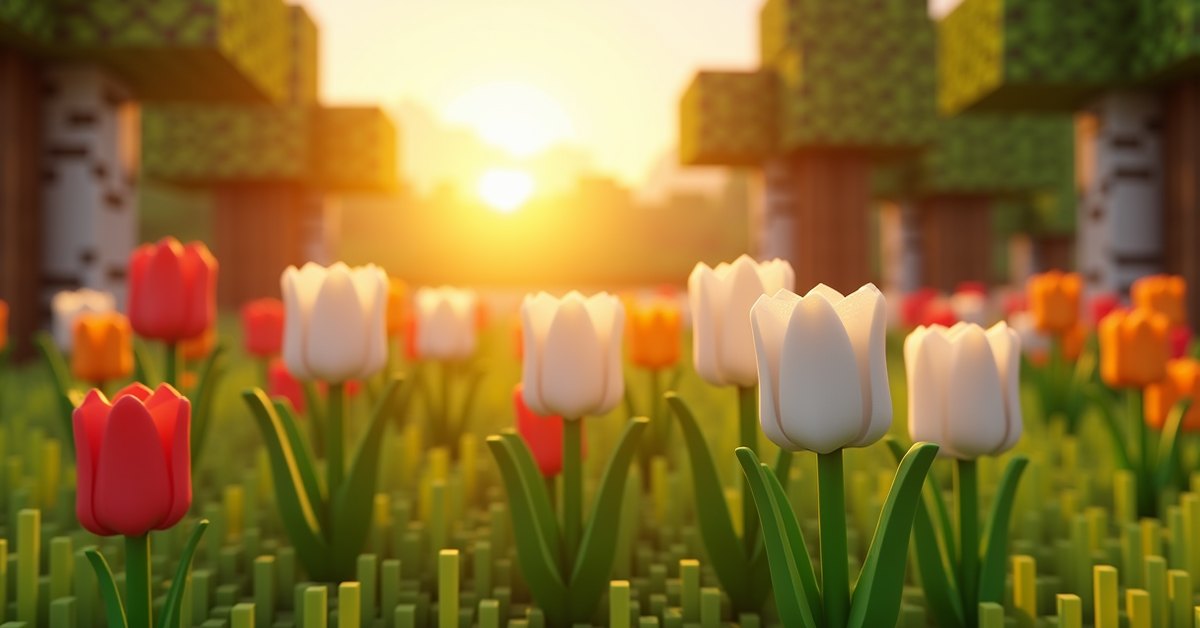
What white tulip is
White tulip is one of four tulip colors in Minecraft, alongside red, orange, and pink. It’s a single-block flower you can pick by hand, replant on grass, turn into dye, or toss into a suspicious stew for a brief Weakness effect.
If you’re hunting one on purpose, the fastest place to look is a flower forest. White tulips spawn there with the other three tulip colors in dense patches that you can clear out in a minute or two. They also show up in plains, but plains coverage is thinner and you may walk a while before you find one.
Where to find white tulip
White tulips generate naturally in two biomes. Flower forest is the obvious target. Every flower forest spawns the full tulip family along with other flowers like dandelions, poppies, oxeye daisies, and cornflowers. Walk a flower forest for a few minutes and you’ll see white tulips in clusters with the other tulip colors.
Plains can also produce tulips as part of the random flower set, but the spawn density is much lower than a flower forest. If you only have plains nearby, breaking out bone meal on grass blocks is usually faster than searching for wild patches.
Outside those two biomes, white tulips don’t generate. You won’t find them in a regular forest, dark forest, jungle, taiga, or any of the cold or warm biomes. If you’ve cleared the local flower forest and want more, you have two reliable options: bone meal on grass in a plains biome, or trading with a wandering trader.
How to get white tulip
There are four practical ways to get a white tulip in Minecraft.
Pick one from the ground
Walk up to a wild white tulip and break it with your hand. No tool required. The flower pops as an item you can grab. Tulips don’t drop seeds or any byproduct, just the flower itself.
Bone meal a flower forest
Right-click bone meal on a grass block inside a flower forest. The biome’s flower roll triggers and you usually get a small patch of mixed flowers around the spot. White tulips show up in that mix along with the other tulip colors. This is the fastest way to fill a chest with flowers from scratch.
Bone meal grass in plains
Same idea, different biome. In a plains biome, bone meal on a grass block can spawn flowers from the plains flower set, which often includes tulips. Yields are smaller than flower forest, but if plains is what you have, this still works.
Duplicate one with bone meal
Place a white tulip on a grass block and right-click it with bone meal. Each use drops a second white tulip as an item. The planted flower stays in place, so you can stand still and farm. This is the cleanest way to scale up once you have one starter flower, and it skips the random biome roll entirely.
Trade with a wandering trader
Wandering traders sometimes sell flowers from a random set, and white tulip can show up among them at one emerald each. The trade isn’t guaranteed on any given trader, so don’t count on it as your main source. Treat it as a bonus if one wanders into camp with the right offer.
What you can do with white tulip
White tulip has four real uses. The first three matter for most players.
Craft light gray dye
One white tulip placed anywhere in a crafting grid produces one light gray dye. This is the simplest dye recipe in the game, and it’s the main reason most players farm white tulips. Light gray dye colors wool, terracotta, concrete powder, glass, candles, beds, banners, shulker boxes, and dyeable leather armor. If you’re building anything with a light gray scheme, a small white tulip farm pays for itself fast.
You can also get light gray dye from white dye plus black dye, or by combining two white dye with one black dye for three light gray dye. White tulip is the only single-flower source of light gray dye in the game.
Brew suspicious stew with Weakness
Combine one white tulip, one brown mushroom, one red mushroom, and one bowl in a crafting grid to make suspicious stew. White tulip gives the stew the Weakness effect for nine seconds. All four tulip colors produce the same Weakness effect, so any tulip works the same way.
Weakness lowers your melee attack damage, which makes the stew useful in one specific situation: curing a zombie villager. The cure needs Weakness plus a golden apple, and a stewed Weakness saves you a splash potion of Weakness if you don’t have one brewed.
Compost it for bone meal
Drop a white tulip into a composter and you have a 65% chance to add a layer. Once you fill all seven layers, the composter outputs one bone meal. Composting flowers is one of the cleanest renewable bone meal sources in the game, and white tulips are easy to mass-produce once you have a bone meal duplication loop running.
Decorate
White tulip is also just a flower. Plant it in a flower pot, line a row along a path, drop a few in a garden, or pot one on top of a chiseled bookshelf for a study look. The texture is small and clean, and the white pop reads well against grass or stone backgrounds.
How white tulip behaves in the world
A few mechanics are worth knowing if you’re farming or building with white tulips.
White tulip can be placed on dirt, grass block, coarse dirt, podzol, mycelium, rooted dirt, farmland, mud, and moss block. It cannot sit on sand, gravel, stone, or any block that doesn’t count as soil. If you want a flower garden on a stone roof, you need a soil layer underneath.
Bees treat white tulips like any other small flower. A bee flies to the flower, pollinates, and carries pollen back to a beehive or bee nest. The pollinated bee then produces honey faster in the nest. If you’re running a bee farm, a ring of white tulips around the hive works as well as any other flower.
White tulips are flammable through fire spread. If lava or fire reaches one, it burns. They don’t catch quickly enough to cause runaway fires the way dry grass can in some biomes, but a careless campfire next to a flower garden can take out a row.
You can pick up a planted white tulip by breaking it. It drops itself as an item every time, no tool requirement, no Fortune scaling, no Silk Touch consideration. Shears do not affect tulip drops the way they do for tall grass or ferns.
Tips and common mistakes
The biggest mistake players make with white tulips is searching for them in the wrong biome. If you’ve spent ten minutes in a regular forest looking for tulips, you’re in the wrong biome. Open the map, find a flower forest or a plains biome, and the search ends fast.
A smaller mistake is bone-mealing grass in a biome that doesn’t spawn tulips. Bone meal triggers the local biome’s flower table. Snowy biomes give you almost nothing. Forests give you ferns and a narrow flower set. The tulip roll fires in plains and flower forest, so save your bone meal until you’re standing on the right grass.
For a steady supply of light gray dye, set up a small white tulip farm: one grass block, one planted white tulip, and a stack of bone meal. Each bone meal pops a second tulip you can pick up. Two minutes of clicking gives you a stack, and a stack of tulips becomes a stack of light gray dye one craft at a time.
If you’re bulk-crafting dye, place the tulip in any single cell of the 3×3 crafting grid. The recipe is shapeless, so position doesn’t matter. You can also fill all nine cells with tulips and get nine light gray dye at once.
Don’t waste tulips on a composter if you need dye. A flower in a composter only adds a layer 65% of the time, and seven full layers give you one bone meal. If you have a duplication loop running, your bone meal supply is already covered, so spend the tulips on dye instead.
Java vs. Bedrock
White tulip behavior is the same on both editions for the things players actually do with it. The dye recipe, suspicious stew recipe and effect, composter chance, placement rules, and bone meal duplication all match between Java and Bedrock.
The one nuance is that suspicious stew obtained from a moo-shroom or a random source can differ between editions for some flowers, but the player-crafted version with white tulip always gives Weakness on both Java and Bedrock.
Frequently asked questions
What biome has the most white tulips?
Flower forest. It’s the only biome that spawns tulips densely, and all four tulip colors generate together there. Plains has tulips too, but coverage is much sparser.
How do I get light gray dye fast?
Plant one white tulip on grass, then right-click it with bone meal until you have a stack of tulips. Craft each tulip into one light gray dye. This is faster than combining white and black dye if you already have a starter tulip and a grass block.
Can I farm white tulips with bone meal?
Yes. Place a white tulip on a grass block and right-click it with bone meal. It drops a duplicate as an item. The planted flower stays in place, so you can repeat from the same spot until you have what you need.
What does white tulip suspicious stew do?
Suspicious stew made with white tulip grants the Weakness effect for nine seconds. Weakness lowers your melee attack damage, which is exactly what you want when curing a zombie villager with a golden apple.
Will bone meal on plains grass give me white tulips?
Sometimes. The plains flower set includes tulips along with dandelions, poppies, and oxeye daisies. Yields are random, so you’ll get other flowers in the mix too. Flower forest is a more consistent target if you can travel to one.
Can wandering traders sell white tulips?
Yes, occasionally. Wandering traders sometimes offer flower trades for one emerald each. It’s not a reliable source, but if you see one on the menu, it’s a cheap way to grab a starter flower without traveling.
Do bees use white tulips?
Yes. Bees pollinate white tulips like any other small flower, and a pollinated bee speeds up honey production in a nearby hive. A ring of tulips around your bee farm works fine.
Can white tulip be planted in a flower pot?
Yes. Right-click a flower pot with a white tulip in hand and it places into the pot. The pot can sit on most full blocks, including chiseled bookshelves, and it makes for a clean indoor decoration.
Bottom line
White tulip is one of the easiest renewable dye sources in Minecraft. One starter flower, a grass block, and a stack of bone meal gives you all the light gray dye you’ll ever want. If you’re heading out to find your first one, put a flower forest on the map first.