What is a bat in Minecraft?
Bats are small flying mobs that live in the dark corners of Minecraft’s caves. They don’t attack, they don’t drop items, and they can’t be tamed or bred. Most players meet a bat by accident: you’re mining, something squeaks, and a little black shape flaps past your torch.
The bat is an ambient mob, which means it exists for atmosphere rather than gameplay. It was one of the first decorative creatures added to the game, arriving in the 1.4 update back in 2012. Before bats, caves were silent. After them, the underground had a heartbeat.
Each bat has 6 health points, the same as three hearts, so almost any hit kills one. They’re passive, so they’ll never come after you and they ignore other mobs entirely. Their whole job is to flap around, squeak, and roost on the ceiling when they rest.
Where bats spawn
Bats spawn underground, in the dark, below sea level. The game looks for a very low light level and a solid block to place them on, then drops a small group into the area at once. You’ll find them most often in natural cave systems, ravines, abandoned mineshafts, and any unlit pocket deep enough to count as cave territory.
Light is the deciding factor. A bat needs a dark block to appear on, so controlling light is the same as controlling bats. Caves you’ve explored and torched up stop producing them. Caves you haven’t touched keep making more. This is why a sealed, well-lit base almost never has a bat problem, while a half-explored cavern next door is full of them.
Bats also tend to appear in clusters rather than one at a time. The game spawns them as a little roost, so hearing one squeak usually means a few more are flitting around the same chamber.
There’s a seasonal quirk worth knowing. Around Halloween, between October 20 and November 3 on your computer’s real-world clock, bats spawn more frequently than usual. It’s a small festive touch, and it’s the one time of year you’ll notice extra bats without changing anything about how you play.
How bats behave
Bats fly in a jerky, looping pattern that looks random because it mostly is. A bat picks a nearby point in the air, flaps toward it, then picks another the moment it arrives. That’s why they seem to bounce off invisible walls and never hold a straight line for more than a second. They’re not chasing anything; they’re just wandering.
Because their hitbox is small, bats can slip through gaps that would stop a player or a zombie. A one-block opening in your wall is an open door to a bat. They’ll thread through cave entrances, fence gaps, and any hole you forgot to patch.
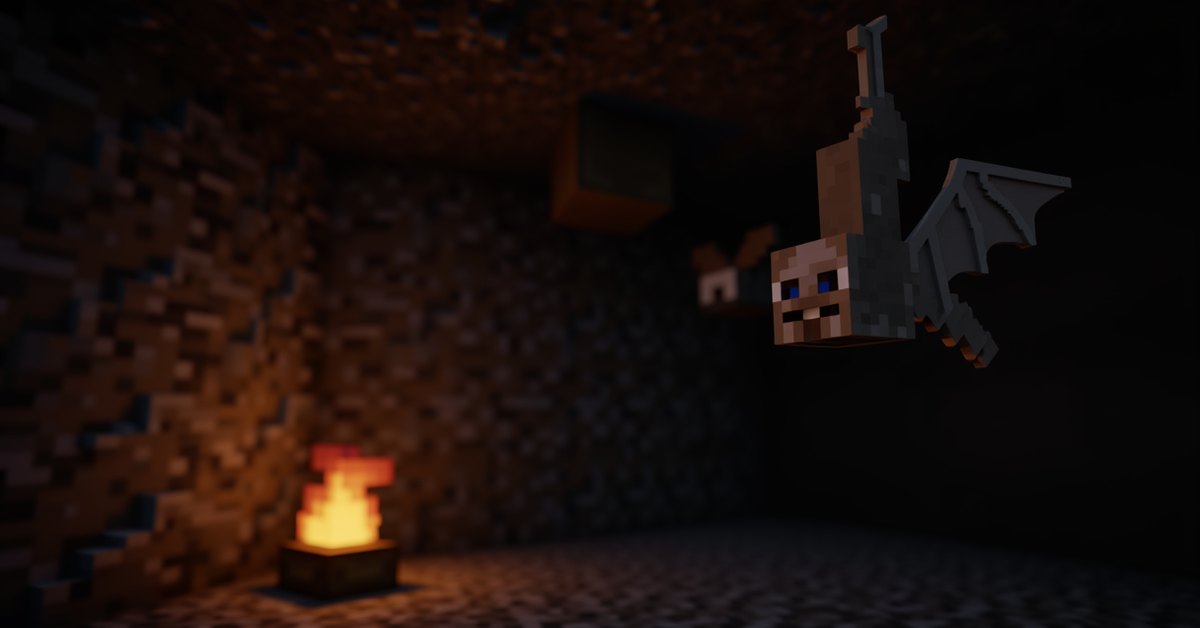
When a bat isn’t flying, it hangs upside down from the underside of a block, the way real bats roost. A hanging bat stays put until something disturbs it. Walk close enough and it wakes up, detaches from the ceiling, and flutters off. They also actively avoid players. Chase one and it flees instead of freezing, which makes them genuinely fiddly to hit.
Bats stay airborne almost constantly, so fall damage rarely touches them, and they steer clear of water and lava as they drift around a chamber. A bat boxed into a small space will keep bumping toward the ceiling, hunting for somewhere to roost.
Then there’s the sound. Bats squeak at intervals, and that squeak carries through solid blocks. It’s the single most recognizable cave noise in the game, and it does more for players than the bat itself ever will.
A short history of the bat
Bats arrived in the 1.4 update, often called the Pretty Scary Update, which landed in late 2012 ahead of Halloween. They were Minecraft’s first ambient mob, a creature added purely to make the world feel alive rather than to give players something to fight or harvest.
That design goal still holds. In more than a decade of updates, the bat has never gained a drop, a real use, or a crafting tie-in. The developers have left it almost untouched, and players have largely made peace with the bat as Minecraft’s resident background extra. The squeak you hear deep in a cave today is essentially the same one that shipped in 2012.
Do bats drop anything?
No. Bats drop nothing when they die, and they give no experience either. That makes them one of the only mobs in the game with zero reward for killing them. There is no bat farm worth building, because there is simply nothing to collect at the end of it.
If you were hoping for bat wings, leather, or some special crafting material, the game has never added one. A dead bat just vanishes with a small puff and a squeak. From a loot standpoint, they’re the emptiest mob in Minecraft.
What bats are actually good for
Even though they drop nothing, bats aren’t pointless. Their squeaks are a free cave detector. If you’re tunneling through solid stone and suddenly hear bats, there’s an open cavern nearby, and open caverns are where the ore is. Plenty of miners treat a stray bat squeak as a cue to stop digging straight and start branching toward the sound.
Bats also trigger sculk sensors, because flying counts as movement and movement is a vibration. In a deep dark area, a wandering bat can set off sensors you were trying to sneak past, and in the worst case nudge the Warden in your direction. If you’re creeping through an ancient city, a bat overhead is a liability worth watching.
Past that, they’re decoration. Some players build cave bases and deliberately leave a few bats around for the mood, since nothing says “underground” quite like a bat looping through the torchlight.
How to get rid of bats
The fix is light. Bats can’t spawn on well-lit blocks, so flooding a space with torches, lanterns, or any decent light source stops new ones from appearing. This is the same lighting pass you’d do to keep zombies and skeletons out, so it usually costs you nothing extra.
For the bats already flying around, you have two choices. Kill them, which takes a single hit, or wait, since bats despawn over time like most mobs once no player stays nearby. Lighting the area solves the long-term problem, and the existing strays clear out on their own.
If bats keep turning up in a base you thought was sealed, there’s a dark gap somewhere. Check under staircases, behind walls, inside double-height rooms where the ceiling stays shadowed, and any cave mouth you capped with glass or a slab instead of a full block. One unlit block below sea level is all the invitation a bat needs.
Java and Bedrock differences
Bats work almost identically across both versions of Minecraft. They spawn in low light below sea level, fly the same erratic way, roost upside down, and drop nothing on either platform. If you switch between Java and Bedrock, a bat is one of the few things that feels exactly the same.
The differences live in the fine print of spawn rules and the exact light thresholds, which have shifted across updates and don’t always match between editions. None of it changes what a normal player sees. The flying, the roosting, and the squeaking play out the same whether you’re on Java or Bedrock.
Frequently asked questions
Do bats drop anything in Minecraft?
No. Bats drop no items and no experience when killed. They’re one of the very few mobs in the game with no reward at all, which is why bat farms don’t exist.
Can you tame a bat?
No. Bats can’t be tamed, leashed, or kept as pets through any normal mechanic. Get close and they’ll always fly away from you.
Can you breed bats?
No. There’s no food that breeds bats, so you can’t grow a colony of them. New bats only come from natural spawning in the dark.
Why do bats keep spawning in my base?
You have a dark spot below sea level somewhere. Bats need a low light level and a solid block to appear on. Light up every corner, including hidden gaps under stairs and behind walls, and they’ll stop showing up.
How much health does a bat have?
A bat has 6 health points, equal to three hearts. Almost anything kills it in a single hit, including a bare fist.
Do bats give XP?
No. Killing a bat gives zero experience, which is another reason nobody bothers farming them.
Can bats hurt you?
No. Bats are passive and will never attack. The worst they’ll do is trip a sculk sensor or distract you while you’re trying to mine in peace.
Bats are the closest thing Minecraft has to background noise you can actually see. They won’t help you and they won’t hurt you, but their squeaks are a quiet tip that a cave full of ore is sitting just out of reach. Next time you hear one through solid rock, grab your pickaxe and start digging toward the sound.