What is a chicken in Minecraft?
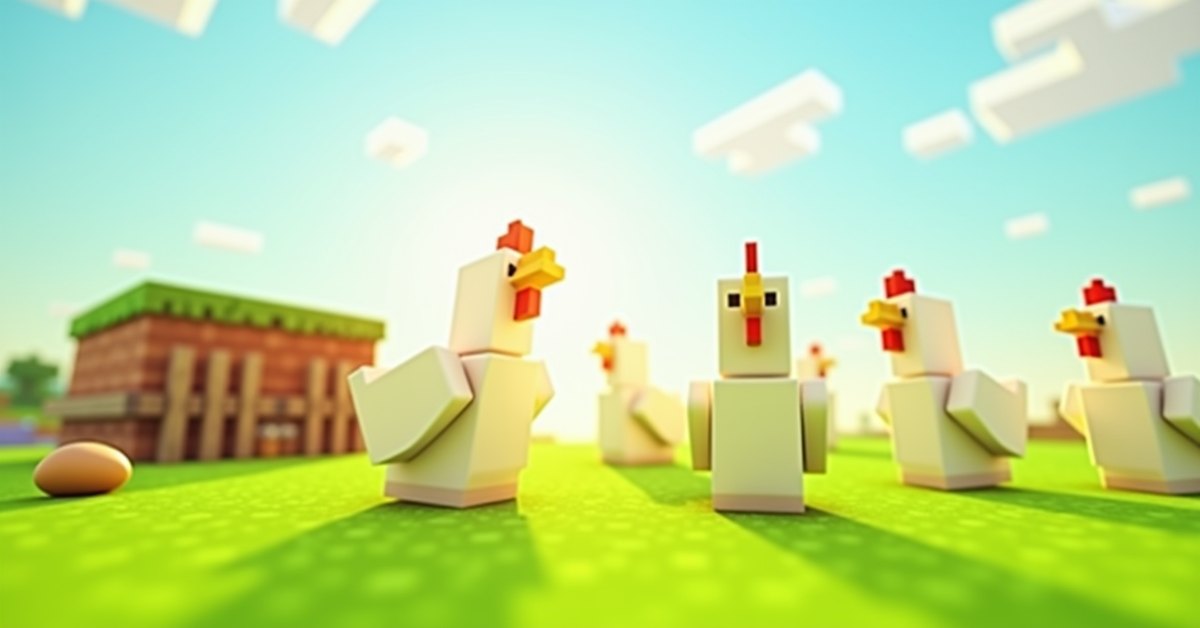
A chicken is a small passive mob that wanders the overworld, lays eggs, and gives you food and feathers when you need them. It is one of the first animals most players meet, and it stays useful well into the late game because of how cheap it is to farm.
Each chicken has 4 health points, which is two hearts. They make a soft clucking sound, flap around aimlessly, and float gently to the ground when they fall off a ledge. That floating trick is the first thing that makes chickens stand out from cows, pigs, and sheep.
If you want eggs for cakes and pumpkin pie, raw meat for an early food supply, or feathers for arrows, a chicken pen pays for itself fast.
Where chickens spawn
Chickens spawn naturally in small groups on grass blocks in most overworld biomes, as long as the light level is high enough. You will see them in plains, forests, savannas, and similar grassy areas, usually in groups of about four. They do not spawn in the Nether or the End.
Roughly one in twenty groups spawns as a baby chick instead of full-grown birds. You can also get a chicken from a spawn egg in Creative mode, and baby chicks sometimes appear riding other mobs, which is covered further down.
How to breed chickens
Breeding chickens is simple and cheap. Hold any kind of seed and feed two adult chickens that are standing near each other. The seeds that work are wheat seeds, melon seeds, pumpkin seeds, beetroot seeds, and torchflower seeds.
When you feed two chickens, red hearts appear above them and a baby chick spawns. Each parent then needs about five minutes before it can breed again. Baby chicks grow into adults after 20 minutes. You can shorten that wait by feeding a chick more seeds, and each feeding knocks a little time off its remaining growth.
Wheat seeds are the easiest to mass-produce because tall grass drops them when you break it. A small wheat-seed supply is usually all you need to grow a flock from two birds to a full pen.
Leading chickens with seeds
Hold seeds in your hand and nearby chickens will follow you. This is the simplest way to walk a few birds back to a pen without a lead. They lose interest if you get too far ahead, so move slowly and keep the seeds visible.
Eggs and how they work
Every adult chicken lays an egg every 5 to 10 minutes. The egg drops on the ground for you to pick up, and the chicken keeps doing this for as long as it is alive, with no food required. That free supply is the heart of any egg farm.
Eggs are throwable. When you throw one, it has about a 1 in 8 chance to spawn a baby chick where it lands. Very rarely, a single thrown egg spawns four chicks at once. The rest of the time the egg simply breaks with a small splat and nothing hatches.
Because thrown eggs can hatch chicks, you can grow a flock without breeding at all. Collect eggs from a few starter chickens, throw them at a fenced area, and let the odds build your population over time. Eggs are also an ingredient in cake and pumpkin pie, so most players split their egg supply between hatching and baking.
Eggs do not stack as high as most blocks, so an active farm fills a chest faster than you might expect. A hopper running under the chickens solves that by funneling every egg straight into storage, where it waits until you have a use for it. If you only want eggs for cooking, you can leave the population small and still collect plenty over a single play session.
Drops and food
When a chicken dies it drops 0 to 2 feathers and one piece of raw chicken. If the chicken was on fire when it died, the meat drops already cooked, which is handy if you set up a farm with a lava or fire kill mechanism. Killing a chicken also gives a small amount of experience.
Raw chicken restores a little hunger but carries a 30% chance of giving you the Hunger effect, so it is risky to eat in bulk. Cook it in a furnace, smoker, or campfire first. Cooked chicken is safe, fills more of your hunger bar, and is one of the cheapest reliable foods in the game.
Feathers are the other reason to keep chickens. You need them to craft arrows, and a steady feather supply means you never run short of ammunition for a bow or crossbow. Feathers are also used in some decorative recipes, so a running chicken farm quietly stocks a resource you would otherwise have to hunt for.
Because cooked chicken is cheap and stacks well, a lot of players lean on it as their main travel food in the early game. One full pen can feed you through your first mining trips and still leave eggs to spare for baking later.
Chicken behavior and quirks
Chickens take no fall damage. They flap their wings and drift down slowly, so you can drop them from great heights without hurting them. This is why so many automatic farms drop chickens down a shaft into a collection area: the fall sorts them without killing them, and a separate mechanism handles the kill.
In water, chickens float on the surface instead of sinking, which can clog up water-based farms if you are not careful. They also wander toward open space and will path off cliffs without hesitation, trusting their slow fall to save them.
Several mobs hunt chickens. Foxes, ocelots, wolves, and cats all go after them, and an untamed ocelot or a stray fox can wipe out an unfenced flock overnight. Keep your pen walled in and lit so hostile mobs and predators cannot reach the birds.
Chicken jockeys
A chicken jockey is a baby zombie, or sometimes another small hostile mob, riding a chicken. A small fraction of baby zombies spawn already mounted on a chicken, and the pair moves fast and can be a nasty surprise at night. The chicken takes the fall damage hits for the rider and the rider does the attacking. If you kill the rider, the chicken is left behind and behaves like any normal chicken.
Building a chicken farm
The classic egg farm is a single chamber with a few chickens at the bottom and a hopper underneath feeding into a chest. The hopper collects every egg the birds lay, so you can pull a full stack out of the chest whenever you pass by.
For a meat farm, players often build a two-level design. The top level holds breeding chickens and an egg-collecting system. Thrown or dispensed eggs hatch chicks that fall through a gap to a lower level, where they grow up and are then killed automatically, often by a small amount of lava or fire so the meat comes out cooked. A hopper line carries the cooked chicken and feathers into storage.
You can automate the egg throwing with a dispenser pointed at the hatching area and a redstone clock, so the whole farm runs without you. Even a basic version with a few chickens and one hopper will keep you stocked with eggs and feathers for a long time.
Frequently asked questions
Do chickens take fall damage?
No. Chickens flap their wings and float down slowly, so they survive any fall. This is the reason they work so well in drop-based automatic farms.
What do you feed chickens?
Any seeds: wheat seeds, melon seeds, pumpkin seeds, beetroot seeds, or torchflower seeds. Feed two adults to breed them, or feed a chick to speed up its growth.
How often do chickens lay eggs?
Each adult chicken lays one egg every 5 to 10 minutes. They do this on their own with no food needed, so a few chickens produce a steady egg supply.
Can you hatch a chicken from an egg?
Yes. Throw an egg and there is about a 1 in 8 chance a baby chick hatches where it lands. Rarely, one egg spawns four chicks at once.
How long does a baby chick take to grow up?
About 20 minutes. You can shorten the wait by feeding the chick seeds, with each feeding removing a little of the remaining time.
Why is my chicken raw meat making me hungry?
Raw chicken has a 30% chance of giving the Hunger effect when eaten. Cook it in a furnace, smoker, or campfire first to remove the risk and restore more hunger.
The bottom line
A pen with two chickens and a single hopper turns into a reliable source of eggs, meat, and feathers within a few in-game days. If you are short on early food or arrows, a chicken farm is one of the best returns on a handful of seeds you will find in the game.