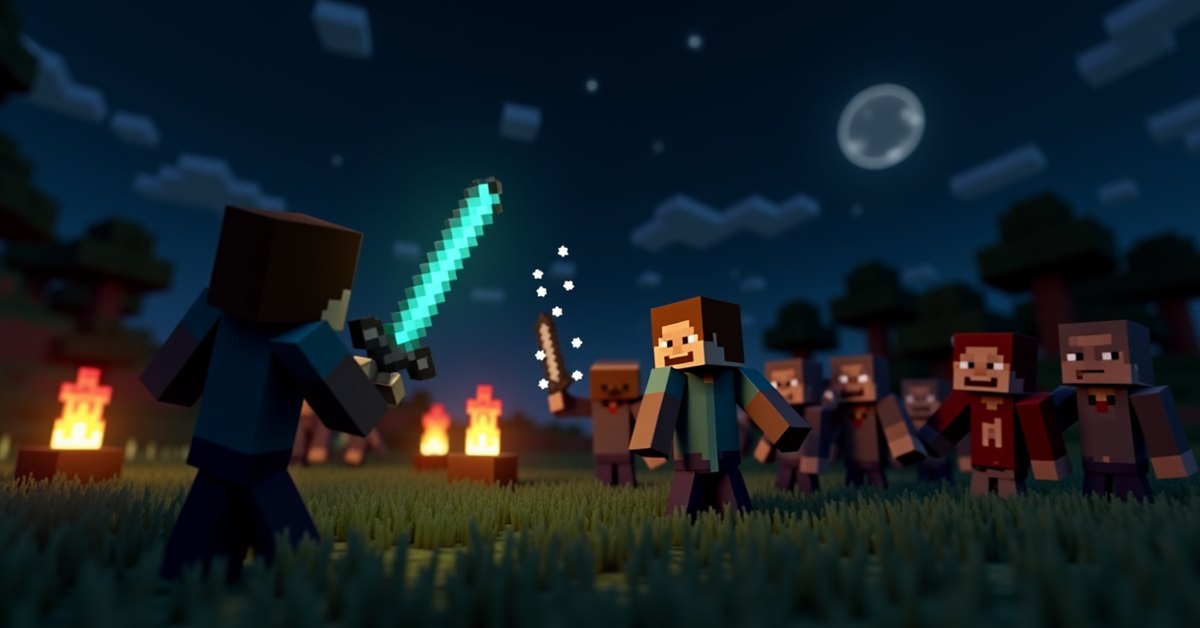
Combat in Minecraft Java Edition is mostly about timing. Since the 1.9 update, swinging your weapon as fast as you can click is the wrong move. Each attack charges up, and a hit lands its full damage only when the charge meter is full.
If you came up on Bedrock Edition or you remember the old click-spam days, the Java system feels strange at first. Once it clicks, fights become a rhythm: hit, wait, hit, wait. This guide covers how that rhythm works, plus critical hits, sweep attacks, shields, knockback, and the enchantments that change the math.
What the 1.9 combat update changed
Before version 1.9, every weapon dealt full damage on every click, so the player who clicked fastest usually won. The 1.9 “Combat Update” added an attack speed value to every item and a cooldown that has to recharge between swings.
That single change is why Java combat looks the way it does today. Spamming attacks now hurts you, because each early hit lands at a fraction of its listed damage. Good players learn the recharge time of whatever they are holding and pace their clicks to match it.
Attack cooldown and timing
Every item has an attack speed attribute. Higher attack speed means a shorter wait between full-power hits. A sword has an attack speed of 1.6, which recharges in about 0.625 seconds. Your bare hand sits at 4.0, so it recharges almost instantly, while an axe is much slower at 0.8 to 1.0.
The small bar that appears next to your crosshair is the attack indicator. It fills up after every swing and tells you when you are back to full power. You can turn it on or off and switch between the crosshair bar and a hotbar version in Options, under Video Settings.
When you attack before the meter is full, damage scales down sharply. An attack at the very start of the cooldown can deal as little as about 20 percent of the weapon’s listed damage, climbing back to 100 percent as the bar fills. The practical rule is simple: wait for the bar, then swing.
Critical hits
A critical hit deals 50 percent more damage and throws off a little spray of star-shaped particles. Landing one is about how you move, not what you click.
To score a critical hit, you have to be falling at the moment you connect. That means jumping and striking on the way down, before you touch the ground. You also cannot be climbing a ladder or vine, swimming, riding a mount or boat, or under the Blindness effect, and the attack has to be at full charge.
Sprinting and critical hits do not mix. A sprint attack applies extra knockback instead, so if you are holding sprint when you connect, the game treats it as a sprint hit rather than a crit. The classic combo is to walk, jump, and hit at the top-down part of the arc, then reset and do it again.
Sweep attacks
Swords can hit more than one target at once with a sweep attack. When you swing a sword at full charge while standing on the ground and not sprinting, the strike sends out a horizontal arc that catches other mobs within about one block of your main target.
Without any enchantment, that sweep only deals 1 damage to the extra mobs, so it is more of a crowd-control nudge than a finisher. The Sweeping Edge enchantment changes that. At level III it raises sweep damage to a large share of your weapon’s normal damage, which turns a sword into a real tool against packs of zombies or a swarm of spiders.
Two things break the sweep: sprinting and attacking before the meter is full. If you want the arc, slow down and let the weapon charge.
Weapons and their numbers
Swords and axes are the two main melee choices, and they pull in opposite directions. Swords hit faster and can sweep. Axes hit harder per swing but recharge slowly and have no sweep. Here are the base values for each material.
| Weapon | Attack damage | Attack speed | Recharge time |
|---|---|---|---|
| Wooden sword | 4 | 1.6 | 0.625s |
| Stone sword | 5 | 1.6 | 0.625s |
| Iron sword | 6 | 1.6 | 0.625s |
| Diamond sword | 7 | 1.6 | 0.625s |
| Netherite sword | 8 | 1.6 | 0.625s |
| Iron axe | 9 | 0.9 | 1.11s |
| Diamond axe | 9 | 1.0 | 1.0s |
| Netherite axe | 10 | 1.0 | 1.0s |
Run the numbers and swords come out ahead on damage per second, while axes win on a single clean hit. An iron sword at 6 damage every 0.625 seconds out-damages an iron axe at 9 damage every 1.11 seconds over time. That is why axes shine when you can land one big crit and back off, and swords shine when you are trading blows.
Other tools can attack too. A pickaxe, shovel, or hoe deals some damage and has its own attack speed, but none of them compete with a real weapon. Your bare fist deals 1 damage and recharges fast, which only matters in a pinch.
Shields and blocking
A shield blocks incoming melee hits, arrows, and most other projectiles from the front, and it cuts down explosion damage. You raise it by holding use (right-click by default) while it is in either hand. There is a short delay of about a quarter second after you raise it before it actually blocks, so you cannot flick it up at the last frame and expect to be covered.
Axes are the counter. Hitting a player who is blocking with an axe can disable their shield for five seconds, locking them out of blocking right when they need it. This is the core of a lot of player-versus-player strategy: bait the block, axe the shield, then punish. A shield only protects against attacks coming from roughly the front, so flanking gets around it as well.
Knockback and invulnerability frames
Every melee hit pushes the target back a little. Sprinting while you attack adds a big extra shove, which is great for knocking creepers away before they blow up or shoving an opponent off a ledge. The Knockback enchantment on a sword stacks even more push on top of that.
Then there are invulnerability frames, often called i-frames. After something takes damage, it ignores most new damage for half a second. During that window, a second hit only registers if it would deal more than the hit that is still counting down. This is why frantically clicking a mob wastes most of your swings. It also rewards heavy, well-timed axe hits, since a big single strike makes full use of each i-frame window.
Enchantments that change combat
A few enchantments matter more than the rest in a fight. Sharpness adds flat damage to every hit and works on any target. Smite adds heavy bonus damage against undead like zombies, skeletons, and the wither, while Bane of Arthropods does the same against spiders, silverfish, and bees. You pick one of the three, since they do not combine on the same weapon.
Sweeping Edge, covered above, boosts the sword’s sweep arc. Knockback increases the push on each hit. Fire Aspect sets the target alight for extra damage over time, which also doubles as a way to cook the meat off animals you kill. On an axe, the same Sharpness, Smite, and Bane of Arthropods options apply, so an enchanted axe becomes a brutal burst weapon.
Tips and common mistakes
The single biggest mistake is clicking too fast. Watch the attack indicator and let it fill. Two full-power hits will almost always beat four rushed ones.
Jump-crit when you can. A jump attack that lands while you are falling adds 50 percent damage for free, as long as you are not sprinting through it. For tough mobs, mixing in crits shortens the fight a lot.
Keep a shield on your off-hand against skeletons and other ranged threats, and remember that your own reach tops out at about three blocks, so backing up one step can pull you out of a mob’s swing while you stay in yours. Against groups, a sword and its sweep will serve you better than an axe.
Frequently asked questions
Why does my attack do less damage sometimes?
You attacked before the cooldown finished. Early hits scale down, sometimes to about a fifth of the listed damage. Wait for the attack indicator to refill and your next hit lands at full power.
How do I always get a critical hit?
You cannot crit on every swing, but you can set them up. Jump and strike on the way down, with a full charge bar and without sprinting. You also need to be out of water, off ladders and vines, and not riding anything.
Is an axe or a sword better in Java?
It depends on the fight. Axes deal more damage per hit and pair well with crits and i-frames, so they hit hard in one-on-one duels. Swords recharge faster, deal more damage over time, and can sweep through groups.
Why is my shield not blocking?
Either you raised it too late, since it takes about a quarter second to engage, an axe hit disabled it for five seconds, or the attack came from your side rather than your front. Shields only cover attacks from roughly ahead of you.
Does sprinting affect my attacks?
Yes. A sprint attack adds extra knockback, which is handy for shoving mobs away, but it cancels critical hits and the sword sweep. Stop sprinting for a beat when you want a crit or a sweep.
What is the difference from Bedrock combat?
Bedrock Edition does not use the attack cooldown. There, clicking fast still works and there is no sweep timing to manage. The cooldown, the charge-based damage, and the sweep arc are specific to Java Edition.
Putting it together
Once you stop spamming clicks and start reading the attack indicator, Java combat turns into a game of spacing and timing rather than reflexes. Pick the weapon that suits the fight, jump for your crits, save your sprint hits for knockback, and let the bar fill before every swing.