Every spot in a Minecraft world has an address. It’s three numbers, written as X, Y, and Z, and once you can read them you stop getting lost. You can find your way back to a base, tell a friend exactly where the diamonds are, and travel through the Nether without wandering in circles.
This guide covers what those three numbers mean, how to put them on your screen, how to read the direction you’re facing, and the tools that help you get around. It applies to both Java and Bedrock editions, with the differences called out where they matter.
What coordinates mean
Minecraft tracks your position with three values. Each one measures distance from the world’s center point, where all three read zero.
- X is your east-west position. Moving east increases X. Moving west decreases it, into negative numbers.
- Z is your north-south position. Moving south increases Z. Moving north decreases it.
- Y is your height. It goes up as you climb and down as you dig. Sea level sits at Y 63.
The world has a floor and a ceiling. In current versions, the lowest block you can stand on is at Y -64, and the build limit at the top is Y 320. Bedrock under Y -64 is the void, and falling into it below the world kills you.
One coordinate unit equals one block. If you’re at X 200 and your friend is at X 250, you’re 50 blocks apart along the east-west line. That simple fact is what makes coordinates so useful: the numbers translate directly into how far you have to walk.
How to show your coordinates
You can’t navigate by numbers you can’t see, so the first step is turning them on.
Java Edition
Press F3 to open the debug screen. Your position appears near the top left under the line that starts with “XYZ.” Some keyboards need Fn + F3 if the function keys are set to media controls by default. Press F3 again to close it.
Bedrock Edition
Bedrock keeps coordinates behind a world setting. When you create or edit a world, turn on “Show Coordinates” in the game settings. They’ll show in the top left of your screen during play. If you’re already in a world and have permission to change settings, you can also run the command /gamerule showcoordinates true.
Using a command
On either edition, if cheats are enabled you can check a position with commands, and the debug or coordinates display updates live as you move. For most players the F3 screen or the Bedrock toggle is all you need.
Reading the F3 debug screen
The debug screen shows more than your location, and a few of its lines are worth knowing.
The XYZ line gives your exact position as decimals. The Block line below it rounds those to whole numbers, which is the value you’d note down or share. The Facing line tells you which direction you’re looking, and it’s the fastest way to orient yourself.
Facing reads out a compass direction along with the axis it affects. Looking south shows south (Towards positive Z). The four cardinal readings map to the axes like this: north is toward negative Z, south is toward positive Z, east is toward positive X, and west is toward negative X. If you ever forget which way the numbers run, look at a wall and read the Facing line.
The screen also lists the chunk you’re standing in and the biome. On Java, F3 + G draws the chunk borders as lines in the world, which helps when you’re lining up farms or builds to chunk boundaries.
Finding direction without coordinates
You won’t always have the debug screen open, and there are quick ways to read direction from the world itself.
The sun rises in the east and sets in the west, the same as real life. At dawn, face the sun and east is ahead of you, so south is on your right. That single trick is enough to keep a straight line while exploring.
The moon and stars follow the same east-to-west path at night. If you build with a consistent layout, like always putting your front door on a known side, your own structures become landmarks too.
Navigation tools
Several items exist to help you get home, and each solves a different problem.
Compass
A compass points toward the world spawn point, the place you first appeared when the world was created. It does not point toward your bed. Craft one with four iron ingots around one redstone dust. A compass is most useful as a “get back to origin” tool rather than a “get back to my base” tool, unless your base happens to be near world spawn.
Lodestone compass
You can lock a compass to a specific spot by using it on a lodestone. The lodestone is crafted from a chiseled stone brick block surrounded by netherite ingots, with a netherite ingot in the center. Once linked, the compass points at that lodestone from anywhere in the same dimension, which makes it a true “point me home” device for a base you choose.
Recovery compass
A recovery compass points to the location of your most recent death. It’s invaluable for getting back to dropped items before they despawn. It’s crafted from a regular compass surrounded by eight echo shards, which you collect from ancient cities in the deep dark.
Maps
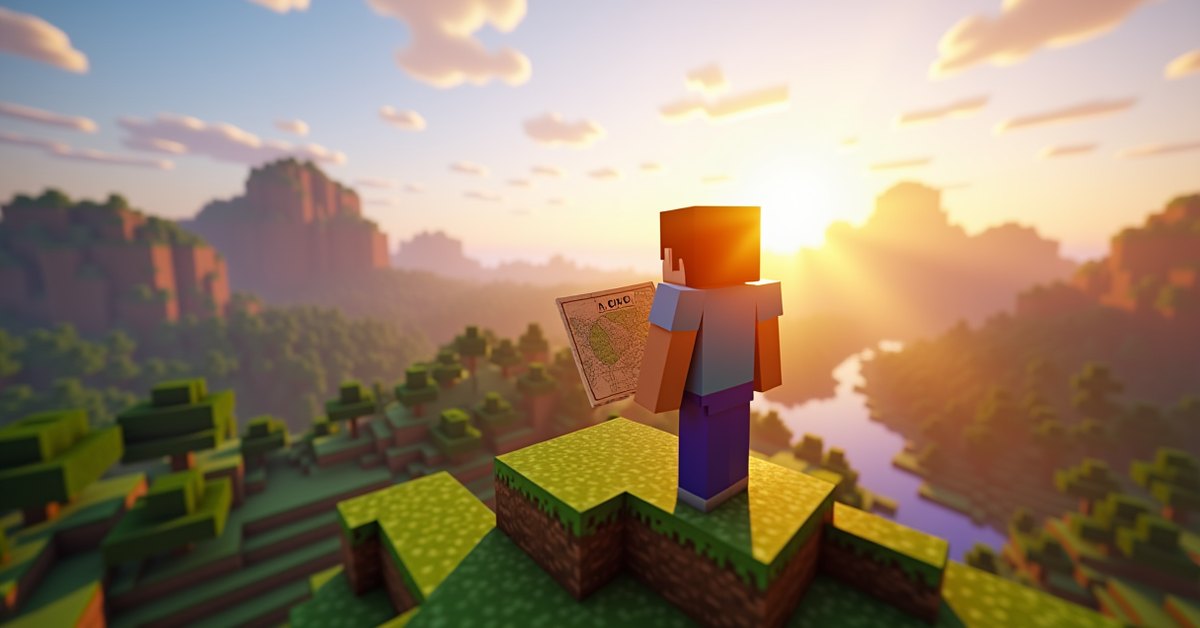
A map fills in the terrain around you as you walk over it. You can place maps in item frames and tile them into a wall to make a large overview of your world. A map shows a marker for your position and direction while you hold it, which turns it into a moving navigation aid rather than a static picture.
Navigating the Nether
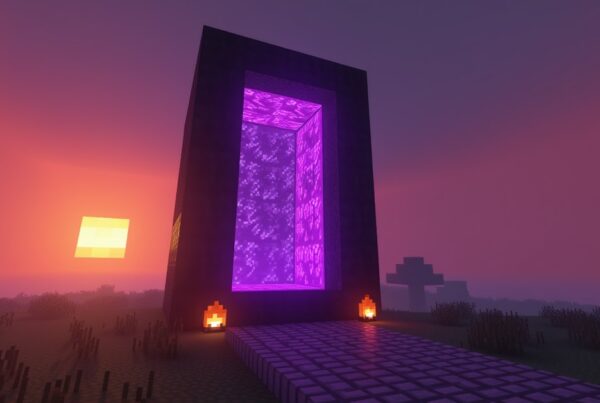
The Nether is where coordinates pay off the most, because of one rule: distance there is compressed. One block traveled in the Nether equals eight blocks in the Overworld, along the X and Z axes. Y height is not scaled.
This is the basis of fast travel. If two Overworld locations are far apart, build a portal at each, then walk the much shorter distance between their linked positions in the Nether. To find where a portal will connect, divide your Overworld X and Z by eight to get the matching Nether coordinates.
For example, an Overworld portal at X 800, Z 400 lines up with a Nether portal near X 100, Z 50. Build the second Nether portal close to those numbers and the two will pair up, giving you a shortcut that covers 800 blocks of overworld with 100 blocks of nether walking.
Always write down the coordinates of every portal on both sides. A mislinked portal network is the most common way players lose a base, and the fix is almost always careful coordinate math.
Teleport and locate commands
If you play with cheats on, two commands speed up navigation. /tp (or /teleport) moves you to an exact coordinate, for example /tp 100 70 -200. The /locate command finds the nearest instance of a structure or biome and reports its coordinates, which saves hours of searching for something like an ocean monument or a stronghold.
These are off in survival worlds by default and using them disables achievements on that world in some setups, so most players keep them for creative builds or testing rather than a normal survival game.
Tips and common mistakes
Note your base coordinates the moment you settle in. Writing down a single XYZ saves you from a long, sad walk later.
Watch the sign on your numbers. The difference between Z 400 and Z -400 is 800 blocks in the wrong direction, and missing a minus sign is the easiest mistake to make when copying coordinates down.
Remember that a compass points to world spawn, not your bed. Plenty of new players follow a compass expecting to reach home and end up back at the map’s origin instead. Use a lodestone compass if you want a needle that points at a place you picked.
When you dig straight down to a Y level for mining, check your height on the debug screen first. Diamonds are most common around Y -59, and knowing your exact depth keeps you in the right band instead of guessing.
Frequently asked questions
What does the Y coordinate mean?
Y is your vertical height. It increases as you go up and decreases as you dig down. Sea level is Y 63, the bottom of the world is Y -64, and the build ceiling is Y 320.
How do I see coordinates in Bedrock?
Turn on “Show Coordinates” in the world settings, either when creating the world or by editing an existing one. You can also run /gamerule showcoordinates true if you have permission to use commands.
Which way is north?
North is the direction of decreasing Z. On the F3 screen in Java, the Facing line tells you which way you’re looking, and north reads as “Towards negative Z.”
Why doesn’t my compass point to my house?
A plain compass always points to the world spawn point, not your bed or base. To make a compass point at a chosen location, use it on a lodestone to lock it there.
How does the Nether coordinate ratio work?
One block in the Nether equals eight blocks in the Overworld on the X and Z axes. Divide your Overworld coordinates by eight to find the matching Nether spot, which lets you travel long distances quickly through linked portals.
Do coordinates change between Java and Bedrock?
The coordinate system itself is identical: same axes, same world height, same Nether ratio. Only the way you display them differs, with F3 on Java and a world toggle on Bedrock.
One last thing
The single habit that separates players who get lost from players who don’t is writing the numbers down. Keep a short list of your base, your portals, and any spot you want to find again, and the world stops being a maze.