What is crafting in Minecraft?
Crafting is how you turn raw materials into almost everything you use in Minecraft. Logs become planks, planks become sticks, and sticks plus iron become a pickaxe. Nearly every tool, weapon, building block, and piece of gear starts life as a crafting recipe.
The system runs on a grid. You place ingredients in a specific pattern, and if that pattern matches a known recipe, the finished item appears in a result slot. Pull it out, and the ingredients are used up.
You can craft from the moment you spawn, with no tools and no setup. The basics are simple enough to learn in a minute, and the full recipe list is deep enough that experienced players still look up the odd pattern years later.
Think of crafting as the bridge between gathering and doing. You chop a tree, smelt some ore, dig up some stone, and crafting is what turns that pile of raw stuff into the pickaxe, furnace, or shelter you actually wanted. Once it clicks, the rest of the game opens up.
The crafting grid: inventory vs crafting table
There are two crafting grids in the game. Your inventory has a small 2×2 grid built in, open at all times. It handles the earliest recipes: planks from logs, sticks from planks, torches, and a crafting table itself.
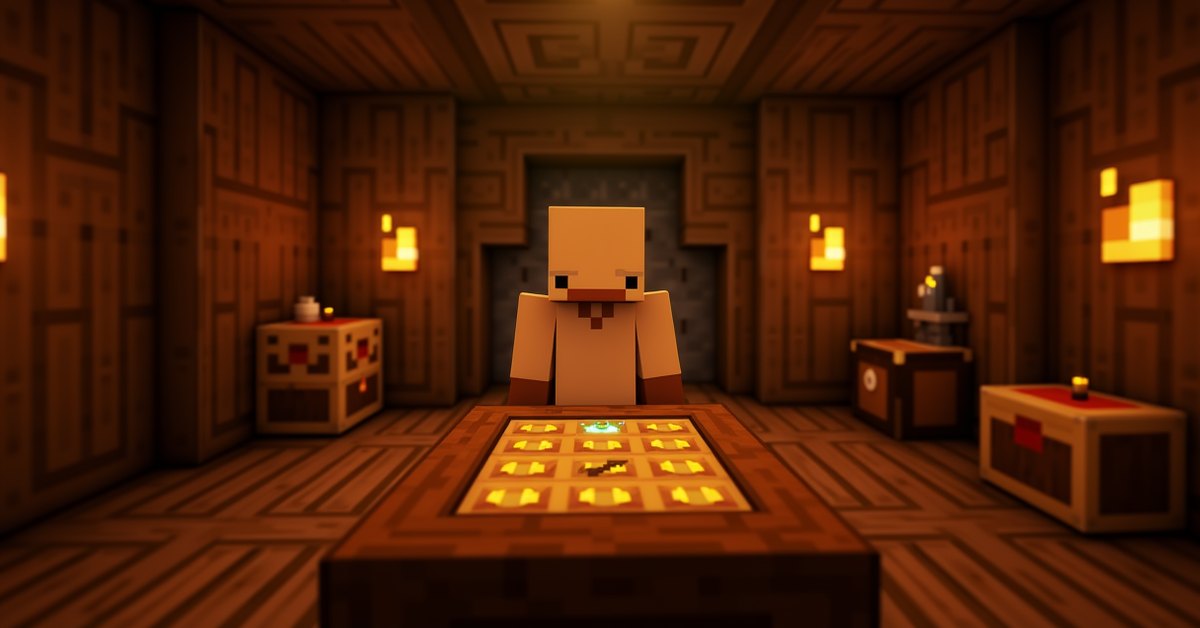
That 2×2 grid runs out of room fast. Any recipe that needs a three-wide or three-tall pattern, which covers most tools, armor, and larger blocks, requires a crafting table. The table opens a full 3×3 grid and unlocks the rest of the recipe list.
A crafting table costs four planks of any wood type. It is usually the first thing a new player builds, and you will want several: one at your base, one down in your mine, and often a spare in your pocket. They are cheap, so there is no reason to ration them.
Why the grid shape matters
Recipes care about position, not just ingredients. A wooden pickaxe needs three planks across the top row and two sticks down the middle column. Put those same items in the wrong cells and nothing happens. The grid is a pattern, not a shopping list, and that catches out almost everyone at first.
Shaped and shapeless recipes
Minecraft has two kinds of recipes, and the difference explains a lot of early confusion.
Shaped recipes require a specific layout. Tools, armor, weapons, and most blocks fall here. A chest, a furnace, a sword, a door: each has a fixed shape you have to copy. The shape can sit anywhere in the grid, though. A small 2×2 shape works in any corner of the 3×3 table, as long as the relative positions stay the same.
Shapeless recipes ignore position entirely. As long as the right ingredients are somewhere in the grid, the recipe fires. Crafting planks from logs, dyeing items, mixing dye colors, and making mushroom stew all work this way. Drop the items in any cells and you get the result.
How to craft, step by step
The flow is the same whether you use the inventory grid or a table:
- Open your inventory, or right-click a crafting table.
- Place ingredients into the grid in the correct pattern.
- Watch the result appear in the output slot on the right.
- Click the result to pull out one batch, or shift-click to craft as many as your materials allow and send them straight to your inventory.
Shift-clicking the output is the single most useful habit to build. If you have a full stack of planks in the grid, shift-clicking the stick output will burn through all of them at once instead of two planks at a time.
The recipe book
Every crafting screen has a recipe book, opened with the small book icon next to the grid. It lists the recipes you have unlocked and lets you filter to ones you can build right now with what you are carrying.
Click a recipe in the book and the game auto-fills the grid for you, pulling ingredients from your inventory. This is the fastest way to craft something you have not memorized. You unlock new recipes by picking up the relevant ingredients for the first time, so the book grows as you play and explore.
On Bedrock the recipe book doubles as a near-complete crafting menu, so you can often craft straight from the list without arranging anything by hand. Java keeps the grid more central and uses the book mainly as a lookup and auto-fill helper.
Other crafting stations, in brief
The crafting table is the heart of the system, but several other blocks handle specialized work the grid cannot. Knowing what each one is for saves a lot of searching:
- Furnace smelts ore into ingots, cooks food, and turns sand into glass. The blast furnace and smoker are faster furnaces for ores and food.
- Smithing table applies armor trims and upgrades diamond gear to netherite using a netherite upgrade template.
- Stonecutter cuts stone-type blocks into stairs, slabs, and chiseled variants with a better yield than the grid.
- Anvil repairs and renames gear and combines enchanted books, at the cost of experience levels.
- Grindstone repairs two items together and strips enchantments off gear, returning a little experience.
- Loom applies patterns to banners far more cheaply than the old crafting-grid method.
- Brewing stand makes potions, which is its own system rather than grid crafting.
None of these use the 3×3 grid, but players often group them under crafting because they all turn materials into something more useful. The grid is where you start, and these stations are where you go once you outgrow it.
Automating crafting with the Crafter
The Crafter, added in the 1.21 update, is the first block that crafts without a player. It holds a 3×3 grid you set up once, and a redstone pulse makes it produce one batch of that recipe, dropping the result out of its front face.
Feed it ingredients with hoppers, pulse it with a clock or an observer, and you have an automatic crafting farm. Builds that used to be impossible, like auto-crafting paper from sugar cane or compacting loose items into storage blocks, are now routine. The Crafter also lets you switch off specific slots so it only fires when the right items are present, which keeps recipes from misfiring.
Tips and common mistakes
A few things trip up new and returning players alike:
- If a recipe will not work, check the shape first. The right items in the wrong cells produce nothing.
- Wood type usually does not matter for the recipe, only for the look. Any planks craft a crafting table, a chest, or sticks.
- Use the stonecutter for stone stairs and slabs. It gives a better yield than the crafting grid and skips the pattern entirely.
- Keep a crafting table and a furnace next to each other. Most early gameplay loops between the two.
- Shift-click outputs to batch-craft. Making 64 torches one click at a time is a waste of an evening.
Java vs Bedrock differences
The core grid works the same on both editions, but a few habits differ. Bedrock’s recipe book can craft items directly from the menu, so many players there rarely arrange the grid by hand. Java leans on the grid more and uses the book for auto-fill.
Control schemes also differ. On console and mobile Bedrock, you tap a recipe and confirm, while Java’s mouse-driven shift-click batching is faster for bulk work. The recipes themselves match across editions in nearly all cases, so a pickaxe is a pickaxe wherever you play.
Frequently asked questions
Do I need a crafting table for everything?
No. The 2×2 inventory grid handles planks, sticks, torches, and a handful of other basics. Anything that needs a three-wide or three-tall pattern needs a table.
Does the type of wood matter when crafting?
Almost never for function. Oak, spruce, birch, and the rest all make the same tools and blocks. Wood type only changes the color and texture of the result.
Why is my recipe not working?
The usual cause is wrong placement. Shaped recipes need the exact pattern, so check your layout against the recipe book, which will auto-fill the grid correctly.
How do I unlock new recipes in the recipe book?
Pick up the ingredients. Collecting an item for the first time usually unlocks any recipe that uses it, and a small notification pops up to tell you.
Can crafting be automated?
Yes, since the 1.21 update. The Crafter block crafts a set recipe whenever it gets a redstone signal, so you can wire it into hopper-fed farms.
What is the difference between a crafting table and a Crafter?
A crafting table is the manual 3×3 grid you use yourself. A Crafter is a redstone-powered block that crafts automatically with no player involved.
Where crafting fits
Crafting is the spine that holds the rest of the game together. Mining, farming, and exploring all feed into it, and almost every goal you set runs through a recipe at some point. Learn the grid, lean on the recipe book when your memory fails, and let the Crafter take over the repetitive jobs once you reach the late game.