What is a cornflower?
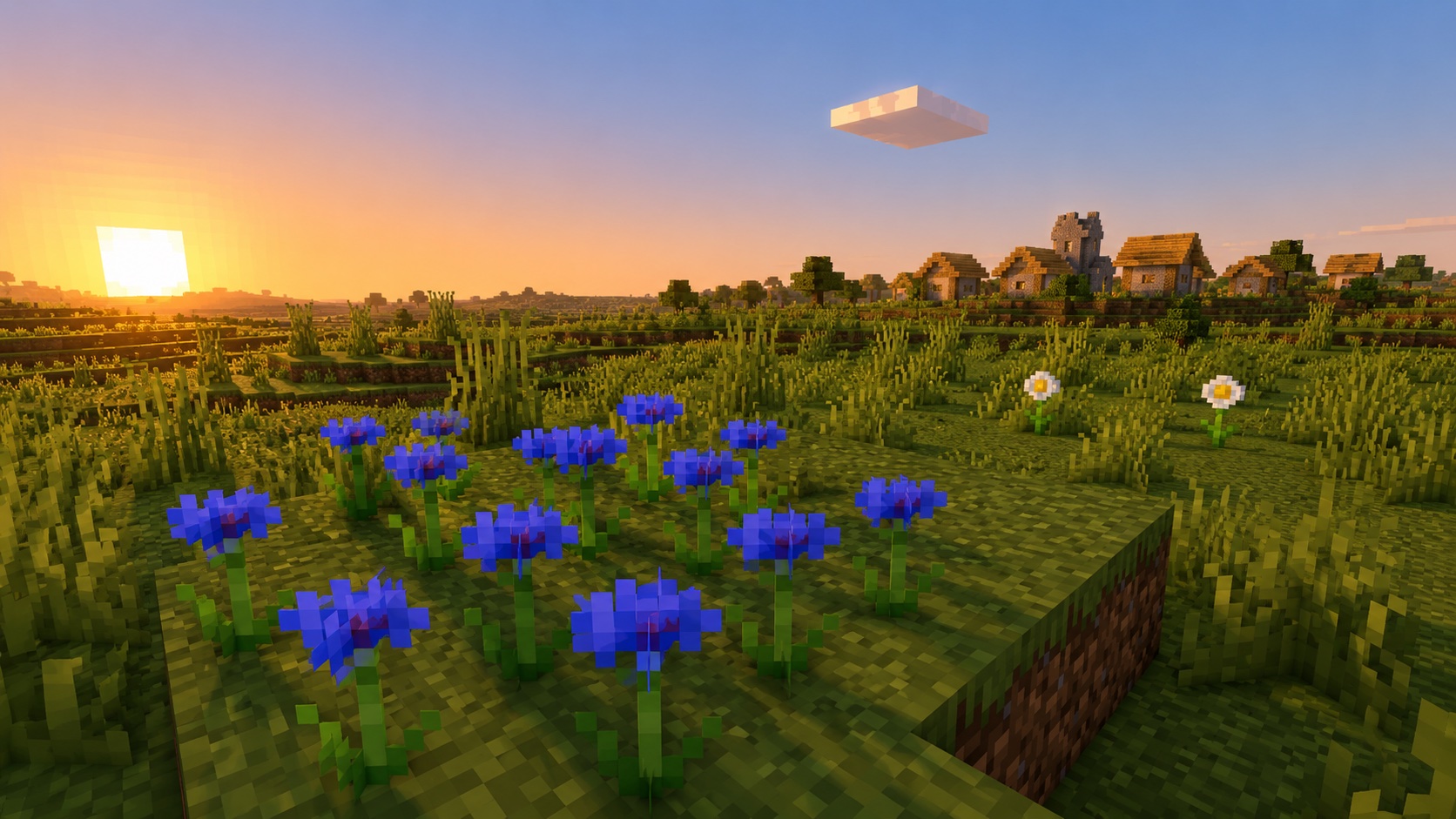
A cornflower is a small blue flower in Minecraft. It grows naturally in plains and sunflower plains biomes, gives one blue dye when you put it in a crafting grid, and turns suspicious stew into a short jump boost potion. It’s also one of the easiest flowers to bone-meal in bulk, which makes it the cheapest source of blue dye in the game once you find a plains biome.
Mojang added the cornflower in version 1.14, the Village and Pillage update. It became the most common route to blue dye for most players, since you no longer have to mine for the color.
Where to find cornflowers
Cornflowers spawn naturally in two biomes:
- Plains. The most common source. Plains biomes are common across the Overworld, especially around villages.
- Sunflower plains. Rarer to find, but you’ll usually see more cornflowers per chunk than in regular plains.
You can also pick them up two other ways. Wandering traders sometimes sell cornflowers for an emerald each, which is a useful fallback if you can’t find a plains biome nearby. Bone-mealing a grass block in a flower forest can occasionally produce a cornflower along with other flowers, but the rate is low and not worth farming.
How to grow cornflowers with bone meal
The fastest way to farm cornflowers is bone meal. Apply bone meal to a grass block while standing in a plains biome (or sunflower plains), and one of the flowers it spawns will be a cornflower. The biome you’re standing in matters: bone meal in a forest will produce dandelions and poppies, not cornflowers. Plains and sunflower plains are the two biomes where cornflowers grow from bone meal directly on grass.
If you want to scale this up, set up a small grass-block patch inside a plains biome and a steady bone meal supply. A skeleton farm gives you bones, and one bone crafts into three bone meal, so even a modest farm produces hundreds of cornflowers per hour. Expect plenty of dandelions, poppies, and oxeye daisies in the mix; cornflowers tend to make up roughly a quarter of plains flower spawns.
What cornflowers are used for
Blue dye
The main use. Place a cornflower in any slot of a crafting grid and you get one blue dye. That dye works exactly like blue dye made from lapis lazuli, so once you have a cornflower farm running, you don’t need to mine lapis just for color.
Blue dye has a lot of uses: dyeing wool, concrete powder, terracotta, beds, carpets, banners, leather armor, and shulker boxes, plus combining with other dyes (blue plus green for cyan, blue plus red for purple, blue plus white for light blue). For any building project that needs blue, cornflower-based dye is faster than the lapis route.
Suspicious stew with jump boost
Use a cornflower as the flower ingredient when you craft suspicious stew (one bowl, one brown mushroom, one red mushroom, and one flower in the crafting grid). The stew you get gives Jump Boost for 6 seconds when you eat it. That’s a short window, but it’s enough to clear a 4-block jump or a small wall, and stew is cheap to make.
Cornflower is one of two flowers tied to a movement effect. Lily of the valley produces a Poison stew instead, so don’t mix them up in storage.
Flower pots and decoration
Cornflowers fit in flower pots like any other small flower. The blue is cleaner than lapis-blue concrete or wool, which makes them useful as accents in builds where you want a real flower look rather than a solid color.
Bee food
Bees treat cornflowers like any other small flower. They pollinate a cornflower, fly back to a beehive or bee nest, and leave honey behind at the normal rate. If you’re setting up a bee farm in plains, you don’t need to plant special flowers. Cornflowers and the other plains flowers work fine.
Build palette
Cornflowers fit well in two kinds of builds. The first is any naturalistic plains build (cottage, farm, village house) where scattered single cornflowers in flower pots or grass blocks add color without looking decorated. The second is anywhere you want a single splash of true blue: a windowsill flower pot, a small flowerbed, or a path edging. Because the in-game color is a clean cornflower blue rather than the cyan-leaning blue of lapis or the purple-leaning blue of blue concrete, it reads as a flower rather than a block.
How cornflowers break and what they drop
Cornflowers break instantly with any tool, including your bare hand. They drop themselves when broken normally, and the drop rate is 100% (no Fortune scaling, no random failure). Water flowing through a cornflower will also break it and drop the item, which is useful if you want to sweep flowers into a hopper at the bottom of a bone meal farm.
Pistons can push cornflowers, and pushing them off their support block will break them and drop the item. This is the basis of most automatic cornflower farms: bone-meal a grass block, then a piston sweeps through the flowers a moment later, and water carries the drops to a collection hopper. Combine this with an auto-bone-meal dispenser and you have a hands-off setup.
Where you can place a cornflower
Cornflowers can be placed on grass blocks, dirt, podzol, mycelium, coarse dirt, rooted dirt, moss blocks, mud, and farmland. They can’t be placed on stone, sand, or in the Nether or End. They break if the block underneath is removed, the same as other flowers.
Cornflowers also need a light level of 8 or higher to stay placed. In a dim cave, they’ll pop off the next time the chunk updates. If you’re decorating an interior space, light it well or use a flower pot, which ignores the light requirement.
Tips and common mistakes
A few things that trip players up:
- Bone-meal biome matters. If you’re not getting cornflowers from bone meal, check the biome at your feet. Standing one block over the plains border into a forest will give you forest flowers instead. Use F3 in Java, or the world map in Bedrock, to confirm where you actually are.
- Stew flower mix-ups. Cornflower stew gives Jump Boost. Lily of the valley stew gives Poison. They look different in the inventory, but in low light or while moving fast, it’s easy to grab the wrong one. Label the chests if you’re storing both.
- Don’t mine lapis just for blue dye. One cornflower makes one blue dye. Mining lapis takes longer and gives you a resource you might want for enchanting anyway. If all you need is the color, the flower is the better source.
- Flower forest is not a cornflower biome. Flower forests have lots of flowers, but bone meal there won’t reliably give you cornflowers. The flower forest’s main draw is variety; for cornflower volume, you want plains.
- Stack and store as flowers, not dye. Cornflowers stack to 64. Once you craft them into dye, the dye also stacks to 64, but the flower form is more flexible because you can still pot it, feed it to bees, or turn it into stew. Convert to dye on demand.
Java and Bedrock differences
Cornflowers behave the same in both editions. The crafting recipe for blue dye is identical, the suspicious stew effect (Jump Boost, 6 seconds) is identical, and the spawn biomes are identical. The flower spawn rates from bone meal can vary slightly between versions, but in either edition you’ll get plenty of cornflowers from a small plains farm.
One small Bedrock note: wandering traders in Bedrock can occasionally sell cornflowers in groups rather than singles, depending on the trade roll. Java traders almost always sell them one at a time. The price (one emerald) is the same.
Frequently asked questions
What does a cornflower do in Minecraft?
A cornflower has two main uses: crafting blue dye and crafting suspicious stew with the Jump Boost effect. It also fits in flower pots, pollinates bees, and works as a small decorative block in builds.
Where do cornflowers spawn?
Cornflowers spawn naturally in plains and sunflower plains biomes. They can also be obtained from wandering traders or by using bone meal on grass in those biomes.
Can you get blue dye from cornflowers?
Yes. One cornflower in a crafting grid gives one blue dye. It’s the most reliable non-mining source of blue dye in the game.
What stew does cornflower make?
Suspicious stew made with a cornflower gives Jump Boost for 6 seconds. The recipe is one bowl, one red mushroom, one brown mushroom, and one cornflower.
Can bees pollinate cornflowers?
Yes. Cornflowers count as flowers for bees, so a hive surrounded by cornflowers will produce honey at the normal rate.
Can you grow cornflowers with bone meal?
Yes, but the biome matters. Bone meal on a grass block in plains or sunflower plains can produce cornflowers. Bone meal in a forest, jungle, or other biome will not.
Do cornflowers grow on dirt?
You can place a cornflower on dirt, but dirt doesn’t spawn new cornflowers from bone meal. To grow new cornflowers, use a grass block in a plains biome.
Are cornflowers in the Nether?
No. Cornflowers don’t spawn in the Nether or the End, and they can’t be placed on Netherrack or End Stone. If you want flowers in those dimensions, bring flower pots.
Worth knowing
If you’re building anything blue, set up one small plains-biome bone meal farm and you’ll never run out of dye. The cornflower also pulls double duty as a free 6-second jump potion when you don’t have time to brew. Two bowls of cornflower stew in your inventory can save you from a fall or get you over a wall when you need it.