What a daylight detector does
The daylight detector is a redstone block that reads the position of the sun and turns it into a redstone signal. Drop it on the ground with a clear view of the sky, run a wire out of it, and the signal strength changes through the day. At noon you get the maximum output of 15. At sunrise and sunset the signal sits near zero. At night it stays at zero entirely.
Right-click the block once and it flips into inverted mode. Now it does the opposite. The signal climbs at dusk, peaks at midnight, and falls again as the sun comes up. That second mode is what most players actually want, because automating “turn this on when it gets dark” is more useful than the daytime version.
This is a small block, but it solves one of the bigger annoyances in survival builds: lighting that switches itself on and off without a button or a lever.
How to craft a daylight detector
The recipe takes three materials and fills the standard 3×3 crafting grid:
- 3 glass blocks across the top row
- 3 nether quartz across the middle row
- 3 wooden slabs of any type across the bottom row
Glass is easy. Sand smelted in a furnace gives you blocks of glass. Nether quartz comes from quartz ore in the Nether, mined with any pickaxe. Wooden slabs work with oak, spruce, birch, jungle, acacia, dark oak, mangrove, cherry, bamboo, and crimson or warped (which technically aren’t wood, but the recipe still accepts them).
One craft gives you one detector. Pick it back up later with any pickaxe. Without a pickaxe the block breaks but drops nothing, so always swap to the right tool before you mine it.
If you have access to a stonecutter, that does not help here. Daylight detectors only come from the crafting recipe. The recipe is also non-shapeless, which means the materials have to go in those specific rows. Mixing the order will not produce the block.
How the signal works
The output of a daylight detector is tied to the sun’s altitude in the sky, measured on a scale from 0 to 15. Place a piece of redstone dust on top of it or run a wire out the side, and the wire carries that strength.
The values map roughly to the time of day:
- Around 6:00 AM (sunrise): signal climbing from 0 to about 4
- Noon: peak signal of 15
- Around 6:00 PM (sunset): signal dropping from about 4 back to 0
- Night (7:00 PM to 5:00 AM): 0
Rain or thunder reduces the maximum daytime signal. On a heavily overcast day you might top out at 12 instead of 15. The detector still works, you just lose the high end.
Output also depends on biome and altitude. The detector reads the world’s day-night cycle, not local lighting, so a torch sitting next to it does nothing. What matters is whether the block can see the sun. If you bury one in a cave or place it on a sub-roof under another floor, it will read 0 even at noon.
One catch: the block needs sky access. If you cover it with another block, glass, or even a slab on top, the signal drops or disappears. Put it on a roof, on a tall pillar, or anywhere with nothing solid above it.
Inverted mode (the night detector)
Right-click the daylight detector to toggle inverted mode. The texture changes slightly so you can tell at a glance which way it is set: the regular version has a sun-like pattern on top, and the inverted version shows a darker, moon-like one.
In inverted mode, the math flips. Signal strength is 15 minus the regular reading. So:
- Noon: 0
- Sunset: signal climbs from 0 to about 11
- Midnight: peak signal of 15
- Sunrise: signal drops back to 0
This is the version that controls night-active builds. Wire an inverted detector to a comparator or a redstone repeater, and you can switch lamps, doors, or trapdoors based on time of day without ever touching them.
Things to build with it
Once you understand the signal, the uses get obvious quickly. A few standard setups follow.
Street lights that switch on at dusk
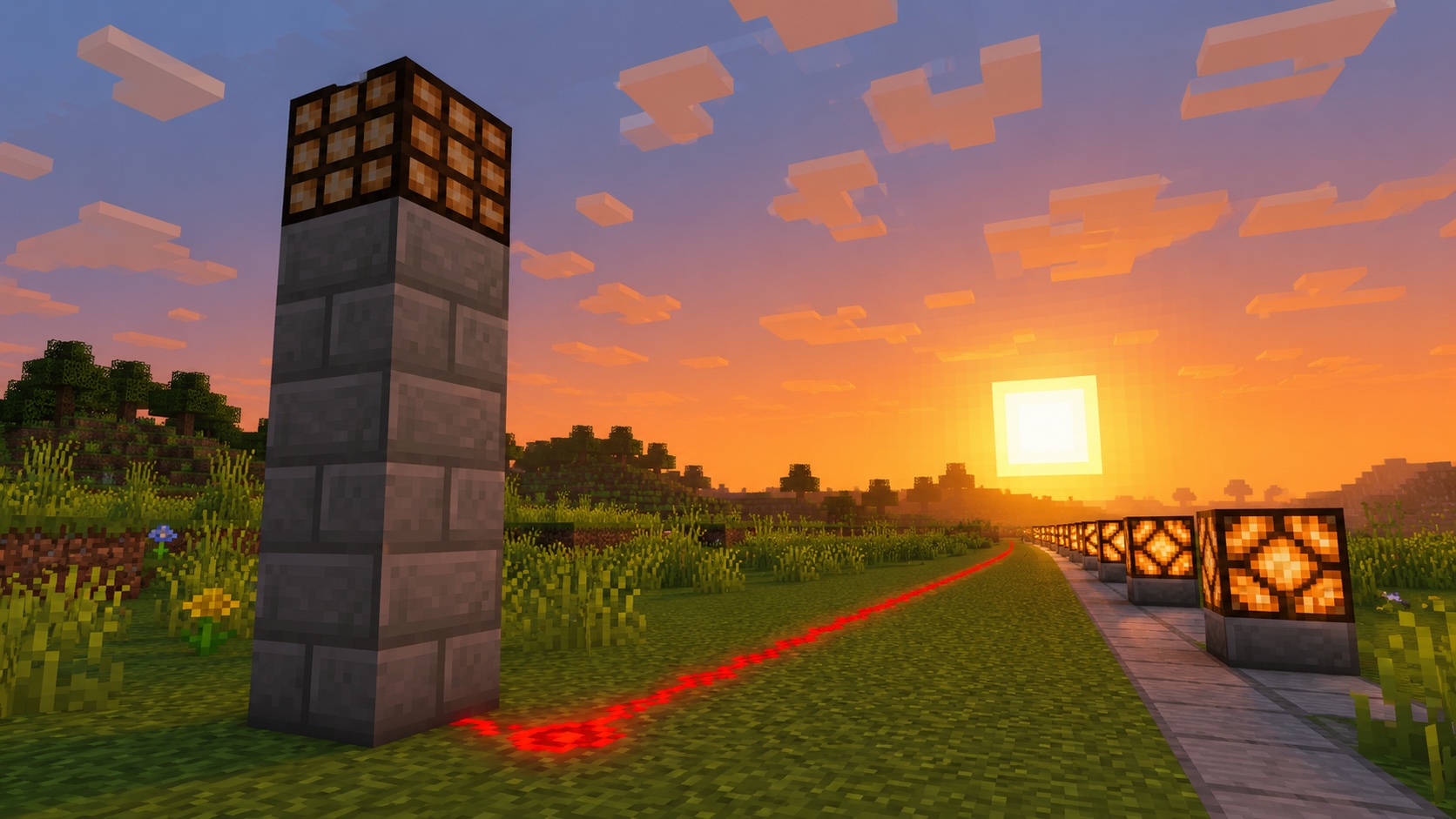
Run an inverted daylight detector into a row of redstone lamps. As the sun drops, the signal rises, the lamps light up, and the path through your village stays usable. In the morning the signal falls back to zero and the lamps go dark again.
Auto-closing iron doors at night
Iron doors don’t open without a redstone trigger. An inverted daylight detector wired into a row of iron doors will keep your base sealed up after dusk and open back up at sunrise. Pair it with a button on the inside if you want to leave manually.
Mob farm controls
Some mob farms work better with the lights off, and some only work in daylight (certain crop-walker designs that use mob movement, or sunflower-fueled iron golem setups that need a steady spawn area). A daylight detector lets you switch farms on and off automatically without standing there.
Phantom alarms
If you don’t sleep for three Minecraft nights, phantoms spawn. A regular daylight detector wired to a piston or noteblock can trigger a small chime each morning to remind you to drop into a bed at dusk.
Time-locked rooms
Adventure-map builders use daylight detectors to gate areas by time of day. Wire one through a comparator into a piston that pulls back a wall, and a hidden room only opens during a specific window of in-game time. Pair a regular and an inverted detector with an AND-gate (two redstone torches feeding a third) and you can require an exact light level to access something.
Wiring tips
The detector outputs a “weak” power signal, the same kind a button or lever produces. That means it powers the block it is sitting next to but won’t push current through a long line of solid blocks. Use redstone dust, repeaters, or a comparator to extend the signal further.
If you want the lamps to come on only once it is actually dim enough to matter (instead of at any signal above zero), feed the inverted detector through a comparator in subtract mode, or stage a few repeaters with the lamps wired to a higher signal threshold. Most players just accept “any signal turns the lamp on” because the inverted detector hits that threshold roughly when it gets too dark to see anyway.
The block can be moved by pistons in both Java and Bedrock, so a piston-based reset or a flying machine can pick it up and reposition it. Just make sure the destination spot still has sky access, or the signal goes dead.
Java vs. Bedrock
Most of the daylight detector’s behavior is the same on both editions. Recipe, output values, sky-access requirement, inverted toggle: identical.
One small difference: in Java, the detector ticks predictably with the world clock and reacts on the next game tick. Bedrock redstone timing is generally less precise than Java, so very tight clock circuits driven by detectors can behave slightly differently between editions. For normal lighting and door circuits, neither edition shows any noticeable lag.
The texture for inverted mode looks slightly different between editions, but both clearly show which mode is active.
Frequently asked questions
Can a daylight detector see through glass?
No. A glass block above the detector blocks the sunlight signal entirely. The block needs an unobstructed line straight up to the open sky. A solid block, a slab, or even a clear pane will kill the signal.
Does a daylight detector work in the Nether or the End?
No. There is no day-night cycle in either dimension, so the detector reads zero at all times. Place one in the Overworld and trigger your circuit there.
Does rain affect a daylight detector?
Yes. Rain caps the maximum daytime signal at around 12 instead of 15. Thunderstorms can push it lower. The dropoff isn’t usually enough to break a circuit, but if your build relies on hitting exactly 15, account for the weather.
How do I switch between regular and inverted mode?
Right-click (or use the secondary action button) on the placed block. Each tap toggles between the two modes. You can do this any time without breaking and replacing the block.
Can a daylight detector be moved by pistons?
Yes. Both regular and inverted versions are piston-movable in Java and Bedrock. Just remember the new spot needs sky access for the signal to come back.
What is the easiest way to get nether quartz?
Nether quartz ore is everywhere in the Nether. It shows up in nearly every biome, often along bastion paths and on the lower levels of fortresses. Any pickaxe works to mine it, and Fortune III on a pickaxe doubles the quartz drop.
Do daylight detectors stack?
Yes. Both modes stack to 64 in the inventory. The mode is set when you place the block, not while it sits in the slot.
One last note
If you have never wired up an inverted detector to a row of lamps, do that first. It is a five-block circuit and it changes how a survival base feels at night. The auto-light setup costs almost nothing, takes a single pass through the Nether to get quartz, and turns the most repetitive lighting chore in the game into something the world handles for you.